
In the pursuit of sub-micron precision, the “battle of the base” has become a central topic for mechanical engineers. As CNC machining speeds increase and semiconductor lithography requires absolute stillness, the material holding your equipment together is no longer just a frame—it is a functional component of the machine’s performance.
When choosing between a traditional granite machine base and a modern mineral casting machine base, the decision often hinges on one critical factor: vibration damping.
The Science of Stillness: Vibration Damping Comparison
Vibration is the enemy of precision. In high-speed CNC milling, it causes “chatter,” ruining surface finishes. In semiconductor inspection, even microscopic oscillations can lead to measurement errors.
| Feature | Natural Granite | Mineral Casting (Polymer Concrete) |
| Damping Ratio | Moderate | High (Up to 10x better than Granite) |
| Logarithmic Decrement | ~0.001 – 0.004 | ~0.02 – 0.03 |
| Decay Time | Longer resonance | Rapid energy dissipation |
Mineral casting consists of approximately 90% mineral aggregates (quartz, basalt) bonded with high-performance epoxy resin. This composite structure is engineered specifically to absorb kinetic energy. While natural granite is incredibly stiff, its crystalline structure can allow vibrations to ring longer than the dense, multi-layered matrix of a mineral casting.
Thermal Stability: The Precision Anchor
For semiconductor equipment, thermal expansion is as much of a threat as vibration.
-
Granite: Offers an extremely low coefficient of thermal expansion (CTE). It is a “slow” material, meaning it reacts very little to ambient temperature changes, making it the gold standard for CMMs (Coordinate Measuring Machines).
-
Mineral Casting: While its CTE is slightly higher than granite, it has high thermal inertia. It resists rapid temperature fluctuations, providing a stable environment for high-duty cycle CNC operations where motors generate significant heat.
Design Flexibility & Integration
This is where the two materials diverge most significantly for OEMs:
1. Granite: The Subtractive Process
Granite is quarried and then ground to shape. While it achieves the highest possible flatness (Grade 00), it is difficult to incorporate complex internal features. Adding threaded inserts or coolant channels requires labor-intensive drilling and bonding.
2. Mineral Casting: The Additive Advantage
Mineral casting is a casting process. This allows for “Integrated Design”:
-
Cast-in components: Threaded inserts, pipes, and cable ducts can be cast directly into the structure.
-
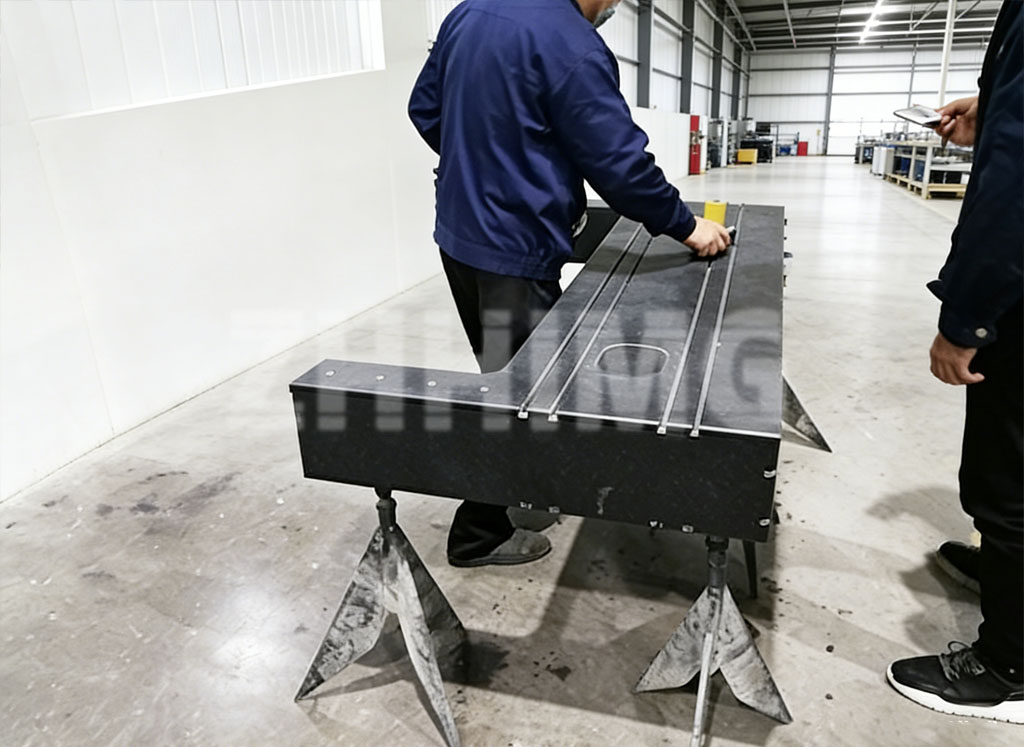
Complex Geometries: Designers can create hollow structures or ribbed reinforcements that are impossible to machine out of solid stone.
-
Reduced Assembly: By casting multiple parts into one monolithic base, you reduce the number of bolted joints—further improving overall machine rigidity.
Cost-Benefit Analysis: Which is Right for You?
Choose a Granite Machine Base if:
-
You are building ultra-precision laboratory equipment or metrology devices.
-
The production volume is low (1–5 units), as there are no mold costs involved.
-
Absolute surface hardness and wear resistance are your primary concerns.
Choose a Mineral Casting Machine Base if:
-
You are an OEM producing CNC centers or semiconductor bonders in mid-to-high volumes.
-
You need superior vibration damping to increase tool life and surface quality.
-
You want to reduce Total Cost of Ownership (TCO) by integrating parts and reducing secondary machining.
Conclusion: Partnering with ZHHIMG for Precision
At ZHHIMG, we don’t believe in a one-size-fits-all solution. Whether your application demands the timeless stability of natural granite or the advanced damping performance of mineral casting, our engineering team provides custom-tailored bases that meet the rigorous standards of the CNC and semiconductor industries.
Ready to stabilize your next project? Contact ZHHIMG today for a technical consultation and data-driven material comparison.
Post time: Apr-01-2026