
In semiconductor manufacturing, precision is not simply a technical requirement—it is the foundation of the entire industry. As device geometries continue to shrink into the nanoscale range, every stage of production, from lithography to inspection, demands extreme stability and repeatability. Even the smallest deviation, measured in nanometers, can affect yield, performance, and overall product reliability.
Within this highly controlled environment, granite precision components have quietly become an essential part of the infrastructure supporting advanced semiconductor fabrication. While they may not be as visible as lithography systems or wafer inspection tools, their role is fundamental: providing a stable, vibration-resistant, and thermally consistent foundation for critical processes.
The Invisible Foundation of Semiconductor Precision
Modern semiconductor fabs operate in an environment where mechanical stability is as important as electronic performance. Equipment must maintain alignment and accuracy over long production cycles, often operating continuously for weeks or months.
This is where granite-based structures come into play. Used in stages, base platforms, inspection systems, and metrology equipment, granite provides a stable mechanical reference that helps maintain system integrity.
The reason granite is so widely adopted in this field is not accidental. It combines natural material stability with excellent damping characteristics, making it highly suitable for environments where both vibration control and dimensional consistency are critical.
Why Nanoscale Tolerance Requirements Change Everything
The shift toward nanoscale tolerance requirements has fundamentally changed how engineers think about mechanical design. At this scale, traditional assumptions about rigidity and stability are no longer sufficient.
A deviation that would once have been considered negligible can now lead to significant alignment errors. In semiconductor lithography or wafer inspection systems, even minor mechanical drift can result in pattern distortion or measurement inconsistency.
As a result, every structural element within the equipment chain must be evaluated not only for strength, but also for long-term dimensional stability. Granite components play a key role in this context by minimizing mechanical drift and maintaining geometric accuracy over time.
Thermal Stability as a Critical Performance Factor
One of the most important challenges in semiconductor manufacturing is thermal variation. Even small temperature changes can cause materials to expand or contract, leading to misalignment in high-precision systems.
Granite offers a significant advantage in this area due to its natural thermal stability granite characteristics. With a low coefficient of thermal expansion, granite responds minimally to temperature fluctuations compared to metals such as steel or aluminum.
This stability is particularly important in cleanroom environments, where temperature is controlled but not completely static. Equipment may operate continuously, generating localized heat that can affect surrounding structures. Granite helps reduce the impact of these variations, ensuring that the mechanical reference remains consistent.
Understanding Coefficient of Thermal Expansion in Practice
The concept of coefficient of thermal expansion is central to understanding why material selection matters in semiconductor applications.
Every material expands or contracts in response to temperature changes. In high-precision systems, this movement must be carefully controlled or minimized. If different components expand at different rates, misalignment can occur, affecting the accuracy of the entire system.
Granite’s relatively low and stable expansion behavior makes it an ideal candidate for base structures in precision environments. It does not eliminate thermal movement entirely, but it significantly reduces its impact compared to conventional engineering metals.
In semiconductor metrology equipment, where alignment tolerances are extremely tight, this difference becomes critical.
Granite in Semiconductor Metrology Equipment
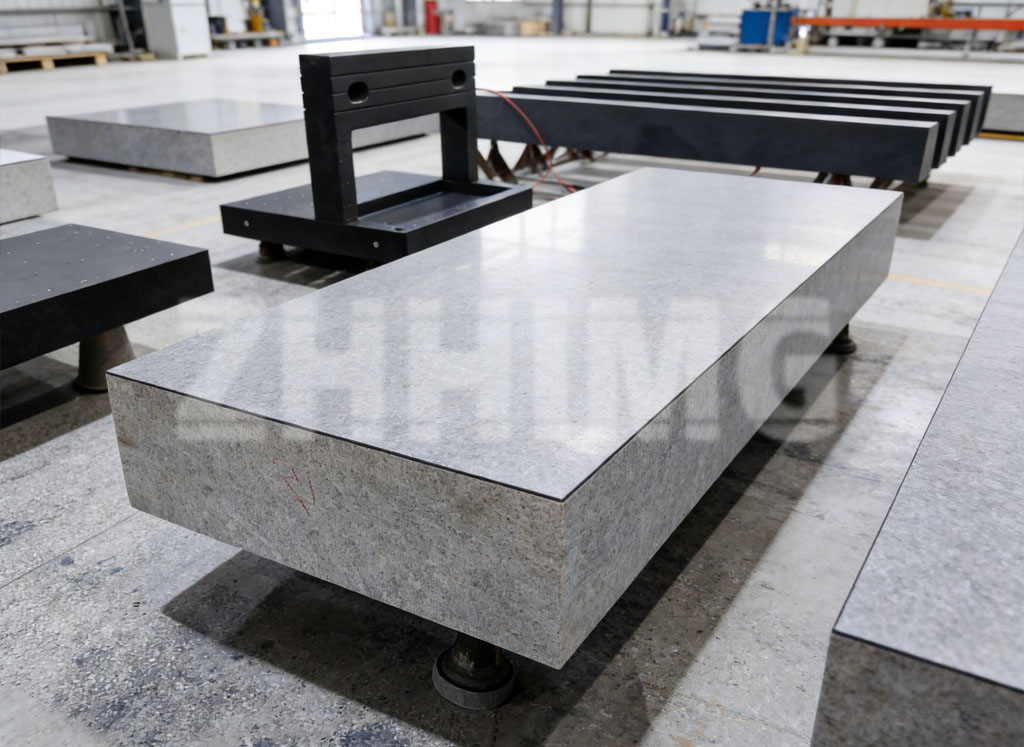
The role of granite extends across a wide range of semiconductor metrology equipment, including wafer inspection platforms, coordinate measurement systems, and alignment stages.
In these applications, granite is typically used as:
- Base plates for inspection systems
- Structural frames for measurement equipment
- Vibration-isolated platforms for sensitive instruments
- Reference surfaces for alignment and calibration
What makes granite particularly valuable is its ability to maintain flatness and geometric integrity over long periods. Unlike many engineered materials, granite does not suffer from internal stress release or long-term deformation under normal operating conditions.
This stability is essential in environments where equipment must remain calibrated over extended production cycles.
Vibration Control in a Nanoscale Environment
While thermal stability is critical, vibration control is equally important in semiconductor manufacturing. At nanoscale levels, even microscopic vibrations can introduce measurement noise or alignment errors.
Granite’s internal crystalline structure provides natural damping characteristics that help absorb and dissipate vibrational energy. This makes it especially effective in isolating sensitive equipment from external disturbances such as building vibration, nearby machinery, or operational noise.
In many semiconductor fabs, granite bases are integrated into multi-layer isolation systems that combine mechanical damping, air suspension, and active control technologies. Within these systems, granite serves as a stable intermediate layer that enhances overall performance.
Precision Manufacturing of Granite Components
Although granite is a natural material, achieving semiconductor-grade performance requires highly controlled processing. Raw stone alone is not sufficient for nanoscale applications.
Manufacturers must perform:
- Precision grinding to achieve ultra-flat surfaces
- Stress relief and stabilization processes
- Multi-point inspection and calibration
- Environmental-controlled finishing operations
Each step contributes to ensuring that the final component meets strict dimensional and surface quality requirements.
In high-end applications, granite components are often measured and certified using laser interferometry or coordinate measurement systems to ensure compliance with customer specifications.
Integration with Advanced Semiconductor Systems
As semiconductor equipment becomes more advanced, granite components are increasingly integrated into complex mechanical-electronic hybrid systems.
Modern wafer inspection platforms, for example, may combine granite bases with:
- Linear motor stages
- Optical measurement systems
- Real-time feedback sensors
- Active vibration control systems
In these configurations, granite provides the mechanical foundation upon which all other systems depend. Without a stable base, even the most advanced control systems cannot achieve consistent nanoscale performance.
Challenges and Engineering Considerations
Despite its advantages, granite is not a universal solution. Engineers must carefully consider design constraints when integrating it into semiconductor systems.
Key considerations include:
- Weight and structural support requirements
- Machining limitations for complex geometries
- Interface design with metallic and electronic components
- Cleanroom compatibility and particle control
These factors require close collaboration between material suppliers, equipment manufacturers, and system integrators to ensure optimal performance.
The Future Role of Granite in Semiconductor Manufacturing
As semiconductor technology continues to advance toward even smaller nodes, the demand for mechanical stability will only increase. While new materials and composite structures are being explored, granite remains a reliable and proven solution for foundational support systems.
Future developments are likely to focus on:
- Hybrid granite-composite structures
- Enhanced surface treatment technologies
- Integration with smart sensing systems
- Improved precision machining techniques
Rather than being replaced, granite is expected to evolve alongside semiconductor manufacturing technologies, maintaining its role as a core material in high-precision environments.
Conclusion
Granite precision components play a quiet but essential role in semiconductor manufacturing. As the industry continues to push toward nanoscale tolerance requirements, the importance of mechanical stability, thermal consistency, and vibration control becomes increasingly critical.
Through its natural properties and engineered refinement, granite provides a stable foundation for some of the most advanced manufacturing systems in the world. Its low coefficient of thermal expansion, strong vibration damping characteristics, and long-term dimensional stability make it uniquely suited for semiconductor metrology equipment.
In an industry defined by microscopic precision, granite remains a macroscopic solution with lasting relevance.
Post time: Apr-10-2026