
Air-bearing motion platforms rely on compressed air to form micron-scale air films and achieve nearly frictionless smooth motion. They serve as core motion solutions for ultra-precision inspection, lithography and nano-measurement equipment. When building air-bearing systems, many R&D teams focus heavily on air bearings, gas supply circuits and motion controllers, while often overlooking the worktable substrate supporting these moving assemblies. Air bearings are extremely sensitive to the flatness, rigidity and damping properties of reference surfaces. Tiny deformation or surface defects on the substrate will disturb air-film thickness and cause motion jitter and degraded positioning repeatability. Granite precision worktables matched for air-bearing systems are custom-made base carriers dedicated to air bearing assemblies. Combining the motion principle of air-bearing mechanisms, ZHHIMG Group has formed a complete supporting process covering raw stone selection, reference surface lapping, hole machining and pre-delivery verification to guarantee long-term stable operation of air-bearing platforms.
The requirements for worktable substrates in air-bearing systems differ fundamentally from those for worktables fitted with conventional mechanical guideways. Ordinary guideways transmit motion through physical contact and tolerate minor local surface flaws on substrates. In contrast, air bearings operate fully depending on a uniform and stable thin air film. Any bumps, pits or waviness deviations on the worktable surface will directly alter air pressure distribution within gaps. Fluctuations of the air film will introduce non-linear motion errors, and in severe cases, there is a risk of air bearings scraping against the table surface. Therefore, granite worktables for air-bearing systems are not merely simple load-bearing bases; they act as mating working surfaces for air bearings, demanding higher grades of table waviness, flatness and surface roughness.
Raw material selection determines the underlying capacity of worktables to resist deformation and vibration. ZHHIMG adopts high-density, low-stress black granite with densely interlaced mineral crystals and high elastic modulus. When air-bearing platforms start and stop at high speed, reaction force generated by motion transfers to the worktable, and the high-rigidity substrate suppresses overall bending deformation. The natural high internal damping of granite quickly absorbs subtle vibration induced by air-bearing movement and prevents continuous vibration reflection across the tabletop from interfering with the air film. Compared with cast iron or aluminum alloy, granite features an ultra-low thermal expansion coefficient. Minor temperature fluctuations brought by compressed air from gas supply systems will not trigger obvious deformation of reference surfaces and keep air-film gaps stable. Stones with loose texture and hidden cracks are screened out to avoid surface particle shedding under long-term alternating loads, which would scratch air bearings.
Ultra-precision lapping of reference surfaces constitutes the core of the whole process. For air-bearing applications, ZHHIMG applies exclusive low-waviness lapping technology, with multiple rounds of fine lapping finished in a constant-temperature workshop. Emphasis is placed on controlling long-wave waviness of the tabletop instead of only single-point flatness. Lapping for conventional granite worktables mostly focuses on local flatness indicators, yet air-bearing platforms impose strict requirements on continuous surface profile across the entire travel range. During lapping, laser interferometers scan the full surface continuously to correct profile errors in real time, ensuring smooth and uninterrupted reference surfaces over the whole sliding stroke of air bearings.
Hole machining of worktables for air-bearing systems also has special requirements. It includes air supply through-holes, vacuum suction holes, locating pin holes and mounting threaded holes. The position tolerance of holes and chamfering of hole openings must be elaborately controlled. Hole edges of air supply ports must be free of burrs and chipping, to prevent tiny debris from entering gas paths and choking air-bearing restrictors. After all hole machining, passivation treatment is carried out on hole rims, followed by overall clean purging to remove internal machining dust and protect air bearings and gas supply loops from contamination. 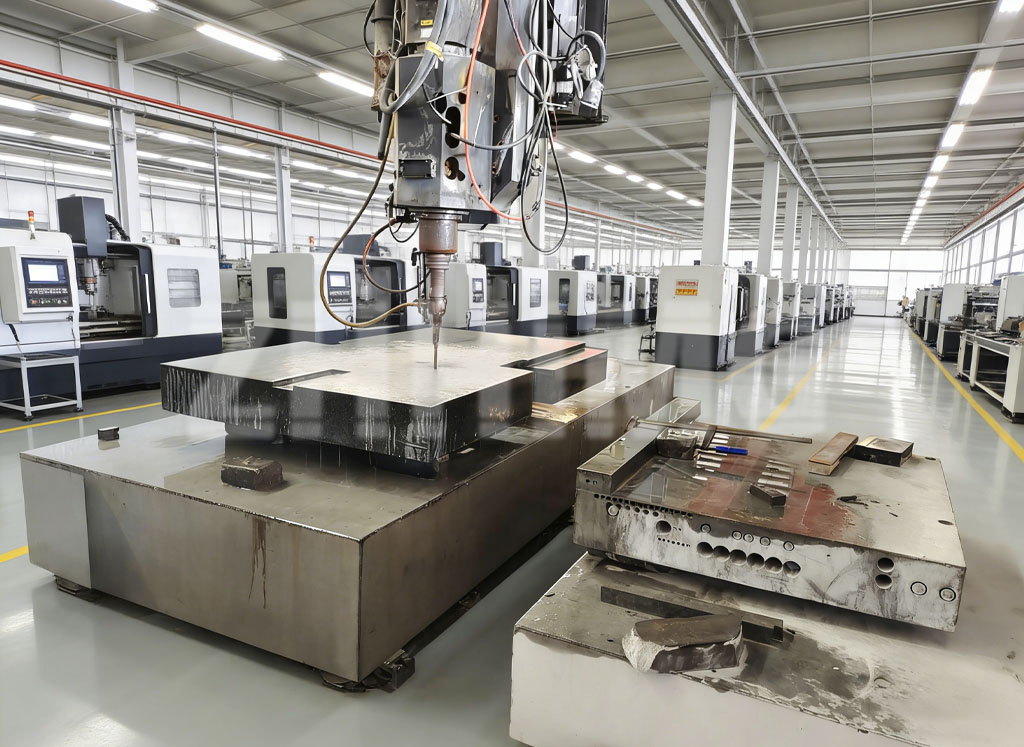
Before delivery, special air-bearing adaptability verification is mandatory. Beyond standard geometric accuracy inspection, the real working state of air bearings is simulated to test surface profile stability of the table under air-bearing loads and evaluate vibration attenuation performance. Cleanliness inspection is also implemented to check risks of particle emission and stop micro-particles from entering air-film gaps. All test data can be traced to national metrology standards to confirm that the worktable meets assembly requirements of air-bearing systems.
The accuracy ceiling of an air-bearing platform is often determined by the substrate reference it rests upon. Difficult commissioning and insufficient long-term stability of many air-bearing systems originate not from bearings themselves, but from inadequate surface profile, rigidity or cleanliness of matching worktables. Tailored for special working conditions of air-bearing equipment, ZHHIMG Group manufactures supporting granite precision worktables. Featuring ultra-high surface profile accuracy, excellent vibration damping and low thermal deformation, they serve as ideal mating substrates for air bearings. The frictionless air-bearing motion systems can fully release nano-level positioning performance, serving high-end equipment sectors including semiconductor inspection, precision metrology and micro-nano fabrication.
Post time: Oct-16-2026