
In precision manufacturing and dimensional metrology, accuracy does not begin with sensors, software, or motion systems. It begins with the reference surface. Whether in inspection laboratories, production lines, or advanced automation systems, the stability and integrity of the surface plate directly determine the reliability of every measurement performed on it.
As industries across Europe and North America continue to pursue tighter tolerances and higher throughput, the debate surrounding granite surface plate vs cast iron surface plate has gained renewed attention. At the same time, advancements in granite air bearing technology and precision machining of granite have expanded the role of granite far beyond traditional inspection tables, positioning it as a core structural material in ultra-precision systems.
Surface plates serve as the physical reference plane for measurement, assembly, and calibration. Any deviation in flatness, stability, or vibration behavior directly influences measurement uncertainty. Historically, cast iron surface plates were widely used due to ease of manufacturing and compatibility with traditional machining environments. However, as metrology requirements evolved, the limitations of metallic reference surfaces became increasingly apparent.
Granite surface plates offer a fundamentally different material behavior. Natural granite, when properly selected and processed for precision applications, provides superior vibration damping, excellent wear resistance, and long-term dimensional stability. Unlike cast iron, granite is non-magnetic and corrosion-resistant, making it suitable for cleanrooms, laboratories, and environments where environmental consistency is critical.
The comparison between granite surface plates and cast iron surface plates is not a matter of preference, but of performance. Cast iron exhibits relatively high stiffness, but its vibration damping capability is limited and highly dependent on mass and structural design. External vibrations, thermal gradients, and residual stresses can all influence the flatness and stability of cast iron plates over time.
Granite, by contrast, naturally dissipates vibrational energy through its crystalline structure. This intrinsic damping reduces the amplitude and duration of vibrations caused by nearby machinery, foot traffic, or motion systems. For precision inspection and metrology tasks, this results in a quieter, more stable measurement environment without the need for additional isolation systems.
Thermal behavior further distinguishes the two materials. Cast iron responds quickly to temperature changes, expanding and contracting in response to ambient fluctuations. Granite has a lower coefficient of thermal expansion and reacts more slowly to temperature variation, helping maintain flatness and alignment during daily operation. In laboratories where temperature control may vary slightly throughout the day, this thermal stability is a decisive advantage.
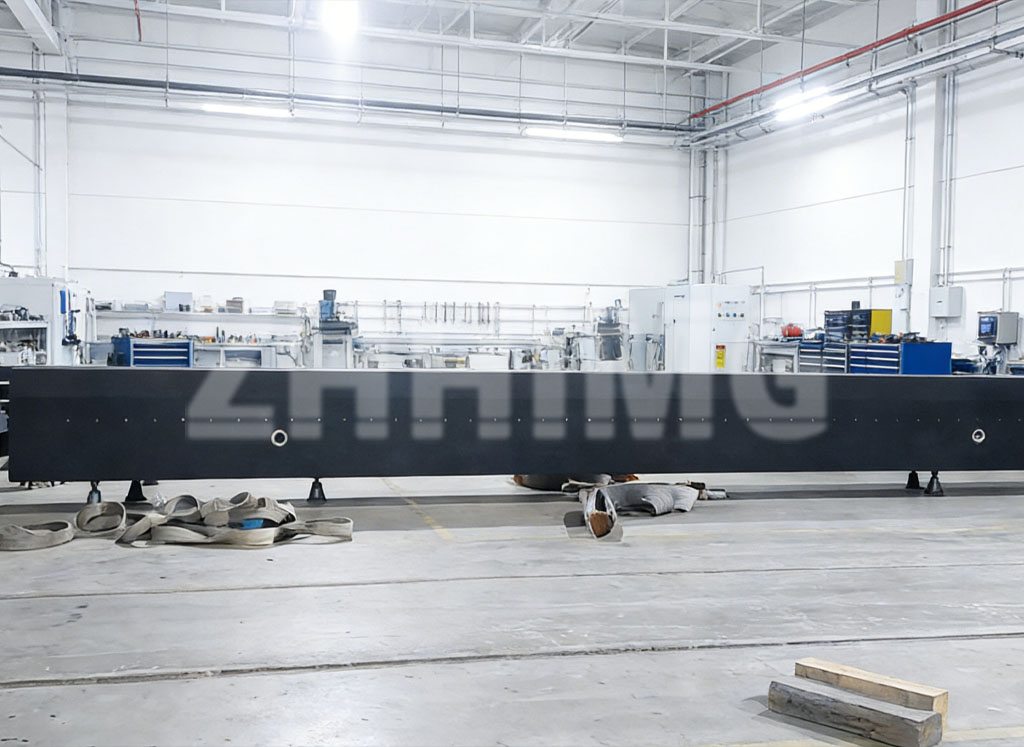
As measurement and positioning technologies advance, granite surface plates are increasingly integrated into complex systems rather than used as standalone tools. One of the most significant developments in this area is granite air bearing technology.
Air bearings enable frictionless motion by supporting moving components on a thin film of pressurized air. This technology is widely used in ultra-precision positioning stages, optical inspection systems, wafer handling equipment, and high-end metrology machines. The effectiveness of an air bearing system depends directly on the flatness, stiffness, and vibration behavior of the supporting base.
Granite provides an ideal foundation for air bearing systems. Its ability to maintain ultra-flat surfaces over large areas ensures uniform air film distribution, while its vibration damping properties prevent micro-disturbances from disrupting motion stability. Granite air bearing bases are therefore capable of supporting smooth, repeatable motion with nanometer-level precision.
In contrast, cast iron bases often require additional damping treatments or isolation structures to achieve similar performance. Even then, long-term thermal drift and residual stress relaxation can compromise air bearing performance over time.
The success of granite-based systems depends not only on material selection, but also on the precision machining of granite. Unlike metals, granite cannot be cut or shaped using conventional machining methods. Achieving high-precision geometry requires specialized grinding, lapping, and hand-finishing techniques developed specifically for hard, brittle materials.
Precision machining of granite involves multiple stages of controlled material removal, often performed in temperature-stabilized environments. CNC grinding machines establish the primary geometry, while fine lapping and manual finishing achieve the final flatness and surface quality. For metrology-grade components, tolerances are commonly measured in microns or even sub-micron ranges.
Advanced granite machining also enables complex features such as threaded inserts, precision holes, reference edges, and integrated air bearing surfaces. These capabilities allow granite to function not only as a reference plane, but as a structural element within sophisticated equipment assemblies.
In modern precision systems, the combination of granite surface plates, air bearing technology, and high-accuracy granite machining creates a synergistic effect. Stable reference surfaces support accurate motion, while precise machining ensures alignment and repeatability across the entire system.
Industries such as semiconductor manufacturing, optics, aerospace inspection, and advanced automation increasingly rely on granite-based structures to meet demanding performance requirements. In these applications, surface plates are no longer passive tools—they are integral components of the machine architecture.
From an industry perspective, the growing preference for granite over cast iron reflects a broader shift toward system-level accuracy and long-term reliability. While cast iron remains suitable for many conventional applications, its limitations become increasingly evident in high-precision environments.
Granite surface plates offer predictable performance over decades, minimal maintenance requirements, and compatibility with advanced technologies such as air bearings and laser measurement systems. These advantages align closely with the needs of modern metrology and automation.
At ZHHIMG, extensive experience in granite processing and precision machining has reinforced a clear understanding of these industry trends. By combining high-quality granite material selection, advanced machining techniques, and deep application knowledge, granite surface plates and air bearing bases can be produced to meet the highest international standards.
As precision engineering continues to evolve, the role of granite will remain foundational. Whether as a surface plate, a machine base, or an air bearing platform, granite continues to define the reference against which accuracy is measured.
Post time: Jan-28-2026