
In precision manufacturing, performance is often judged by what can be measured: flatness, straightness, repeatability, and accuracy. Yet behind every reliable measurement system or high-precision machine lies a less visible but decisive factor — the machine base material. As tolerances continue to tighten across industries such as semiconductor equipment, aerospace, optics, and advanced automation, manufacturers are re-evaluating traditional base materials and increasingly turning to granite.
At ZHHIMG Group, discussions with global customers frequently center on three closely related questions: the difference between granite surface plates and granite machine bases, how to choose the right machine base material, and how thermal stability impacts long-term precision. These questions reflect a broader industry shift toward more stable, predictable, and maintenance-friendly foundations for precision systems.
Granite Surface Plates and Machine Bases: Similar Material, Different Roles
Granite surface plates and granite machine bases are often mentioned together, but they serve different purposes within precision engineering environments.
Granite surface plates are primarily reference tools. They provide an ultra-flat, stable plane used for inspection, calibration, layout, and measurement. In quality control rooms and metrology labs, surface plates function as a physical standard, enabling accurate comparison and verification of parts and instruments. Their design prioritizes flatness, wear resistance, and long-term dimensional stability under static conditions.
Granite machine bases, by contrast, are structural components. They support dynamic systems such as coordinate measuring machines, optical inspection systems, precision stages, and automated equipment. In these applications, the granite base must do more than remain flat. It must absorb vibration, maintain geometric integrity under load, and provide a thermally stable platform for moving axes, sensors, and tooling.
While both products rely on the same fundamental material properties of granite, machine bases require deeper engineering consideration. Load paths, mounting interfaces, internal stress distribution, and integration with motion systems all influence the final performance of the equipment. At ZHHIMG, granite machine bases are custom-engineered components rather than standardized reference tools.
Why Machine Base Material Matters More Than Ever
As manufacturing systems become faster and more precise, the influence of the base material becomes more pronounced. Even small variations in temperature, vibration, or structural stiffness can translate into measurement drift or positioning errors at the micron or sub-micron level.
Historically, cast iron and welded steel were widely used as machine base materials. While these materials remain suitable for many applications, they present limitations in high-precision environments. Metal structures are more sensitive to thermal expansion, prone to long-term stress relaxation, and less effective at damping vibration. As a result, manufacturers are increasingly evaluating alternative materials that offer greater dimensional stability.
Granite has emerged as a preferred solution in precision metrology and automation because its physical properties align closely with the demands of modern inspection and motion systems. Its naturally low coefficient of thermal expansion, combined with excellent vibration damping and long-term stability, makes it particularly well suited for environments where accuracy must be maintained over extended periods.
How to Choose the Right Machine Base Material
Selecting a machine base material is not a purely mechanical decision. It requires a holistic view of the operating environment, performance requirements, and lifecycle costs.
Thermal behavior is often the first consideration. In real production environments, temperature fluctuations are unavoidable. Even well-controlled facilities experience daily and seasonal variations. Materials with high thermal expansion can introduce subtle but cumulative errors as dimensions change with temperature. Granite’s low thermal expansion helps minimize these effects, allowing machines to maintain accuracy without constant recalibration.
Vibration control is another critical factor. Modern inspection systems, especially optical and laser-based equipment, are highly sensitive to micro-vibrations from nearby machinery, foot traffic, or building infrastructure. Granite’s internal crystalline structure dissipates vibrational energy far more effectively than metals, improving signal stability and measurement repeatability.
Long-term dimensional stability also plays a role. Over time, metal structures may experience creep or stress release, especially in welded assemblies. Granite, when properly selected and seasoned, remains dimensionally stable for decades. This stability reduces maintenance requirements and extends the usable life of precision equipment.
Finally, integration flexibility must be considered. Granite machine bases can be precisely machined to include threaded inserts, reference planes, guideway mounts, and custom interfaces. This allows seamless integration with linear motors, air bearings, and precision guide systems, supporting both current and future system upgrades.
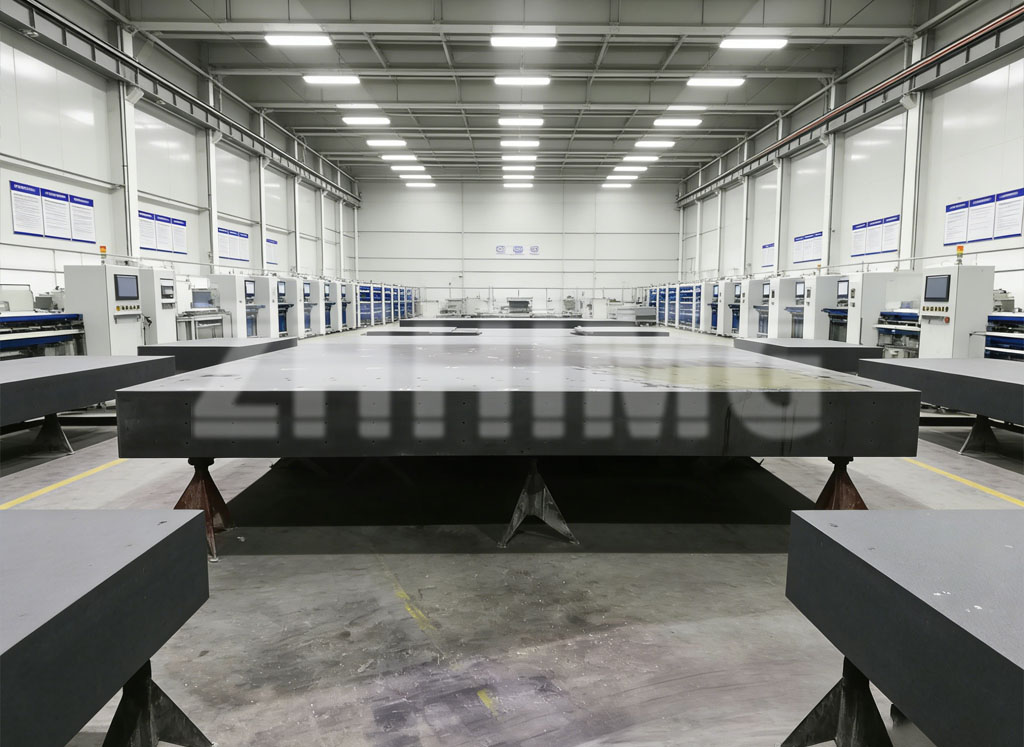
Thermal Stability: A Defining Advantage of Granite
Thermal stability is one of the most important — and often underestimated — aspects of machine base performance. In precision systems, even a few microns of thermal deformation can compromise accuracy.
Granite’s low thermal conductivity means it responds slowly to ambient temperature changes. This characteristic helps prevent localized thermal gradients, which are a common source of distortion in metal structures. Instead of rapidly expanding or contracting, granite maintains a more uniform temperature distribution, supporting consistent geometry across the entire machine base.
In applications such as coordinate measuring machines or optical inspection platforms, this thermal behavior directly translates into measurement reliability. Systems remain stable throughout the day, even as environmental conditions change. Operators benefit from reduced warm-up time and fewer compensation corrections in software.
At ZHHIMG, thermal stability is a key design consideration for every granite machine base we manufacture. Material selection, internal structure, and machining processes are all optimized to ensure predictable thermal performance in real-world operating conditions.
Industry Applications Driving Demand for Granite Bases
The adoption of granite machine bases is accelerating across multiple high-precision industries. Semiconductor equipment manufacturers rely on granite foundations to maintain alignment in lithography, inspection, and handling systems. Optical and photonics companies use granite bases to support interferometers, laser systems, and imaging platforms where vibration and thermal drift cannot be tolerated.
In aerospace and automotive metrology, granite-based CMMs provide the stability required to inspect large, complex components with tight tolerances. Automation and robotics manufacturers increasingly integrate granite stages into high-accuracy positioning systems, where repeatability and smooth motion are critical.
These applications share a common requirement: consistent performance over time. Granite enables manufacturers to meet this requirement while reducing long-term operating costs and maintenance complexity.
ZHHIMG’s Approach to Granite Precision Engineering
ZHHIMG Group specializes in precision granite solutions designed for demanding industrial applications. Our granite machine bases are manufactured from carefully selected natural granite, processed through precision grinding, lapping, and inspection to meet strict flatness and geometric tolerances.
Unlike standard surface plates, ZHHIMG granite bases are engineered as structural components. We collaborate closely with customers to understand load conditions, thermal environments, and integration requirements. This allows us to deliver custom solutions that support advanced inspection systems, motion platforms, and automated machinery.
By combining material expertise with precision manufacturing capabilities, ZHHIMG helps customers build equipment that performs reliably not just during initial installation, but throughout its entire service life.
Looking Forward: Foundations for the Next Generation of Precision
As manufacturing technology continues to evolve, the importance of stable, predictable machine foundations will only increase. Higher speeds, tighter tolerances, and smarter inspection systems all place greater demands on the materials beneath them.
Granite surface plates will remain essential tools for calibration and inspection, while granite machine bases will play an expanding role in high-precision equipment design. Choosing the right base material is no longer a secondary decision — it is a strategic one that influences accuracy, efficiency, and long-term competitiveness.
At ZHHIMG Group, we remain committed to advancing granite precision engineering, supporting global manufacturers as they build the next generation of high-performance machines.
Post time: Feb-03-2026