
Granite surface plates are fundamental reference tools in precision metrology. They serve as primary datum surfaces for inspection, calibration, and precision assembly in aerospace, semiconductor, and advanced manufacturing industries.
Compared with metallic reference platforms, granite provides superior long-term geometric stability, vibration damping, and thermal neutrality, making it a preferred material for high-precision measurement environments.
Material Science of Granite
Granite is an igneous rock composed mainly of quartz, feldspar, and mica. Its metrology performance is derived from its microstructure rather than uniform composition.
Key properties:
- Thermal expansion: 4–7 × 10⁻⁶ /°C
- High vibration damping
- No plastic deformation under normal load
- Long-term dimensional stability
Unlike steel, granite does not exhibit creep or stress relaxation under metrology conditions.
International Standards
Granite surface plates are manufactured under global standards:
- DIN 876 (Germany)
- ASME B89 (USA)
- ISO 9001 quality systems
- JIS B7513 (Japan)
These standards define flatness grades and calibration requirements.
Measurement and Uncertainty
Flatness is a geometric deviation field rather than a single value.
Common measurement methods:
- Laser interferometry
- Electronic levels
- Autocollimators
Uncertainty sources include thermal gradients, probe repeatability, vibration, and instrument drift.
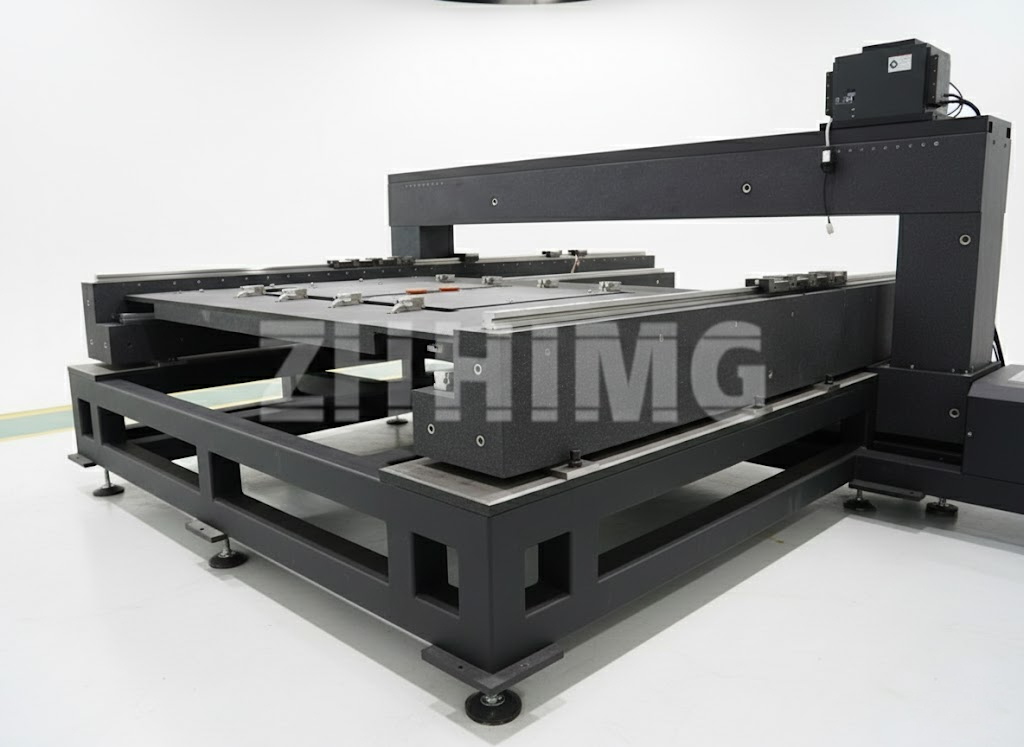
Applications
- Coordinate Measuring Machines (CMM)
- Semiconductor inspection systems
- CNC calibration platforms
- Optical alignment systems
- Laser metrology benches
FAQ
Why is granite used in metrology?
Because of its stability, damping, and low thermal distortion.
Can granite deform over time?
Under normal conditions, deformation is negligible.
What standard defines surface plates?
DIN 876.
How is flatness measured?
Laser interferometry or electronic leveling systems.
Post time: Jul-03-2026