
In the ultra-precision world of semiconductor manufacturing—where nanometer-scale tolerances dictate yield and performance—the choice of machine base material is not just a design detail; it’s a strategic decision that impacts long-term stability, throughput, and ROI. While cast iron has long served as an industrial workhorse, precision granite machine bases have emerged as the undisputed gold standard for advanced lithography tools, metrology systems, and wafer inspection platforms. Here’s why.
1. Unmatched Thermal Stability for Sub-Micron Consistency
Semiconductor fabs operate under tightly controlled thermal environments, yet even minor fluctuations can induce drift in measurement or alignment systems. Granite boasts an ultra-low coefficient of thermal expansion (CTE) of approximately 3 × 10⁻⁶/°C—less than one-third that of cast iron (~11 × 10⁻⁶/°C). This means a granite machine base maintains dimensional integrity across temperature shifts, ensuring consistent performance without constant recalibration. For processes like EUV lithography or atomic-layer deposition, this thermal inertness is non-negotiable.
2. Superior Vibration Damping Without Added Complexity
High-frequency vibrations from pumps, chillers, or nearby equipment can blur imaging sensors or disrupt electron beams. Granite’s natural crystalline structure provides inherent vibration damping, absorbing over 85% of high-frequency vibrations (>500 Hz)—significantly outperforming cast iron’s ~70%. Unlike metal bases that often require external active or passive isolation systems, a precision granite base delivers built-in stability, reducing system complexity and footprint while enhancing signal-to-noise ratios in sensitive measurements.
“In our cleanroom deployment, switching to a granite base reduced stage jitter by 40%, directly improving overlay accuracy.” — Process Engineer, Tier-1 Semiconductor Equipment OEM
3. Zero Corrosion & Chemical Inertness in Harsh Environments
Semiconductor tools frequently operate in high-vacuum chambers or expose components to aggressive etchants and cleaning agents (e.g., HF, Cl₂ plasmas). Cast iron, despite coatings, remains vulnerable to oxidation and pitting over time. In contrast, granite is chemically inert, non-porous, and immune to rust or chemical degradation. This eliminates maintenance downtime for surface reconditioning and ensures decades-long service life—even in corrosive process environments.
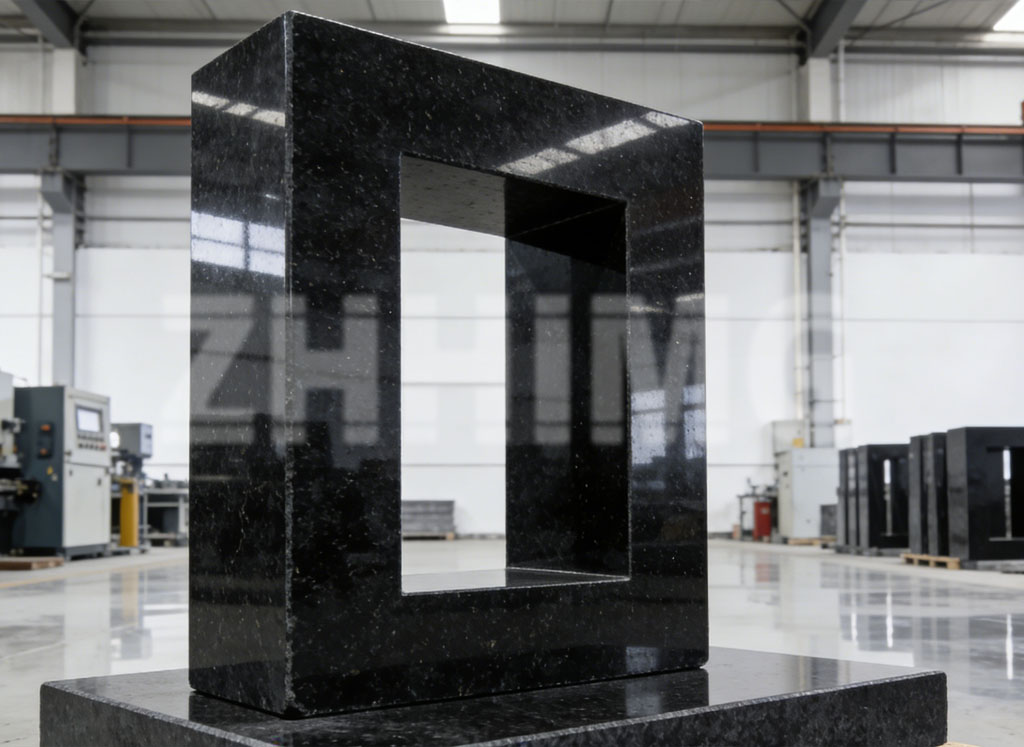
4. Long-Term Precision Retention Without Internal Stress
Cast iron platforms contain residual stresses from casting and machining, which can slowly relax over years—causing subtle warping and precision drift. Granite, formed over millions of years deep underground, arrives stress-free. Once precision-ground to 00-grade flatness (≤0.005 mm/m²), it retains that geometry with minimal drift (<0.2 µm over 5 years). This “set-and-forget” reliability translates to extended calibration intervals and lower total cost of ownership.
5. Non-Magnetic & Electrically Insulating for Sensitive Electronics
Magnetic interference can distort electron paths in SEMs or e-beam writers. Granite’s non-magnetic nature eliminates this risk entirely. Additionally, its electrical insulation prevents stray currents or grounding loops—critical for protecting delicate sensor arrays and control electronics in metrology and inspection tools.
The Bottom Line for Semiconductor Equipment Designers
While cast iron offers advantages in impact resistance and heavy-load capacity, precision granite machine bases deliver the trifecta demanded by next-gen semiconductor manufacturing:
✅ Thermal stability
✅ Passive vibration damping
✅ Long-term geometric fidelity
✅ Thermal stability
✅ Passive vibration damping
✅ Long-term geometric fidelity
At ZHHIMG, we specialize in ultra-precision granite components engineered for the most demanding applications—from 300mm wafer probers to quantum computing test platforms. Our in-house metrology lab ensures every base meets ≤1 µm flatness tolerance, with custom geometries, tapped holes, and embedded fiducials available for seamless integration.
Ready to future-proof your equipment platform?
→ Request a free granite sample kit
→ Download our Semiconductor-Grade Granite Design Guide
→ Contact our engineering team for a confidential application review
→ Request a free granite sample kit
→ Download our Semiconductor-Grade Granite Design Guide
→ Contact our engineering team for a confidential application review
ZHHIMG – Where Precision Meets Permanence.
Post time: Mar-20-2026