
In the landscape of high-precision manufacturing and metrology, the debate over the foundational material of a measurement platform is more than just a technicality; it is a fundamental choice that dictates the accuracy, longevity, and cost-efficiency of the entire operation. Whether you are outfitting a laboratory for micro-electronics or a heavy-duty workshop for automotive machining, the two titans of the industry—Natural Granite and Cast Iron—each offer distinct advantages. Understanding the nuance between these materials requires looking beyond the surface and analyzing how they interact with their environment over time.
The Traditional Strength of Cast Iron
For decades, high-quality cast iron, specifically gray iron with a pearlitic structure, was the undisputed king of the machine tool industry. Its popularity was rooted in its versatility and mechanical properties. One of the primary reasons engineers still favor cast iron is its modulus of elasticity. Because it is a metal, it possesses a level of stiffness and structural rigidity that allows for thinner profiles compared to stone.
Furthermore, cast iron is significantly easier to rework. If a surface becomes worn or damaged, it can be scraped or ground back to its original tolerance relatively quickly. In heavy-duty environments where heavy parts are frequently loaded and unloaded, the impact resistance of metal is a comforting safeguard. However, this metallic nature is also its greatest weakness. Cast iron is highly susceptible to oxidation (rust), requiring constant oiling and maintenance. Moreover, its high coefficient of thermal expansion means that even a few degrees of temperature change in a facility can cause a cast iron table to “grow” or warp, potentially throwing off sensitive measurements.
The Inert Superiority of Natural Granite
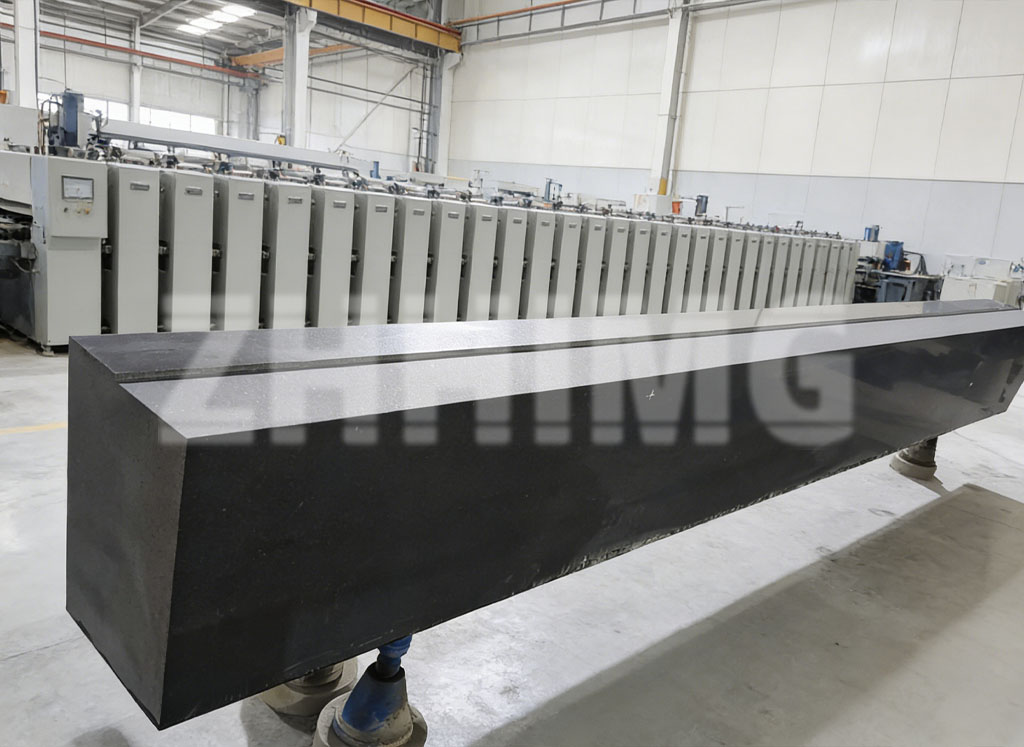
As industries pushed toward sub-micron precision, the limitations of metal became more apparent, paving the way for the rise of black granite. Unlike cast iron, which is melted and poured, granite is a material born of millions of years of natural aging. This geological history results in a material that is virtually free of internal stresses. While a cast iron casting might “creep” or deform slightly over years as internal tensions relax, granite remains remarkably stable.
The most significant advantage of granite is its thermal stability. It has a much lower coefficient of expansion than iron, making it far less sensitive to the environmental fluctuations common in modern production floors. Additionally, granite is naturally non-magnetic and non-conductive. For manufacturers using electronic sensors or testing sensitive magnetic components, a granite base provides an inert environment that eliminates interference.
From a maintenance perspective, granite is the “set it and forget it” option. It does not rust, it does not corrode, and it is resistant to most chemicals. If a granite surface is accidentally nicked, the material does not “burr” upward like metal does; instead, it simply chips away, leaving the surrounding flat surface intact and accurate.
A Side-by-Side Comparison: Performance Metrics
To better understand which material suits your specific application, we must compare how they handle the rigors of the workplace across several key categories:
| Feature | Cast Iron | Natural Granite |
| Durability | High impact resistance; prone to rust. | Brittle (can chip); immune to rust/corrosion. |
| Vibration Damping | Good (better than steel). | Superior (high density absorbs micro-vibration). |
| Thermal Stability | Moderate; expands/contracts with heat. | Excellent; very low expansion rate. |
| Maintenance | Requires frequent oiling and cleaning. | Minimal; simple cleaning with soap/water. |
| Magnetism | Magnetic; can interfere with electronics. | Non-magnetic; inert. |
| Cost | Generally lower for smaller sizes. | Higher initial cost; lower long-term TCO. |
Vibration Damping and the “Quiet” Platform
In modern metrology, especially when using Coordinate Measuring Machines (CMM) or high-magnification optical systems, vibration is the enemy. Even the hum of nearby air conditioning units or the footfalls of workers can introduce “noise” into a measurement.
Granite is naturally more adept at vibration damping than cast iron. Because of its complex crystalline structure, energy from external vibrations is dissipated more quickly within the stone. This creates a “dead” platform that allows sensors to settle faster and provide more repeatable data. While cast iron is certainly better at damping than fabricated steel, it still possesses a resonance that can, in certain high-frequency environments, compromise the integrity of a nanometer-scale reading.
Finding the Right Balance for Your Project
Choosing between these two materials ultimately comes down to your operational environment and the specific tolerances you need to hold.
If your application involves high-impact manual labor, heavy magnetic clamping, or a workspace where temperature is strictly controlled but maintenance staff is readily available to prevent rust, Cast Iron remains a robust and cost-effective choice. It is the classic “heavy-duty” solution that has powered the industrial age for a reason.
However, if you are operating in a cleanroom, dealing with sensitive electronics, or requiring the absolute highest level of geometric stability over long periods, Granite is the undisputed winner. Its resistance to the elements and its “silent” physical properties make it the foundation of choice for the semiconductor and aerospace industries.
Our Commitment to Precision
We recognize that there is no “one size fits all” in the world of precision engineering. That is why we specialize in the custom manufacturing of both Precision Granite Components and High-Grade Cast Iron Platforms.
Our engineering team works closely with you to analyze your machine’s load requirements, environmental variables, and budget constraints to recommend the material that will provide the best Return on Investment (ROI). Whether it is a hand-lapped granite surface plate or a custom-machined cast iron T-slotted base, our facility is equipped to deliver the micron-level accuracy your project demands.
By blending traditional craftsmanship with modern CNC technology, we ensure that regardless of the material you choose, your measurement platform is built on a foundation of excellence.
Post time: Apr-13-2026