
In precision manufacturing and advanced metrology, the structural foundation of a machine is just as important as the measurement or processing technology it supports. Equipment used in industries such as semiconductor manufacturing, optical metrology, aerospace inspection, and high-precision automation must operate with extreme stability. Even minimal vibration can lead to measurement errors, misalignment, or reduced product quality.
For decades, cast iron machine bases were widely used in industrial machinery due to their strength and manufacturability. However, as equipment accuracy requirements have increased, many manufacturers have begun evaluating alternative materials—particularly natural granite. This has led to an important engineering question frequently asked by equipment designers and procurement teams: granite vs cast iron machine base vibration performance—which material is better for vibration-sensitive equipment?
Understanding the differences between granite and cast iron machine bases can help manufacturers select the most appropriate structural material for high-precision applications.
The Role of Machine Bases in Precision Equipment
Machine bases serve as the structural backbone of industrial equipment. They support key components such as motion systems, sensors, optical instruments, and measurement devices. A well-designed machine base must provide:
structural rigidity
dimensional stability
resistance to vibration
long-term accuracy
In vibration-sensitive systems—such as coordinate measuring machines (CMMs), laser inspection equipment, semiconductor metrology tools, and precision optical systems—the machine base must also isolate sensitive components from environmental disturbances.
If the base material transmits vibration or deforms under thermal changes, the entire machine system can lose accuracy. This is why material selection plays a critical role in machine design.
Traditional Use of Cast Iron Machine Bases
Cast iron has historically been one of the most commonly used materials for machine structures. It offers several advantages that made it popular in conventional industrial machinery.
Cast iron provides good compressive strength and can be cast into complex shapes, which allows machine builders to integrate ribs and structural reinforcements into the base design. It also has moderate vibration damping compared to materials such as steel.
Because of its mechanical strength and relatively low production cost, cast iron became the standard structural material for machine tools, milling machines, and industrial equipment throughout the twentieth century.
However, as manufacturing technologies have evolved and precision requirements have increased, the limitations of cast iron have become more apparent.
Limitations of Cast Iron in Vibration-Sensitive Applications
While cast iron performs well in general industrial machinery, it can present challenges in high-precision equipment environments.
One issue is vibration transmission. Although cast iron provides some damping capability, it still transmits mechanical vibrations through the machine structure. External disturbances from nearby equipment, building infrastructure, or moving machine components can propagate through the cast iron frame.
Another limitation involves thermal expansion. Cast iron has a relatively higher coefficient of thermal expansion compared with granite. When ambient temperatures change, the structure may expand or contract, which can influence alignment and measurement accuracy.
Additionally, large cast iron structures can accumulate internal stresses during the casting and machining process. Over time, these stresses may lead to small structural distortions that affect the long-term stability of precision machines.
Because of these factors, engineers working on ultra-precision equipment have increasingly explored alternative materials.
Why Granite Machine Bases Are Increasingly Preferred
Natural granite has long been used in metrology laboratories as the material for surface plates and measurement platforms. In recent years, the same advantages that make granite ideal for metrology have led to its widespread use in machine bases for advanced manufacturing equipment.
When comparing granite vs cast iron machine base vibration performance, granite offers several unique advantages.
Superior Vibration Damping
One of the most significant benefits of granite is its natural vibration damping capability. Granite’s crystalline structure absorbs and dissipates mechanical vibrations more effectively than most metals.
Instead of transmitting vibration through the machine frame, granite helps reduce vibration energy before it reaches sensitive components such as optical sensors or precision motion systems.
For vibration-sensitive equipment—such as interferometers, semiconductor inspection tools, and laser measurement systems—this damping characteristic significantly improves measurement stability and repeatability.
Exceptional Thermal Stability
Granite also provides excellent thermal stability, which is critical in precision manufacturing environments.
Because granite has a relatively low coefficient of thermal expansion, its dimensions remain stable even when environmental temperatures change slightly. This property helps maintain accurate alignment between machine components over long operating periods.
In contrast, cast iron structures may expand or contract more noticeably under temperature variation, potentially affecting machine calibration.
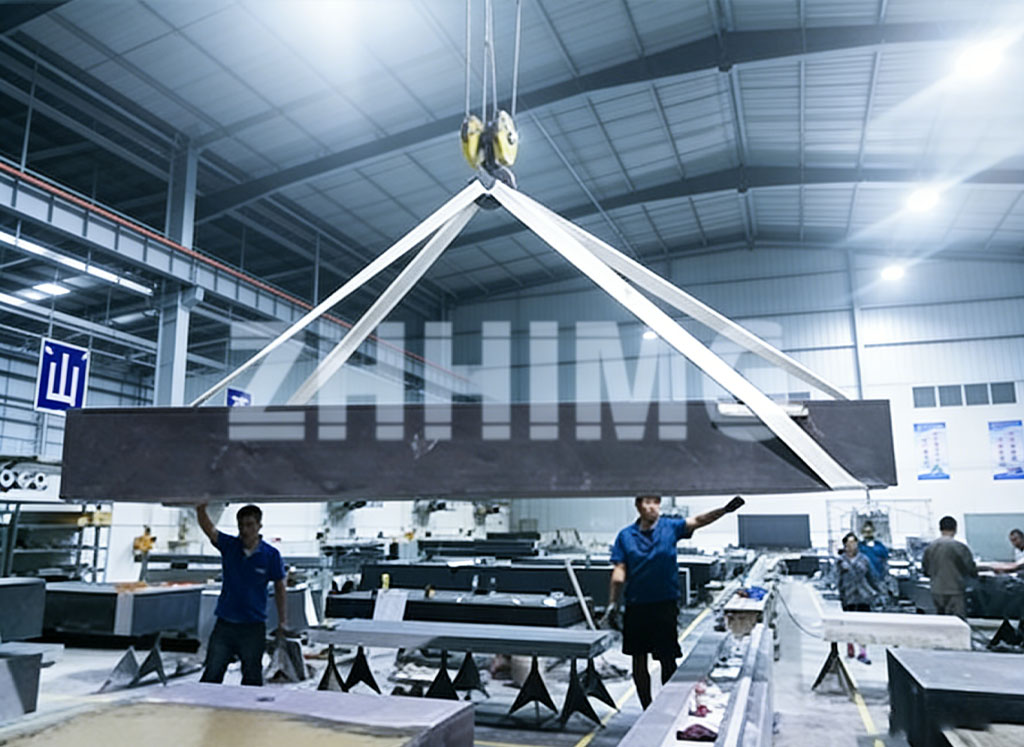
Long-Term Dimensional Stability
Another important factor when comparing granite vs cast iron machine base vibration behavior is long-term dimensional stability.
Granite does not accumulate internal stress in the same way cast metal structures do. Once a granite component has been precision-ground and calibrated, it maintains its geometry for many years without significant deformation.
This stability is particularly important for equipment used in semiconductor manufacturing, optical measurement systems, and precision inspection platforms.
Non-Magnetic Properties
Granite also offers a non-magnetic structure, which can be essential for certain high-precision applications.
Some measurement systems—such as electron microscopes, magnetic sensors, or optical instruments—can be affected by electromagnetic interference from metallic structures. Granite eliminates this risk because it does not generate magnetic fields.
For industries that rely on sensitive electronic instrumentation, this non-magnetic property adds another advantage over traditional cast iron structures.
Applications Where Granite Machine Bases Excel
Because of these performance benefits, granite machine bases are increasingly used in industries where vibration control and stability are critical.
Typical applications include:
semiconductor inspection equipment
laser measurement systems
optical metrology platforms
coordinate measuring machines (CMM)
precision automation equipment
high-resolution imaging systems
In these environments, even small mechanical disturbances can influence measurement results. Granite’s ability to damp vibration and maintain stable geometry helps ensure consistent machine performance.
Engineering Considerations When Choosing Between Granite and Cast Iron
Although granite offers clear advantages in many precision applications, the final choice between materials should consider the specific requirements of the equipment.
Cast iron may still be suitable for:
heavy industrial machinery
general machining equipment
applications where vibration sensitivity is moderate
Granite, on the other hand, is typically preferred for:
high-precision measurement equipment
vibration-sensitive optical systems
semiconductor manufacturing tools
advanced metrology platforms
Machine designers must evaluate factors such as equipment accuracy requirements, environmental conditions, and system integration when selecting the appropriate structural material.
The Future of Precision Machine Structures
As manufacturing technology continues to advance, the demand for ultra-stable machine platforms will only increase. Emerging technologies such as semiconductor lithography, nanoscale measurement, and advanced optical inspection require machine structures that provide exceptional stability.
This trend is one reason why the discussion around granite vs cast iron machine base vibration performance has become increasingly relevant.
While cast iron will continue to serve many traditional industrial applications, natural granite is becoming the preferred material for high-precision equipment where vibration damping, thermal stability, and long-term dimensional accuracy are essential.
For equipment manufacturers seeking to achieve the highest levels of performance and reliability, granite machine bases offer a compelling solution that supports the growing demands of modern precision engineering.
Post time: Mar-09-2026