
In precision metrology laboratories, the surface plate is the foundational reference plane for dimensional inspection, calibration, and quality control. Selecting the proper material directly affects flatness stability, measurement uncertainty, instrument longevity, and maintenance costs. Among all options, granite and cast iron surface plates remain the two most widely used standards.
For procurement engineers and metrology specialists evaluating Granite vs Cast Iron Surface Plate, this article provides a technical comparison focused on three critical performance factors: corrosion resistance, magnetic interference, and long-term dimensional stability.
As a manufacturer of ultra-precision granite components, ZHHIMG applies advanced metrology standards and material science to help laboratories reduce measurement flatness error and optimize precision instrument selection.
1. Material Composition and Structural Behavior
Granite Surface Plate
Granite is a natural igneous rock formed through slow crystallization under extreme geological pressure. High-density metrology-grade granite features:
- Uniform crystalline structure
- Excellent vibration damping
- Very low thermal expansion coefficient
- High compressive strength and rigidity
Because granite is non-metallic, it does not suffer from internal stress deformation caused by casting and machining processes.
Cast Iron Surface Plate
Cast iron plates are manufactured by metal casting followed by machining and hand scraping. While traditionally used in mechanical workshops, cast iron presents:
- Higher ductility but lower long-term stability
- Residual internal stresses from casting
- Susceptibility to environmental oxidation
- Greater thermal distortion under temperature fluctuations
Over time, stress redistribution can gradually degrade flatness accuracy.
2. Corrosion Resistance: A Critical Factor in Accuracy Preservation
Granite: Naturally Corrosion-Proof
Granite is chemically inert and does not oxidize. It is resistant to:
- Humidity
- Cutting fluids
- Laboratory chemicals
- Coolants and oils
This ensures the reference plane remains unaffected even in high-humidity or chemical laboratory environments.
Cast Iron: Vulnerable to Rust and Oxidation
Cast iron reacts with moisture and airborne contaminants, forming iron oxide (rust). Corrosion results in:
- Surface pitting
- Micro-scale height variations
- Progressive flatness deterioration
- Increased maintenance frequency
Even with protective coatings and regular oiling, oxidation cannot be fully prevented.
Impact on Measurement:
Rust formation alters the reference datum plane, directly increasing flatness measurement error and reducing repeatability.
Conclusion: For environments requiring stable long-term precision, granite provides superior corrosion resistance and accuracy retention.
3. Magnetic Properties and Measurement Interference
Granite: Non-Magnetic and Electrically Insulating
Granite’s non-metallic nature eliminates magnetic interference. This is critical for:
- Electronic measuring instruments
- Optical inspection systems
- Semiconductor metrology
- Coordinate measuring machines (CMM)
Sensitive probes and sensors operate without magnetic field distortion.
Cast Iron: Magnetically Conductive
As a ferrous alloy, cast iron generates magnetic fields that can:
- Attract metallic dust and debris
- Interfere with precision probes
- Distort electronic sensor readings
- Affect laser and optical calibration systems
Impact on Measurement:
Magnetic interference introduces micro-deviations that accumulate into systematic measurement errors.
Conclusion: Granite is the preferred material for high-precision electronic and optical metrology applications.
4. Wear Resistance and Long-Term Flatness Stability
Granite Wear Characteristics
Granite offers superior abrasion resistance due to its crystalline mineral composition. When wear occurs:
- Material removal is uniform
- No burrs or raised edges form
- Surface accuracy degrades slowly and predictably
Granite also resists adhesive wear from metal tools.
Cast Iron Wear Characteristics
Cast iron is softer and prone to frictional wear:
- Surface scratching and scoring
- Burr formation around worn regions
- Localized deformation under heavy loads
Burrs create uneven contact points that distort measurement baselines.
Impact on Measurement:
Uneven wear accelerates loss of geometric tolerances and increases recalibration frequency.
Conclusion: Granite maintains flatness accuracy longer and requires less reconditioning.
5. Thermal Stability and Environmental Adaptability
Precision laboratories often operate in temperature-controlled environments, yet even minor fluctuations affect reference materials.
| Property | Granite Surface Plate | Cast Iron Surface Plate |
|---|---|---|
| Thermal Expansion | Low | Higher |
| Heat Conductivity | Slow, stable | Rapid, uneven |
| Distortion Risk | Minimal | Significant |
Granite’s slow thermal response prevents localized expansion, preserving geometric integrity.
6. Maintenance Requirements and Lifecycle Cost
Granite
- No anti-rust treatment required
- Minimal cleaning procedures
- Long recalibration intervals
- Lower lifetime maintenance cost
Cast Iron
- Requires regular oil coating
- Sensitive to fingerprints and humidity
- Frequent anti-corrosion servicing
- Higher long-term upkeep cost
For laboratories pursuing lean quality management systems, granite reduces downtime and maintenance labor.
7. Metrology Standards and Industry Adoption
International metrology standards increasingly recognize granite as the preferred reference material:
- International Organization for Standardization flatness grading systems
- ASTM International dimensional inspection specifications
- Semiconductor and aerospace calibration protocols
Granite surface plates are widely adopted in industries where micron-level tolerances are mandatory.
8. Application-Based Material Selection Guide
Choose Granite Surface Plates If:
✔ High-precision laboratory measurement is required
✔ Equipment is sensitive to magnetic interference
✔ Humidity or chemicals are present
✔ Long-term dimensional stability is critical
✔ Low maintenance cost is preferred
Choose Cast Iron Surface Plates If:
✔ Heavy mechanical layout work is primary
✔ Impact resistance is prioritized over precision
✔ Budget constraints outweigh accuracy requirements
9. Why Precision Manufacturers Prefer Granite — The ZHHIMG Advantage
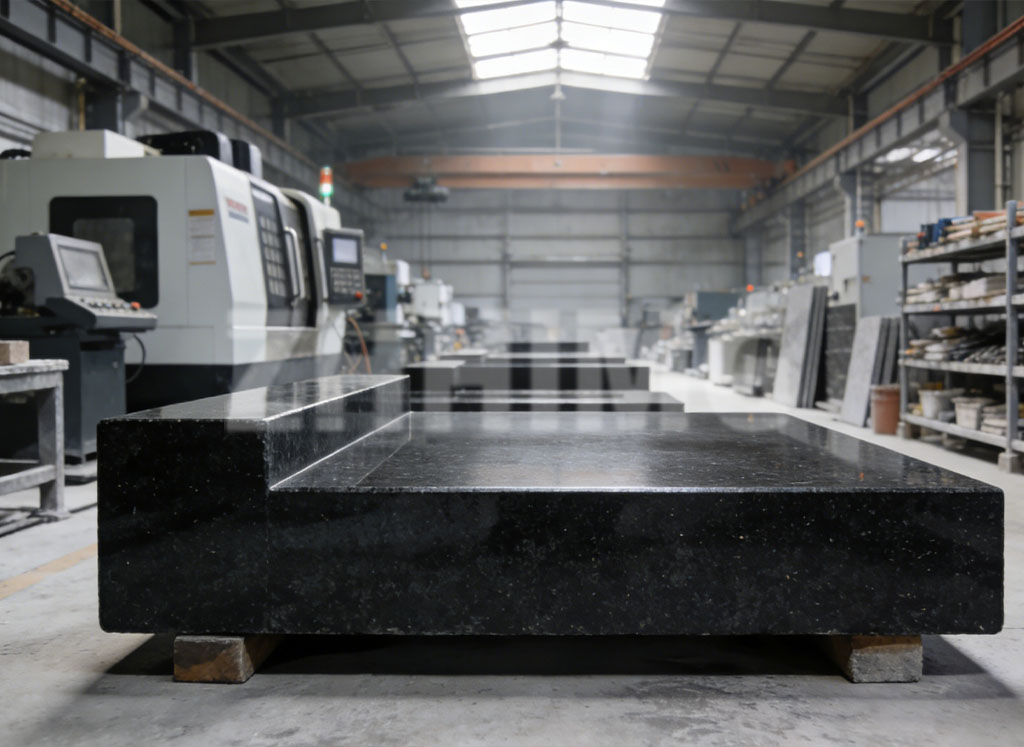
As a global manufacturer specializing in ultra-precision granite components, ZHHIMG produces high-density black granite surface plates engineered for advanced metrology environments.
ZHHIMG Granite Advantages:
- Higher density and finer grain structure
- Superior vibration damping performance
- Stable geometry under continuous use
- Certified flatness accuracy grades
- Compatible with CMM and optical systems
ZHHIMG granite plates are widely used in:
- Semiconductor manufacturing
- PCB inspection systems
- Laser equipment calibration
- Aerospace component metrology
- University research laboratories
By integrating material science with ultra-precision machining, ZHHIMG helps laboratories reduce measurement flatness error and improve precision instrument selection outcomes.
Final Verdict: Which Surface Plate Material Improves Measurement Accuracy?
Granite surface plates outperform cast iron in nearly every factor affecting precision metrology, especially in corrosion resistance, magnetic neutrality, wear uniformity, and thermal stability.
While cast iron remains useful for heavy-duty mechanical applications, granite is the superior choice for laboratories where measurement accuracy, repeatability, and long-term stability define operational excellence.
For modern precision engineering environments, granite is not merely an alternative — it is the metrology benchmark.
Post time: Mar-25-2026