
In the high-stakes world of precision manufacturing, the foundation of quality control lies in the accuracy of its measurements. The choice of a surface plate, the primary datum for inspection, is a critical decision that impacts everything from product quality to long-term operational costs. For procurement managers and technical leads, the debate often centers on two primary materials: granite and cast iron.
This article provides a deep-dive comparison to help you determine which material offers a superior Return on Investment (ROI) for your specific high-end manufacturing application.
The Core Differences: A Tale of Two Materials
At their core, granite and cast iron surface plates offer fundamentally different characteristics. Granite is a natural stone, formed over eons, resulting in a material with exceptional stability and hardness. Cast iron, an engineered alloy, is prized for its strength, toughness, and machinability. Understanding these inherent properties is the first step in making an informed decision on metrology platform material selection.
Dimensional Showdown: Cost, Maintenance, Lifespan, and Precision
To evaluate the true precision measurement ROI, we must look beyond the initial purchase price and analyze four key dimensions.
1. Initial Cost and Machinability
- Cast Iron: Generally has a lower initial purchase price. Cast iron is easier to machine, allowing for efficient production and the easy integration of features like T-slots and threaded holes for workholding. This makes it a cost-effective solution for dynamic production environments where fixtures need to be frequently mounted.
- Granite: Commands a higher upfront investment. The material is extremely hard, making it difficult and time-consuming to cut and grind to the required precision. This specialized manufacturing process contributes to its higher cost.
2. Maintenance and Environmental Resistance
- Granite: This is where granite truly shines. It is virtually maintenance-free. Being a non-metallic, inert material, it is immune to rust and corrosion from oils, coolants, or humidity. It is also non-magnetic, making it ideal for inspecting components in the electronics or aerospace sectors. A simple wipe-down is typically all that’s needed for cleaning.
- Cast Iron: Requires diligent maintenance. To prevent rust, the surface must be kept clean and regularly coated with a protective layer of oil. In harsh shop environments, this ongoing maintenance is crucial to preserve the plate’s accuracy and longevity.
3. Lifespan and Durability
- Granite: Offers exceptional longevity due to its superior wear resistance. Its hardness (Mohs 6-7) means it is highly resistant to scratching and abrasion from parts being slid across its surface. With proper care, a granite plate can maintain its accuracy for decades.
- Cast Iron: While durable and highly resistant to impact (it won’t chip or crack like stone), cast iron is softer and more susceptible to wear over time. However, a significant advantage is its reparability. If a cast iron plate becomes worn or damaged, it can often be re-scraped by a specialist to restore its original accuracy, effectively extending its service life.
4. Precision and Stability
This is the most critical factor for high-end manufacturing.
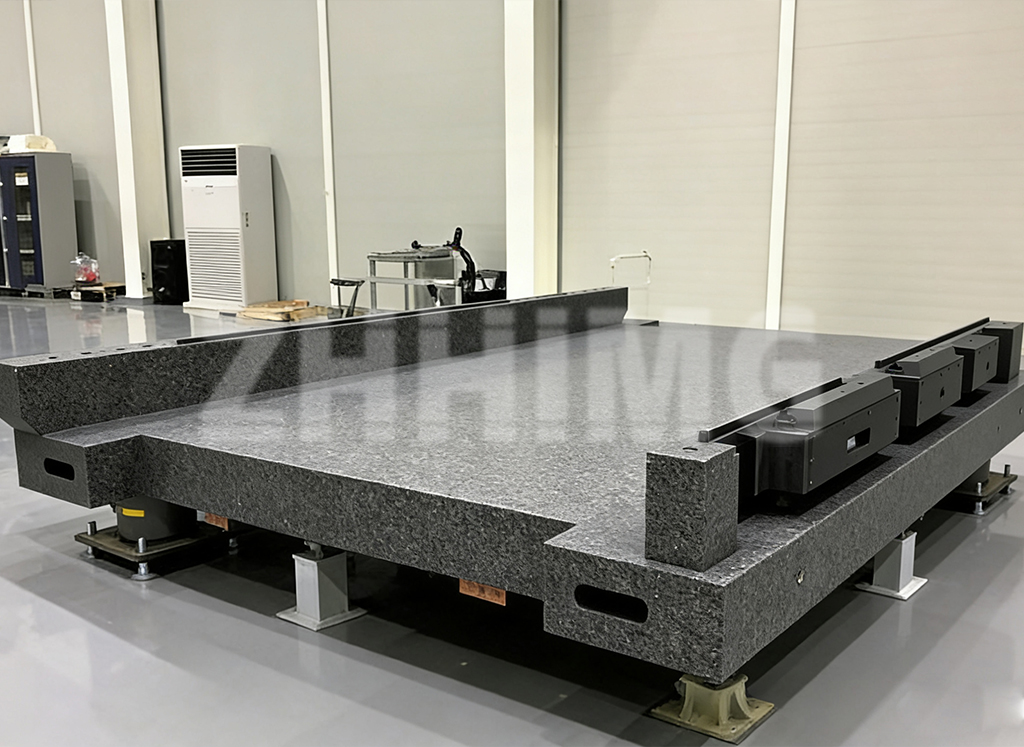
- Granite: The undisputed champion of stability. Granite has an extremely low coefficient of thermal expansion, approximately one-third that of cast iron. For example, while cast iron expands at a rate of roughly 11 x 10⁻⁶/°C, granite’s rate is a mere 4.6 x 10⁻⁶/°C. This means that normal temperature fluctuations in a facility have a minimal impact on a granite plate’s flatness, ensuring consistent, high-precision measurements. Its natural aging process also means it is free from internal stresses that can cause warping or “creep” over time.
- Cast Iron: While stable, cast iron is more sensitive to temperature changes and can be prone to very slight deformation over long periods under heavy, static loads. Its accuracy is more dependent on a controlled environment.
The Verdict: Calculating Your Precision Measurement ROI
So, which material delivers a better ROI? The answer depends entirely on your application.
表格
| Feature | Granite Surface Plate | Cast Iron Surface Plate |
|---|---|---|
| Initial Cost | Higher | Lower |
| Maintenance | Very Low (Rust-proof) | High (Requires oiling) |
| Lifespan | Very Long (High wear resistance) | Long (Reparable) |
| Precision Stability | Excellent (Low thermal expansion) | Good (Requires stable environment) |
| Impact Resistance | Poor (Can chip or crack) | Excellent (Highly durable) |
| Ideal For | High-precision labs, CMMs, electronics, optical inspection | General shop floor use, heavy assembly, welding, applications requiring fixtures |
Choose Granite if: Your priority is maximum, long-term precision in a controlled environment like a quality lab. The higher initial investment is offset by near-zero maintenance costs and unparalleled accuracy stability, delivering a superior ROI for high-precision, long-lifecycle applications.
Choose Cast Iron if: You need a versatile, rugged platform for a dynamic production floor. Its lower initial cost, impact resistance, and ability to be fitted with clamps make it a practical workhorse. Its reparability also contributes to a strong long-term ROI in demanding environments.
Post time: Mar-30-2026