
In precision metrology, the surface plate serves as the fundamental reference plane—the true plane against which all dimensional measurements are made. As metrologists, quality control engineers, and precision manufacturers know, the choice of surface plate material can significantly impact measurement accuracy, long-term reliability, and total cost of ownership.
The debate between granite and cast iron surface plates has persisted for decades, with compelling arguments supporting each material. This comprehensive comparison examines the key differences, advantages, and applications to help you make an informed decision for your precision measurement needs.
Historical Context: The Evolution of Surface Plates
The precision surface plate has a rich history dating back to the early 19th century. Henry Maudslay, a pioneering British engineer, first developed manual scraping methods to produce extremely flat cast-iron plates, providing essential reference surfaces for precision measurement and machining. Later, Joseph Whitworth refined and publicized the three-plate method in 1840, establishing standardized manufacturing practices that enabled reliable production of interchangeable parts.
For nearly 150 years, cast iron dominated the surface plate market. However, during World War II, metal shortages drove innovation. Wallace Herman and Donald V. Porter in the United States began experimenting with granite as an alternative material. Their work, confirmed by investigations at Crown Windley in the UK, demonstrated that granite offered superior stability, wear resistance, and corrosion resistance compared to metal.
Since the 1940s, granite has gradually become the preferred material for surface plates, though cast iron still maintains relevance in specific applications. Today, granite surface plates have become the industry standard for precision metrology applications worldwide.
Granite Surface Plates: The Modern Standard
Key Advantages
Exceptional Dimensional Stability
Granite’s greatest advantage lies in its inherent stability. Having undergone millions of years of geological aging, granite possesses a highly stable internal structure with minimal residual stress. Its coefficient of thermal expansion is extremely low (approximately 4-6 × 10⁻⁶/°C), significantly lower than cast iron’s 10-12 × 10⁻⁶/°C. This means granite plates maintain their flatness accuracy even under varying temperature conditions, making them ideal for environments where strict temperature control is challenging.
Superior Wear Resistance
High-quality granite, particularly quartz-bearing varieties used in premium surface plates, offers exceptional hardness and wear resistance. According to technical specifications from leading manufacturers, granite surface plates are approximately twice as hard as cast iron, ensuring longer service life and maintaining flatness accuracy even after years of heavy use.
When damage occurs to a granite surface plate, it typically results in chipping or pitting rather than raising burrs above the working plane. This means that undamaged portions of the plate can still provide accurate measurements, whereas damage to cast iron often raises surrounding material, rendering large areas unusable.
Corrosion Resistance and Low Maintenance
Granite is naturally resistant to acids, alkalis, and most chemicals encountered in industrial environments. It does not rust, requires no protective oil coatings, and is less likely to accumulate dust or metal particles. These properties significantly reduce maintenance requirements and extend service life.
Non-Magnetic Properties
The non-magnetic nature of granite surface plates is crucial in precision metrology. Magnetic interference can affect sensitive measuring instruments and cause measurement errors. Additionally, the absence of magnetic attraction allows precision tools to move smoothly across the surface without drag or resistance.
Vibration Damping
Granite exhibits excellent vibration damping characteristics, absorbing vibrations that could otherwise affect measurement accuracy. This property is particularly valuable in busy manufacturing environments where external vibrations from machinery or foot traffic are present.
Typical Applications
- Calibration laboratories (Grade 00/Grade 0)
- Precision quality control inspection areas
- Coordinate measuring machine (CMM) bases
- Aerospace component inspection
- Automotive industry precision measurement
- Research and development metrology labs
Cast Iron Surface Plates: The Traditional Choice
Key Advantages
Impact Resistance
Cast iron surface plates are less prone to chipping when struck by heavy objects compared to granite. In industrial environments where accidental impacts from dropped tools or components are common, cast iron plates offer better resistance to catastrophic damage.
Repairability
When wear occurs, cast iron surface plates can be more easily repaired through lapping and resurfacing processes. The three-plate method can be applied to restore flatness without requiring specialized equipment. This repairability makes cast iron plates suitable for applications where in-house maintenance capabilities are preferred.
Better Bearing Surfaces
Properly seasoned cast iron provides excellent bearing characteristics for creating master standards and other precision reference surfaces. This is why cast iron remains popular among laboratory metrologists, machine builders, and gauge makers who need to create secondary standards.
Availability in Specialized Configurations
Cast iron can be more easily modified with threaded inserts, T-slots, and other mounting features during the casting process. For custom applications requiring integrated fixturing capabilities, cast iron plates offer greater flexibility.
Limitations
Thermal Expansion
Cast iron’s higher coefficient of thermal expansion means it’s more susceptible to dimensional changes with temperature variations. In environments without strict temperature control, this can lead to measurement errors and more frequent recalibration requirements.
Corrosion Susceptibility
Unless properly maintained with protective coatings, cast iron plates are prone to rust and corrosion. Exposure to humidity, coolant, or chemicals can compromise surface accuracy and increase maintenance requirements.
Magnetic Properties
The magnetic nature of cast iron can interfere with sensitive measuring instruments and create measurement errors. Additionally, magnetic attraction can cause tools and workpieces to stick to the surface, potentially affecting measurement accuracy.
Typical Applications
- Workshop environments with heavy component handling
- Tool and die making operations
- Manufacturing areas with frequent resurfacing requirements
- Applications requiring integrated fixturing features
- Environments with minimal temperature variation
Technical Comparison: Key Performance Metrics
| Property | Granite Surface Plates | Cast Iron Surface Plates |
|---|---|---|
| Coefficient of Thermal Expansion | 4-6 × 10⁻⁶/°C | 10-12 × 10⁻⁶/°C |
| Hardness (Mohs Scale) | 6-7 | 4-5 |
| Corrosion Resistance | Excellent | Poor (requires maintenance) |
| Magnetic Properties | Non-magnetic | Magnetic |
| Wear Resistance | Excellent | Good (lower than granite) |
| Impact Resistance | Good (chips if severely impacted) | Excellent |
| Repairability | Limited (professional resurfacing required) | Excellent (can be lapped in-house) |
| Maintenance Requirements | Low | Moderate to High |
| Vibration Damping | Excellent | Good |
| Typical Service Life | 20-30+ years | 10-20 years |
Accuracy Grades and Standards
Both granite and cast iron surface plates are manufactured according to international standards, including ISO 8512-1 (cast iron), ISO 8512-2 (granite), DIN 876, and ASME B89.3.7/3.8. These standards define accuracy grades based on flatness tolerance over specified dimensions.
Common Grade Classifications:
- Grade 00 / Grade AA: Laboratory grade, highest accuracy, used in calibration laboratories and high-precision metrology applications
- Grade 0 / Grade A: Inspection grade, used for quality control and general precision inspection work
- Grade 1 / Grade B: Toolroom grade, suitable for workshop and production floor applications
- Grade 2 / Grade 3: Workshop grade, for less demanding applications where lower accuracy is acceptable
For a 250 × 250 mm surface plate, typical flatness tolerances are:
- Grade 00: 1.5-2 µm
- Grade 0: 3-5 µm
- Grade 1: 7-15 µm
- Grade 2: 15-30 µm
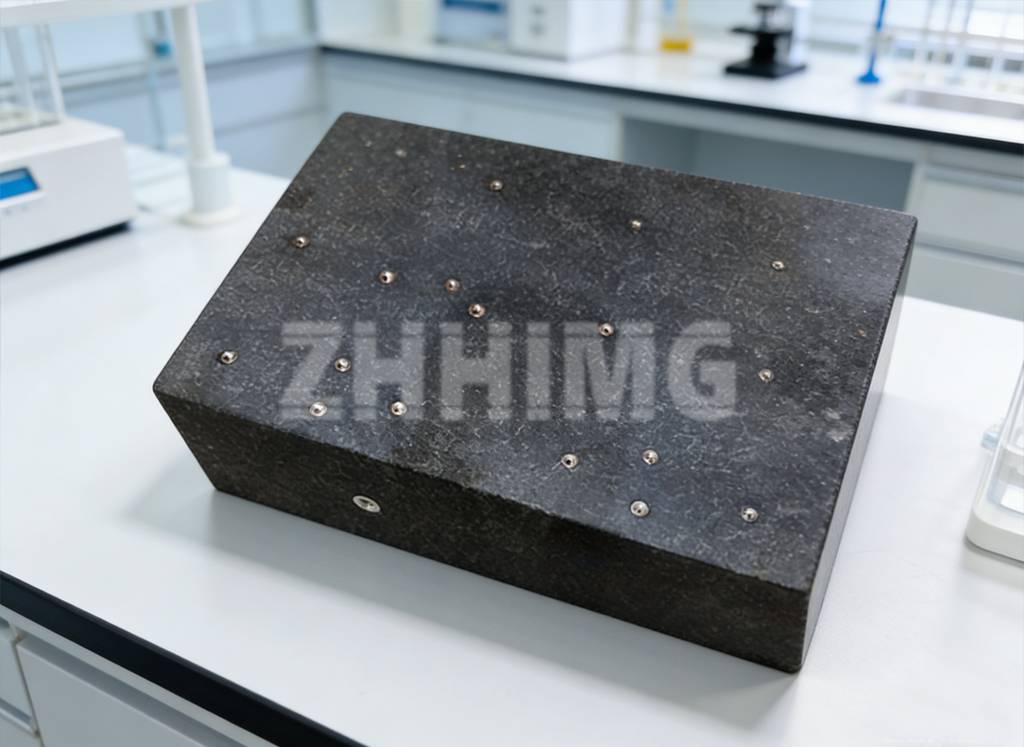
Granite surface plates are more commonly available in higher accuracy grades (00 and 0) due to their superior dimensional stability and wear resistance characteristics.
Cost Considerations: Total Cost of Ownership
When evaluating surface plate options, it’s essential to consider not just the initial purchase price but the total cost of ownership over the equipment’s lifespan.
Initial Investment
Granite surface plates typically have a higher initial purchase cost compared to equivalent-sized cast iron plates, particularly in larger sizes and higher accuracy grades. This premium reflects the material costs, precision machining requirements, and skilled hand-finishing processes involved.
Maintenance Costs
Granite’s corrosion resistance and low maintenance requirements result in significantly lower ongoing costs. No oiling, rust protection, or frequent cleaning beyond normal surface maintenance is required. Cast iron plates require regular oiling, corrosion protection, and more frequent cleaning to prevent rust.
Calibration and Resurfacing
Granite plates typically maintain their accuracy longer, requiring less frequent recalibration. When resurfacing is eventually needed, it must be performed by specialized service providers. Cast iron plates may require more frequent recalibration due to thermal expansion and wear, but can often be resurfaced in-house using appropriate equipment.
Service Life
Granite surface plates commonly achieve 20-30+ years of service with proper care, compared to 10-20 years for cast iron plates in similar applications. This extended lifespan significantly reduces the annualized cost of ownership.
Downtime Considerations
The reliability and reduced maintenance requirements of granite plates result in less downtime for calibration and maintenance, improving productivity in busy metrology and inspection departments.
Making the Right Choice: Application-Specific Recommendations
Choose Granite Surface Plates When:
- Precision is paramount: You’re working in calibration laboratories, quality control inspection areas, or applications requiring Grade 00 or Grade 0 accuracy.
- Environmental conditions vary: Your metrology environment experiences temperature fluctuations or lacks strict climate control.
- Low maintenance is desired: You want to minimize ongoing maintenance requirements and associated costs.
- Non-magnetic properties are essential: Your application involves sensitive measuring instruments or materials affected by magnetic fields.
- Long-term reliability is critical: You need consistent accuracy over decades of service with minimal recalibration requirements.
- Vibration damping is important: Your facility experiences vibrations from machinery or other sources that could affect measurement accuracy.
Choose Cast Iron Surface Plates When:
- Impact resistance is a priority: Your environment involves frequent handling of heavy components with risk of accidental impacts.
- In-house maintenance capabilities exist: You have the equipment and expertise to perform regular resurfacing and maintenance operations.
- Custom fixturing is required: You need integrated T-slots, threaded inserts, or other mounting features that are easier to incorporate during casting.
- Budget constraints are significant: You need to minimize initial investment for lower accuracy applications or temporary installations.
- Thermal environment is tightly controlled: Your facility maintains constant temperature, minimizing thermal expansion concerns.
- Creating master standards: You need bearing surfaces for generating secondary precision standards.
Future Trends in Surface Plate Technology
The surface plate industry continues to evolve with advancements in materials science and manufacturing technology. Current trends include:
Advanced Granite Materials
Manufacturers are developing granite formulations with enhanced properties, including increased quartz content for improved wear resistance and specialized compositions for specific applications such as coordinate measuring machines and precision machine tools.
Hybrid Solutions
Some applications are combining the advantages of both materials through composite approaches, such as granite surfaces with integrated cast iron or steel structural elements for enhanced versatility.
Integrated Measurement Systems
Modern surface plates are increasingly being designed as integrated platforms for advanced measurement systems, incorporating features such as built-in leveling systems, vibration isolation, and compatibility with digital measurement technologies.
Sustainability Considerations
Growing emphasis on sustainable manufacturing is driving research into alternative materials and manufacturing processes that reduce environmental impact while maintaining or enhancing performance characteristics.
Conclusion
The choice between granite and cast iron surface plates ultimately depends on your specific application requirements, environmental conditions, and long-term objectives. While granite has emerged as the preferred choice for most precision metrology applications due to its superior stability, wear resistance, and low maintenance requirements, cast iron still offers distinct advantages in certain scenarios.
For calibration laboratories, quality control inspection areas, and applications requiring the highest levels of accuracy and reliability, granite surface plates represent the superior choice. Their exceptional dimensional stability, corrosion resistance, non-magnetic properties, and long service life make them the foundation of modern precision metrology.
Cast iron surface plates remain relevant for workshop environments, heavy-duty applications, and situations where impact resistance and in-house repairability are paramount considerations. Their lower initial cost and repairability can make them the most economical choice for certain applications.
As precision requirements continue to increase across all industries, the surface plate remains an indispensable tool in metrology. By carefully evaluating your specific needs and considering both immediate and long-term factors, you can select the surface plate material that will provide optimal performance, reliability, and value for your precision measurement applications.
Whether you choose granite or cast iron, proper selection, installation, maintenance, and regular calibration are essential to ensuring your surface plate delivers the accuracy and reliability that modern manufacturing and quality control demand.
Post time: Mar-13-2026