
As precision manufacturing, semiconductor equipment, and advanced metrology systems continue to evolve, the performance requirements placed on machine bases have reached unprecedented levels. Accuracy at the micron and sub-micron scale is no longer limited by sensors or control algorithms alone—it is fundamentally constrained by the mechanical stability of the machine structure itself.
Among the materials most commonly considered for high-precision machine bases, granite and technical ceramics stand out as two dominant solutions. Both are non-metallic, inherently stable, and widely used in applications where thermal behavior, vibration control, and long-term dimensional integrity are critical. However, their engineering characteristics differ significantly, especially when integrated with modern vibration isolation systems.
This article provides an in-depth comparison of granite machine bases versus ceramic machine bases, with a particular focus on structural behavior, vibration damping, thermal stability, manufacturability, and system-level integration. Drawing on real-world industrial use cases, it aims to clarify how material selection directly impacts precision, reliability, and lifecycle cost in advanced automation environments.
The Role of Machine Bases in Precision Engineering
In any precision system—whether a coordinate measuring machine (CMM), lithography platform, laser processing system, or high-speed inspection line—the machine base serves three critical functions:
-
Geometric reference stability for motion axes and metrology components
-
Load-bearing support for static and dynamic forces
-
Vibration attenuation, both internally generated and externally induced
While control systems can compensate for certain dynamic errors, structural vibration and thermal deformation remain fundamentally mechanical problems. Once noise enters the mechanical loop, software compensation becomes limited and increasingly complex.
For this reason, material selection for the machine base is no longer a secondary design decision—it is a system-level engineering choice.
Granite Machine Bases: Material Characteristics and Engineering Advantages
Granite has been used in precision engineering for decades, particularly in metrology and measurement systems. Its continued adoption is not a matter of tradition, but of measurable physical advantages.
High Mass and Natural Damping
Granite exhibits excellent inherent vibration damping due to its crystalline structure. Compared with metals, its internal damping coefficient is significantly higher, allowing it to dissipate vibrational energy rather than transmit it. This makes granite particularly effective in suppressing high-frequency vibrations generated by linear motors, spindles, and rapid axis movements.
Thermal Stability and Low Expansion
With a low and predictable coefficient of thermal expansion, granite maintains dimensional stability under fluctuating ambient conditions. Unlike metallic structures, granite does not develop residual stresses during temperature changes, which is critical for long-duration measurement accuracy.
Non-Magnetic and Corrosion Resistant
Granite’s non-magnetic nature ensures compatibility with sensitive sensors and electronic systems. Its resistance to corrosion eliminates the need for protective coatings, reducing maintenance requirements and long-term drift risks.
Precision Machinability
Modern CNC grinding and lapping technologies allow granite machine bases to achieve flatness and straightness tolerances well below 5 µm over large spans. Complex geometries, embedded inserts, air bearing surfaces, and fluid channels can be integrated directly into the structure.
Ceramic Machine Bases: Strength, Stiffness, and Advanced Applications
Technical ceramics—such as alumina or silicon carbide—have gained attention in ultra-precision and high-speed applications, particularly where extreme stiffness or thermal uniformity is required.
Exceptional Stiffness-to-Weight Ratio
Ceramics offer very high elastic modulus relative to their density. This makes them suitable for applications where mass reduction is critical without sacrificing rigidity, such as fast-moving stages or compact lithography subsystems.
Thermal Conductivity and Uniformity
Certain ceramics exhibit superior thermal conductivity compared to granite, allowing heat to distribute more evenly across the structure. This can be advantageous in tightly controlled thermal environments.
Wear Resistance and Chemical Stability
Ceramic surfaces are highly resistant to wear and chemical exposure, making them suitable for cleanroom or chemically aggressive environments.
However, these advantages come with trade-offs in cost, manufacturability, and vibration behavior.
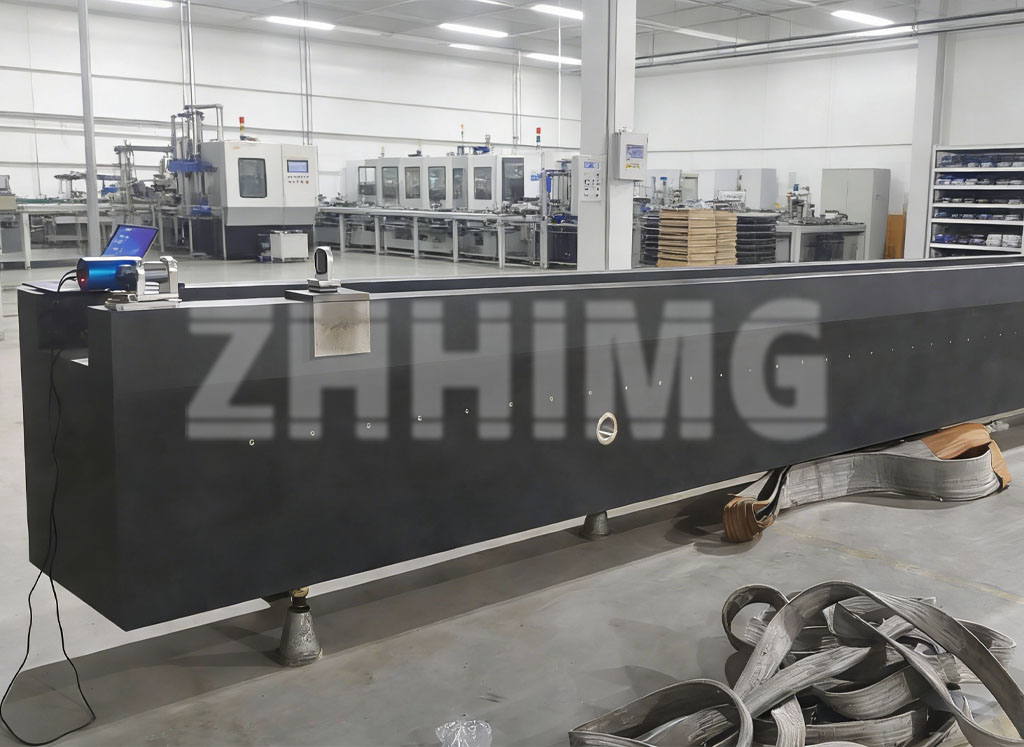
Granite vs. Ceramic: A Structural Comparison
When comparing granite and ceramic machine bases, it is essential to consider not only material properties in isolation, but also how they perform within a complete mechanical system.
Vibration Damping Performance
Granite outperforms ceramics in passive vibration damping due to its internal microstructure. Ceramics, while stiff, tend to transmit vibration rather than absorb it, often requiring additional damping layers or isolation components.
Manufacturing Scalability
Large-format granite machine bases—several meters in length—are routinely manufactured with high precision. Ceramic bases of similar size are significantly more difficult and costly to produce, often limited by sintering constraints and brittleness.
Failure Behavior
Granite exhibits stable, predictable behavior under overload conditions, while ceramics are more susceptible to brittle fracture. In industrial environments where accidental impacts or uneven loading may occur, this distinction is critical.
Cost-to-Performance Ratio
For most industrial precision systems, granite provides a superior balance between performance, reliability, and total cost of ownership.
Vibration Isolation Systems: Passive and Active Strategies
Regardless of base material, vibration isolation has become an essential element of modern precision equipment design.
Passive Isolation
Passive systems—such as pneumatic isolators, elastomer mounts, and mass-spring systems—are commonly paired with granite bases. The high mass of granite enhances the effectiveness of these systems by lowering the natural frequency of the structure.
Active Isolation
Active vibration isolation systems use sensors and actuators to counteract vibrations in real time. While effective, they increase system complexity and cost. Granite bases are often preferred in active isolation setups because their inherent damping reduces the control burden on the system.
System-Level Integration
Granite machine bases can be directly machined to integrate isolation interfaces, mounting pads, and reference surfaces, ensuring precise alignment between the base and isolation components.
Application Case Examples
In semiconductor inspection equipment, granite bases are widely used to support optical measurement modules where vibration amplitudes below 10 nm are required. The combination of granite mass and active isolation achieves stability that would be difficult to realize with lightweight ceramic structures alone.
In contrast, certain high-speed wafer handling subsystems employ ceramic components where rapid acceleration and low inertia are paramount. These are often mounted onto granite sub-frames, combining the strengths of both materials.
Long-Term Stability and Lifecycle Considerations
Precision systems are expected to maintain performance over many years. Granite machine bases demonstrate excellent long-term stability, with minimal aging effects and no structural fatigue. Ceramic bases, while stable, require careful handling and strict operating conditions to avoid microcracking and sudden failure.
From a lifecycle perspective, granite offers predictable performance, ease of refurbishment, and lower risk over extended service periods.
Conclusion
The comparison between granite and ceramic machine bases is not a question of superiority, but of application suitability. Ceramics provide exceptional stiffness and thermal characteristics for niche, high-speed, or compact systems. Granite, however, remains the material of choice for most precision engineering applications due to its unmatched vibration damping, thermal stability, manufacturability, and cost efficiency.
When combined with well-designed vibration isolation systems, granite machine bases form the foundation of reliable, long-term precision in modern automation, metrology, and semiconductor equipment.
For system designers and OEMs seeking a proven balance between performance and durability, granite continues to define the structural standard of precision machinery.
Post time: Jan-28-2026