
In modern precision engineering and dimensional metrology, the accuracy of a measurement system is inseparable from the stability of its mechanical foundation. As coordinate measuring machines (CMMs), optical inspection platforms, and multi-axis precision machines push toward sub-micron and nanometer-level accuracy, the selection of surface plates and machine base materials has become a critical engineering decision rather than a secondary structural choice.
Among the most widely used non-metallic solutions, granite surface plates, ceramic surface plates, and granite or steel machine bases dominate high-precision applications. Each material offers distinct mechanical, thermal, and dynamic properties that directly influence measurement repeatability, vibration sensitivity, and long-term system stability.
This article provides a detailed comparison of granite surface plates and ceramic surface plates, examines the differences between granite and steel machine bases, and explains why granite remains the preferred structural material for most CMM systems. The discussion is framed from a system-level engineering perspective, reflecting real-world industrial requirements rather than theoretical material properties alone.
The Functional Role of Surface Plates in Precision Measurement
Surface plates serve as the primary geometric reference in metrology environments. Whether used for manual inspection, fixture setup, or as the foundation of a CMM, the surface plate defines the flatness, straightness, and stability upon which all measurements depend.
An effective surface plate must provide:
- Long-term flatness stability under static and dynamic loads
- Minimal deformation under temperature variation
- High resistance to vibration transmission
- Excellent wear resistance for repeated contact
Material selection directly determines how well these requirements are met over years of operation.
Granite Surface Plates: Proven Stability for Metrology
Granite surface plates have been the industry standard in dimensional metrology for decades. Their continued dominance is the result of well-balanced physical properties rather than historical convention.
Granite offers high mass density and natural internal damping, allowing it to absorb and dissipate vibration energy efficiently. This characteristic is particularly valuable in metrology labs where ambient vibration from nearby machinery, foot traffic, or HVAC systems can compromise measurement accuracy.
Thermally, granite exhibits a low and highly uniform coefficient of thermal expansion. More importantly, granite responds slowly to temperature changes, reducing thermal gradients across the plate surface. This behavior ensures stable geometry during long measurement cycles, a critical factor for CMM accuracy.
Granite is also non-magnetic, corrosion-resistant, and electrically insulating. These properties eliminate interference with sensitive probes and electronic sensors while reducing long-term maintenance requirements.
Modern precision lapping techniques allow granite surface plates to achieve flatness tolerances well within international standards such as ISO 8512 and DIN 876, even for large-format plates.
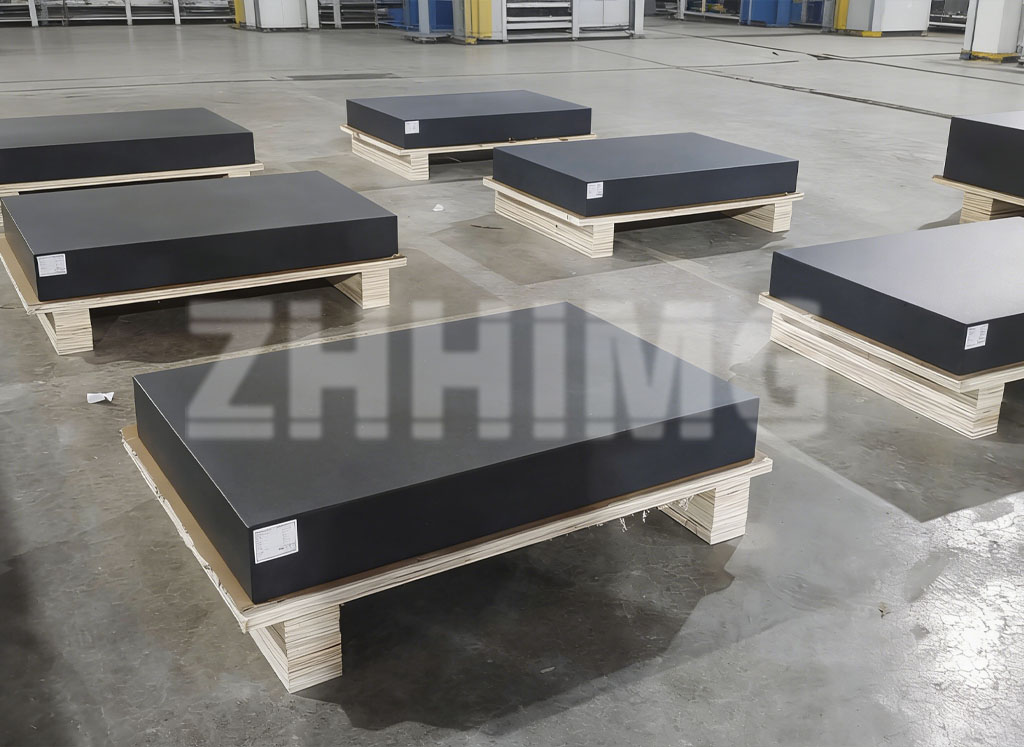
Ceramic Surface Plates: High Stiffness with Trade-Offs
Ceramic surface plates, typically manufactured from advanced technical ceramics such as alumina, have gained attention in niche metrology applications. Their primary advantage lies in high stiffness and hardness, which can provide excellent wear resistance under certain conditions.
Ceramics also exhibit favorable thermal characteristics in tightly controlled environments, with relatively low thermal expansion and good dimensional uniformity when temperature is strictly regulated.
However, ceramic surface plates present several practical limitations. Their intrinsic brittleness increases the risk of cracking or catastrophic failure under impact or uneven loading. Unlike granite, ceramics offer minimal internal damping, meaning they tend to transmit rather than absorb vibration.
Manufacturing large ceramic plates with ultra-high flatness is both technically challenging and cost-intensive. As a result, ceramic surface plates are typically limited to smaller sizes and specialized applications where stiffness outweighs damping requirements.
Granite vs. Ceramic Surface Plates: Practical Comparison
From a system integration perspective, granite surface plates generally provide superior overall performance for industrial metrology. While ceramic plates may offer higher hardness, granite delivers a more balanced combination of vibration damping, thermal stability, manufacturability, and cost efficiency.
In environments where vibration isolation is passive or limited, granite’s damping characteristics offer a decisive advantage. Ceramic plates often require additional isolation measures to achieve comparable measurement stability.
For most CMM applications, granite remains the preferred choice due to its predictable long-term behavior and lower operational risk.
Machine Bases in Precision Systems: Structural Demands
Beyond surface plates, the machine base forms the structural backbone of precision equipment. In CMMs and precision machine tools, the base must support guideways, columns, and moving axes while maintaining strict geometric relationships under load.
Two materials dominate this role: granite and steel.
Granite vs. Steel Machine Bases
Steel machine bases offer high tensile strength and ease of fabrication, making them suitable for general-purpose machinery. However, steel exhibits relatively low internal damping and a higher coefficient of thermal expansion compared to granite.
Thermal fluctuations cause steel structures to expand and contract rapidly, introducing geometric drift that must be compensated through complex control strategies. Steel bases are also susceptible to residual stresses from welding and machining, which can relax over time and affect accuracy.
Granite machine bases, by contrast, provide superior thermal inertia and vibration damping. Their mass reduces sensitivity to external disturbances, while their isotropic structure ensures dimensional stability without residual stress.
For high-precision CMMs, granite bases allow designers to simplify compensation strategies and achieve stable accuracy over long service periods.
Granite for CMM Systems: An Industry Standard
Granite has become the material of choice for CMM structures, including bases, bridges, and guideways. Its compatibility with air bearing technology further enhances its suitability for precision measurement systems.
Granite surfaces can be machined to integrate air bearing pads, reference datums, threaded inserts, and cable channels directly into the structure. This integration improves alignment accuracy and reduces assembly complexity.
The combination of granite structures with air bearings enables near-frictionless motion while maintaining exceptional stiffness and damping. This synergy is one of the key reasons granite-based CMMs achieve repeatability at the nanometer level.
Long-Term Stability and Lifecycle Performance
Precision equipment is often expected to operate reliably for decades. Granite structures exhibit minimal aging effects and are not subject to fatigue in the same manner as metallic structures. Surface re-lapping can restore flatness without compromising structural integrity.
Ceramic and steel components, while effective in specific roles, generally require stricter environmental control and more complex maintenance strategies to maintain equivalent long-term performance.
Conclusion
The comparison between granite surface plates, ceramic surface plates, and steel or granite machine bases highlights the importance of system-level thinking in precision engineering. While ceramics and steel offer advantages in specific scenarios, granite provides the most balanced solution for the majority of metrology and CMM applications.
With its unmatched vibration damping, thermal stability, manufacturability, and long-term reliability, granite continues to define the structural foundation of high-precision measurement systems worldwide. For manufacturers and metrology professionals seeking consistent accuracy and predictable performance, granite remains the benchmark material for both surface plates and machine bases.
Post time: Jan-28-2026