
In the realm of high-end manufacturing, the foundation of accuracy is quite literally the foundation. Whether for a Coordinate Measuring Machine (CMM), a semiconductor inspection station, or a precision assembly line, the material choice for the base or fixture dictates the stability, accuracy, and longevity of the process.
For Quality Control Directors and Procurement Decision Makers, the choice is no longer just between steel and granite. Advanced materials like Precision Ceramics and Carbon Fiber Composites have entered the arena.
This guide provides a comprehensive precision platform material comparison to help you navigate the trade-offs between cost, performance, and application requirements.
The Contenders: Material Profiles
To make an informed decision, we must first understand the physical characteristics of the three dominant materials in modern metrology.
1. Granite: The Stable Standard
Granite has been the industry standard for decades, and for good reason. It is a natural material that has undergone eons of “natural aging,” meaning its internal stresses are virtually non-existent.
Granite has been the industry standard for decades, and for good reason. It is a natural material that has undergone eons of “natural aging,” meaning its internal stresses are virtually non-existent.
- Key Advantage: Exceptional vibration damping and thermal stability.
- Best For: General high-precision measurement and heavy-duty bases.
2. Precision Ceramic: The Ultra-Stiff Specialist
Often made from Alumina (Al₂O₃) or Silicon Carbide, precision ceramics are engineered for extreme rigidity. With an elastic modulus reaching 300-400 GPa (compared to ~70 GPa for aluminum or granite), ceramics offer near-zero deformation under load.
Often made from Alumina (Al₂O₃) or Silicon Carbide, precision ceramics are engineered for extreme rigidity. With an elastic modulus reaching 300-400 GPa (compared to ~70 GPa for aluminum or granite), ceramics offer near-zero deformation under load.
- Key Advantage: Extreme stiffness-to-weight ratio and hardness.
- Best For: Ultra-high precision moving parts (like CMM rams) and vacuum environments.
3. Carbon Fiber: The Dynamic Lightweight
Carbon Fiber Reinforced Polymer (CFRP) is the choice for dynamic applications. It combines high tensile strength with a density roughly one-quarter that of steel.
Carbon Fiber Reinforced Polymer (CFRP) is the choice for dynamic applications. It combines high tensile strength with a density roughly one-quarter that of steel.
- Key Advantage: Massive weight reduction without sacrificing structural integrity.
- Best For: High-speed automation, robotic end-effectors, and aerospace fixtures.
The Comparison Matrix
When evaluating metrology foundation selection, it is crucial to look at specific performance metrics. The table below contrasts these materials against the critical factors for manufacturing.
表格
| Feature | Granite | Precision Ceramic | Carbon Fiber (CFRP) |
|---|---|---|---|
| Stiffness (Elastic Modulus) | Moderate (~50-60 GPa) | Extremely High (300-400 GPa) | High (Anisotropic) |
| Vibration Damping | Excellent (Natural absorption) | Low (Transmits vibration) | Good |
| Thermal Stability | High (Low expansion) | High (Uniform expansion) | Ultra-High (Near-zero expansion) |
| Weight | Heavy | Moderate | Light (~1/4 of steel) |
| Durability | High (Chips on impact) | Very High (Wear resistant) | High (Chemically resistant) |
| Cost | Moderate | High | High |
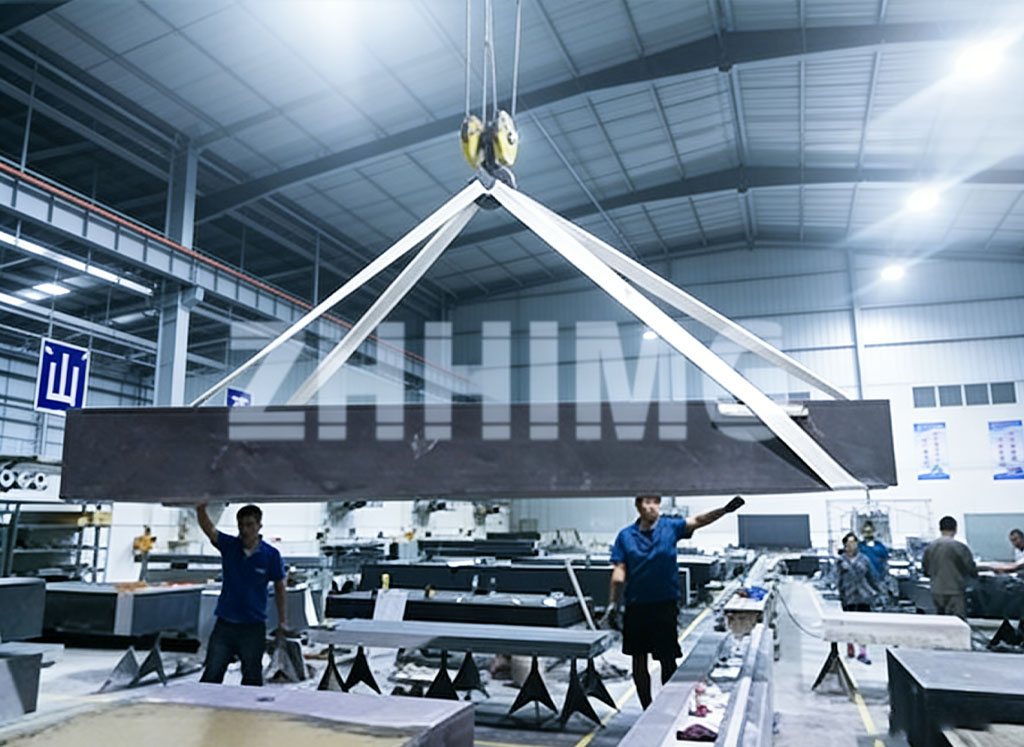
Deep Dive: Performance vs. Application
Granite: The King of Stability
Granite remains the top choice for static applications where vibration damping is critical. Its natural structure absorbs energy rather than transmitting it, which is vital for surface finish and measurement repeatability. Furthermore, granite is chemically inert and rust-proof, making it ideal for harsh shop floor environments.
Granite remains the top choice for static applications where vibration damping is critical. Its natural structure absorbs energy rather than transmitting it, which is vital for surface finish and measurement repeatability. Furthermore, granite is chemically inert and rust-proof, making it ideal for harsh shop floor environments.
- Verdict: Choose Granite for CMM bases, optical tables, and general precision surface plates where budget and stability are balanced.
Ceramic: The Choice for Ultra-Precision
When accuracy requirements dip into the sub-micron range, granite may not be stiff enough to prevent minute deflections during high-speed movement. Precision ceramics, with their superior rigidity, ensure that moving axes (like a CMM bridge or ram) do not flex. This reduces the reliance on software compensation.
When accuracy requirements dip into the sub-micron range, granite may not be stiff enough to prevent minute deflections during high-speed movement. Precision ceramics, with their superior rigidity, ensure that moving axes (like a CMM bridge or ram) do not flex. This reduces the reliance on software compensation.
- Verdict: Choose Ceramic for high-speed scanning bridges, semiconductor wafer stages, and vacuum chamber components.
Carbon Fiber: The Enabler of Speed
In modern automated lines, weight is the enemy of speed. Heavy fixtures slow down robots and increase cycle times. Carbon fiber allows for lightweight metrology fixtures that can be moved rapidly by robots without inducing inertia-related errors.
In modern automated lines, weight is the enemy of speed. Heavy fixtures slow down robots and increase cycle times. Carbon fiber allows for lightweight metrology fixtures that can be moved rapidly by robots without inducing inertia-related errors.
- Verdict: Choose Carbon Fiber for robotic gripping systems, portable inspection fixtures, and aerospace assembly jigs.
Selection Decision Tree
To assist in your metrology foundation selection, use this decision logic to identify the best material for your specific use case.
Step 1: What is the primary constraint?
- Is it Budget & Stability? → Go to Step 2.
- Is it Extreme Stiffness (Sub-micron)? → Select Precision Ceramic.
- Is it Weight Reduction (Dynamics)? → Select Carbon Fiber.
Step 2: What is the operating environment?
- Harsh/Chemical Environment? → Select Granite (Resists corrosion/rust).
- High Vibration Environment? → Select Granite (Superior damping).
- Standard Lab Environment? → Select Granite.
Conclusion
There is no single “best” material—only the best material for your specific application.
- Granite offers the best all-around ROI for static precision.
- Ceramic provides the rigidity needed for the highest tier of accuracy.
- Carbon Fiber solves the challenges of speed and automation.
At ZHHIMG, we specialize in machining and fabricating precision platforms from all three materials. Whether you need a massive granite base for a new CMM or a lightweight ceramic bridge for a high-speed scanner, our engineering team is ready to deliver the stability you demand.
Post time: Mar-30-2026