
Selecting the base material for a high-precision machine—whether it’s a semiconductor lithography tool, a CMM, or a laser cutter—is one of the most critical decisions a systems engineer will make. The base dictates the machine’s thermal stability, vibration damping, and long-term geometric accuracy.
However, the “best” material isn’t always the most expensive one; it is the one that aligns with your specific environmental constraints and budget. This guide compares the three industry leaders: Natural Granite, Epoxy Granite (Mineral Casting), and Technical Ceramics.
1. Natural Granite: The Industry Standard for Stability
Best For: Large-scale metrology, CMMs, and high-precision optical benches.
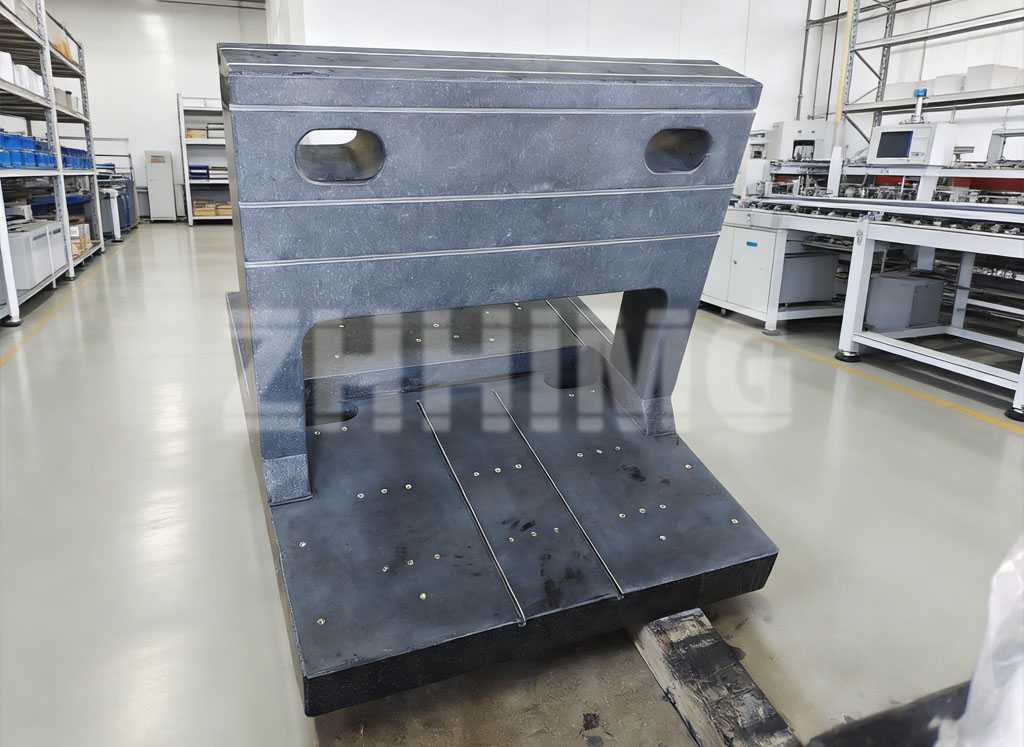
Natural black granite remains the dominant choice for precision bases worldwide. Its primary strength lies in its exceptional long-term dimensional stability and low coefficient of thermal expansion.
-
Pros: * Cost-Effective: For large-format bases, natural granite offers the best precision-to-price ratio.
-
Extreme Flatness: Can be manually lapped to sub-micron tolerances (Grade AA).
-
Corrosion Proof: Unlike cast iron, it will not rust or degrade over decades.
-
-
Cons: High mass makes it difficult to move, and it cannot be easily cast into complex hollow shapes.
-
The Verdict: If your project requires a large, ultra-stable reference surface with a focus on cost-efficiency, natural granite is the undisputed winner.
2. Epoxy Granite (Mineral Casting): The Damping Specialist
Best For: High-speed CNC machines and systems with complex internal routing.
Epoxy granite is a composite material made from stone aggregates bonded with epoxy resin. It is favored by engineers who need high vibration damping.
-
When it Wins: * Complex Geometry: Since it is cast into a mold, you can include internal cooling channels, threaded inserts, and wire conduits directly in the base.
-
Vibration Damping: It dampens vibrations up to 10 times faster than cast iron and significantly better than natural granite, which is vital for high-speed machining.
-
-
The Trade-off: While excellent for damping, epoxy granite is less thermally stable than natural granite and can suffer from “creep” or slight deformation over many years.
3. Technical Ceramics (Alumina/SiC): The High-Performance Alternative
Best For: Ultra-high vacuum (UHV), cleanrooms, and extreme chemical environments.
Ceramics like Alumina (Al2O3) or Silicon Carbide (SiC) represent the “Formula 1″ of base materials.
-
The Use Case: * Weight Sensitivity: Ceramics are significantly lighter and stiffer (higher Young’s Modulus) than stone or composites.
-
Chemical & Thermal Extremes: They offer the highest resistance to acids and can withstand extreme temperature fluctuations without losing accuracy.
-
-
The Trade-off: The manufacturing process (sintering) limits the size of the components. Furthermore, the cost of a ceramic base can be 5 to 10 times higher than natural granite.
Comparative Performance Matrix
| Feature | Natural Granite | Epoxy Granite | Technical Ceramic |
| Vibration Damping | Moderate | Excellent | Moderate |
| Thermal Stability | Excellent | Moderate | High |
| Weight-to-Stiffness | Moderate | Low | Highest |
| Corrosion Resistance | High | High | Extreme |
| Relative Cost | Low/Standard | Medium | Very High |
Why Natural Granite Remains the Strategic Choice
At ZHHIMG, we specialize in the engineering and fabrication of Natural Black Granite. While epoxy and ceramics have their niche, we have found that for the vast majority of international industrial applications—especially in the semiconductor and lithium battery testing sectors—natural granite provides the optimal ROI.
By utilizing high-density granite (approx. 3100kg/m³), we achieve the nano-level precision of ceramics at a fraction of the cost. Our natural stone bases provide a “set-and-forget” level of stability that composite materials often struggle to match over a 10-year lifecycle.
Make the Right Choice for Your Machine
Choosing between these three materials depends on your vibration requirements, your budget, and the complexity of your design.
Not sure if you should switch to granite or stick with a composite? We can help you run the numbers.
Post time: Mar-10-2026