
In the world of ultra-precision manufacturing, the difference between a high-quality component and a rejected part often comes down to a few microns. For precision machining shops, automotive suppliers, and mold manufacturers, choosing the right foundation for measurement is critical.
While metal (steel or cast iron) has been the traditional choice for decades, high-density black granite—specifically professional-grade ZHHIMG® granite—has become the gold standard for high-precision dimensional inspection.
Here is a deep dive into why granite is outperforming metal in modern metrology.
Why Material Choice Matters in Metrology
Every measuring tool is subject to environmental physics. Temperature fluctuations, humidity, and physical wear can warp a metal tool, leading to “measurement drift.” Granite, a natural igneous rock aged for millions of years, possesses inherent physical stability that synthetic metals cannot match.
Performance Comparison: Granite vs. Metal
| Feature | Granite (ZHHIMG® Black) | Metal (Steel/Cast Iron) |
| Hardness (Mohs) | 6–7 (Extremely scratch-resistant) | 4–5 (Prone to burrs and nicks) |
| Thermal Expansion | Very Low ($5 \times 10^{-6}/K$) | High ($12 \times 10^{-6}/K$) |
| Corrosion Resistance | 100% Acid & Rust proof | Requires oiling/coating to prevent rust |
| Magnetic Properties | Non-magnetic | Magnetic (attracts metal shavings) |
| Maintenance | Simple cleaning | Frequent oiling and calibration |
| Long-term Stability | High (No internal stress) | Low (Requires stress-relieving over time) |
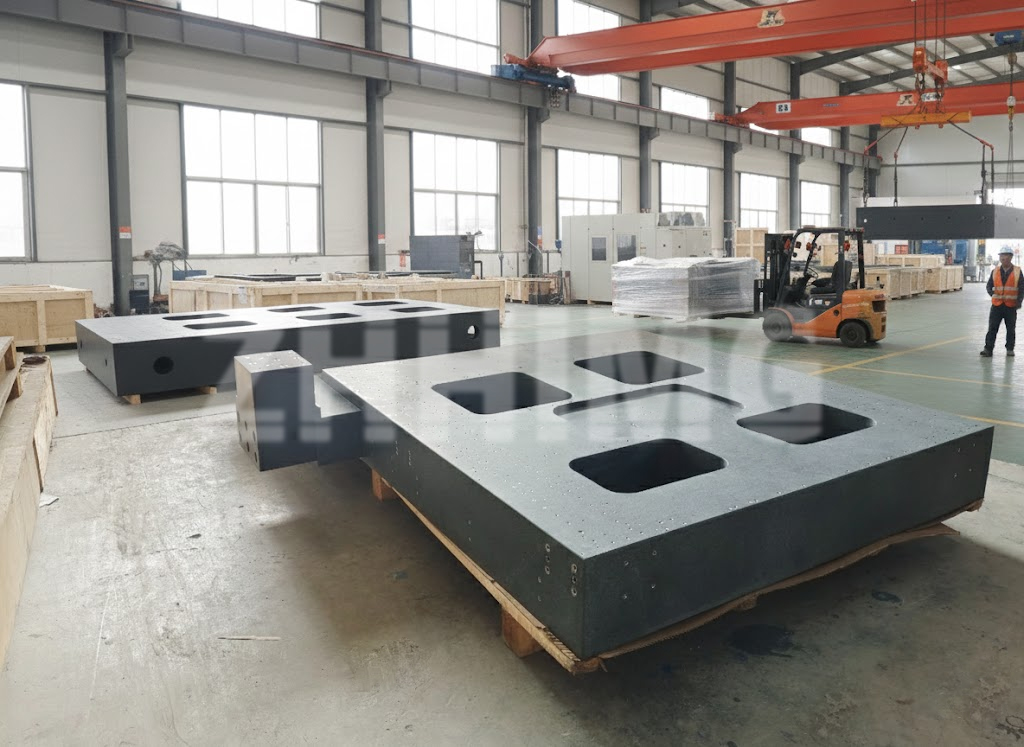
The Granite Advantage for Precision Industries
1. Superior Thermal Stability
For automotive and mold manufacturers, temperature control is a constant battle. Metal expands and contracts significantly with even slight temperature shifts. Granite has a much lower coefficient of thermal expansion, ensuring that your high-precision dimensional inspection tools remain accurate even if the workshop temperature fluctuates.
2. No Burrs, No Errors
When a metal surface plate is scratched, the metal “pushes up,” creating a burr that tilts the workpiece and ruins the measurement. When granite is scratched, it simply loses a few grains of rock; no ridge is formed, and the overall flatness remains intact.
3. Zero Corrosion and Low Maintenance
Metal tools require constant greasing and protection from humidity to prevent rust. Granite is naturally inert. For a busy precision parts processing plant, this translates to lower maintenance costs and zero downtime spent cleaning off protective oils before use.
4. Non-Magnetic Integrity
In electronics and precision machining, magnetic interference can be a nightmare. Granite is non-magnetic and non-conductive, making it the ideal base for testing sensitive components without risk of static or magnetic pull.
Conclusion: The “Lower Long-Term Cost” Reality
While the initial investment in high-quality granite measuring tools might be comparable to high-end metal, the Total Cost of Ownership (TCO) is significantly lower. Granite does not rust, requires less frequent recalibration, and lasts for decades under professional care.
For manufacturers aiming for the highest standards (such as DIN 876 Grade 00 or laboratory grade), granite is no longer just an alternative—it is the necessity.
Post time: Mar-18-2026