
In the relentless pursuit of micron-level accuracy, the foundation of your machine is not just a support structure—it’s the bedrock of precision. For builders of CNC machines and semiconductor equipment, the choice of base material is a critical decision that dictates performance, longevity, and reliability. While steel has long been the traditional choice, granite is increasingly becoming the material of champions for ultra-precision applications.
Here are 5 key differences that explain why granite is outperforming steel in the most demanding manufacturing environments.
1. Vibration Damping: The Silent Guardian of Surface Finish
The enemy of precision is vibration. Even microscopic oscillations can translate into visible defects on a finished part, ruining surface finish and dimensional accuracy.
- Steel’s Limitation: Steel structures can resonate, amplifying vibrations from motors, cutting tools, or even the factory floor. This requires complex and often imperfect damping solutions.
- Granite’s Advantage: Granite possesses a naturally dense, crystalline structure that provides superior vibration damping. It absorbs and dissipates vibrational energy far more effectively than steel, ensuring a smoother, more stable cutting or measurement environment. This translates directly to better surface finishes and tighter tolerances.
2. Thermal Stability: Precision That Doesn’t Fluctuate with the Temperature
Temperature changes are inevitable in any industrial setting. A material’s reaction to these changes is paramount for consistent accuracy.
- Steel’s Limitation: Steel expands and contracts with temperature fluctuations. Its coefficient of thermal expansion is approximately 11.7 x 10⁻⁶/°C. This means a 1-meter steel base can change length by over 11 microns with just a 1°C temperature shift—a massive error in ultra-precision work.
- Granite’s Advantage: Granite is exceptionally thermally stable. With a coefficient of thermal expansion of around 4.6 x 10⁻⁶/°C, it is less than half that of steel. It resists warping and dimensional changes, ensuring your machine maintains its calibration and accuracy regardless of ambient temperature swings.
3. Rigidity and Stability: Unwavering Strength Under Load
A machine base must be incredibly rigid to withstand the forces of high-speed machining or the weight of heavy components without flexing.
- Steel’s Limitation: While strong, steel can be prone to stress relief and slight deformation over time, especially under constant heavy loads or dynamic forces.
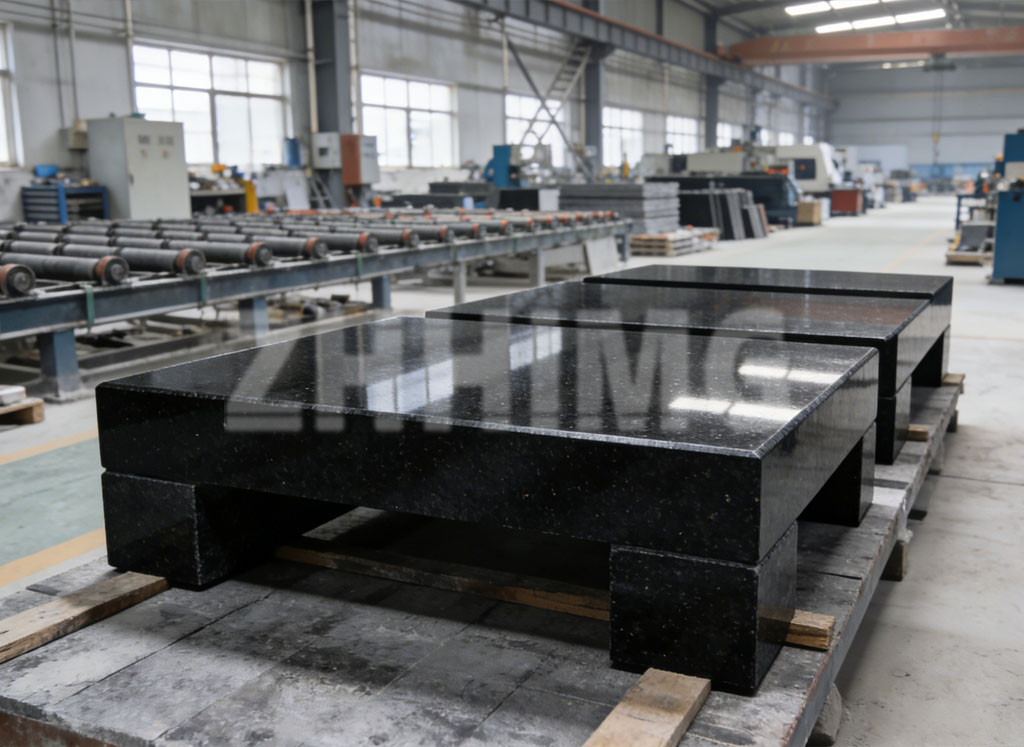
- Granite’s Advantage: Granite has an extremely high compressive strength and density (approx. 3070 kg/m³). This gives it exceptional rigidity, making it highly resistant to deflection and deformation. A granite base provides a permanently stable platform, ensuring consistent performance year after year.
4. Corrosion and Wear Resistance: A Low-Maintenance, Long-Life Asset
The lifespan and maintenance requirements of a machine base are significant operational considerations.
- Steel’s Limitation: Steel is susceptible to rust and corrosion, especially in environments with coolants, humidity, or chemical exposure. It requires protective coatings and regular maintenance to prevent degradation.
- Granite’s Advantage: Granite is chemically inert. It is completely immune to rust and highly resistant to acids, alkalis, and coolants. Its non-porous surface is easy to clean and will not corrode, resulting in virtually zero maintenance and a significantly longer operational life.
5. Non-Magnetic Properties: Essential for Sensitive Applications
For semiconductor manufacturing and other high-tech applications, magnetic interference can be disastrous.
- Steel’s Limitation: Being a ferrous metal, steel is magnetic. This can interfere with sensitive electronic components, electron beams, or magnetic sensors, leading to process errors and defects.
- Granite’s Advantage: Granite is a naturally non-magnetic material. It creates a “clean” environment free from magnetic fields, making it the only viable choice for many semiconductor, medical, and advanced research applications.
Conclusion: The Foundation for the Future of Precision
While steel has its place in general manufacturing, the demands of ultra-precision industries are pushing the boundaries of what’s possible. Granite’s superior damping, thermal stability, and rigidity make it more than just an alternative; it’s a strategic upgrade for any application where accuracy is non-negotiable.
Choosing a granite base is an investment in the long-term precision, reliability, and capability of your equipment.
Ready to elevate your machine’s performance?
Post time: Apr-03-2026