
In the high-stakes world of precision manufacturing, the foundation of your machinery is just as critical as the technology it supports. Whether you are operating a Coordinate Measuring Machine (CMM), a semiconductor wire bonder, or a high-speed laser processing center, the stability of the machine base dictates the upper limit of your accuracy. For decades, steel and cast iron were the standard. However, as tolerances tighten to the micron and sub-micron level, granite machine base structures are becoming the dominant choice for industry leaders.
At ZHHIMG, we understand that selecting the right material is a complex engineering decision. This article breaks down the comparison between granite and steel across seven critical factors to help you make a data-driven choice.
1. Thermal Stability and Expansion
The most significant advantage of granite over steel is its thermal behavior. In a precision environment, temperature fluctuations are the enemy of accuracy.
- Granite: Possesses a low coefficient of thermal expansion (approximately 5.8 × 10⁻⁶ /°C). It reacts slowly to temperature changes, maintaining its geometry even in fluctuating shop floor environments.
- Steel: Typically has a thermal expansion coefficient nearly double that of granite (11-13 µm/m·°C). Steel bases expand and contract more readily with temperature shifts, leading to measurement drift.
For CMM granite base applications, this stability is non-negotiable. Granite ensures that the machine’s geometry remains constant, regardless of minor ambient temperature changes.
2. Vibration Damping
Precision equipment is sensitive to external vibrations from forklifts, nearby machinery, or even foot traffic.
- Granite: Has a high natural vibration damping capacity—significantly higher than steel. Its dense, granular structure absorbs and dissipates vibrational energy rapidly.
- Steel: While rigid, steel tends to resonate. It often requires additional damping treatments or heavy ribbing to achieve the same isolation levels that granite provides naturally.
3. Long-Term Dimensional Stability (Aging)
Materials change over time due to internal stress relief.
- Granite: Being a natural stone formed over millions of years, it has effectively zero internal stress. It does not “age” or warp in a way that affects precision.
- Steel: Castings and welded structures contain residual stresses. Over time, these stresses relieve themselves, causing the base to twist or warp slightly, necessitating frequent recalibration.
4. Maintenance and Corrosion Resistance
The operational environment can be harsh, involving coolants, oils, and humidity.
- Granite: Is chemically inert. It does not rust, corrode, or react to most industrial chemicals. A simple wipe-down is usually sufficient for maintenance.
- Steel: Requires rigorous protection. Paint or plating can chip, leading to rust spots that can affect the mounting surface or contaminate cleanrooms.
5. Rigidity and Stiffness
While steel has a higher Modulus of Elasticity than granite, the design of the component matters.
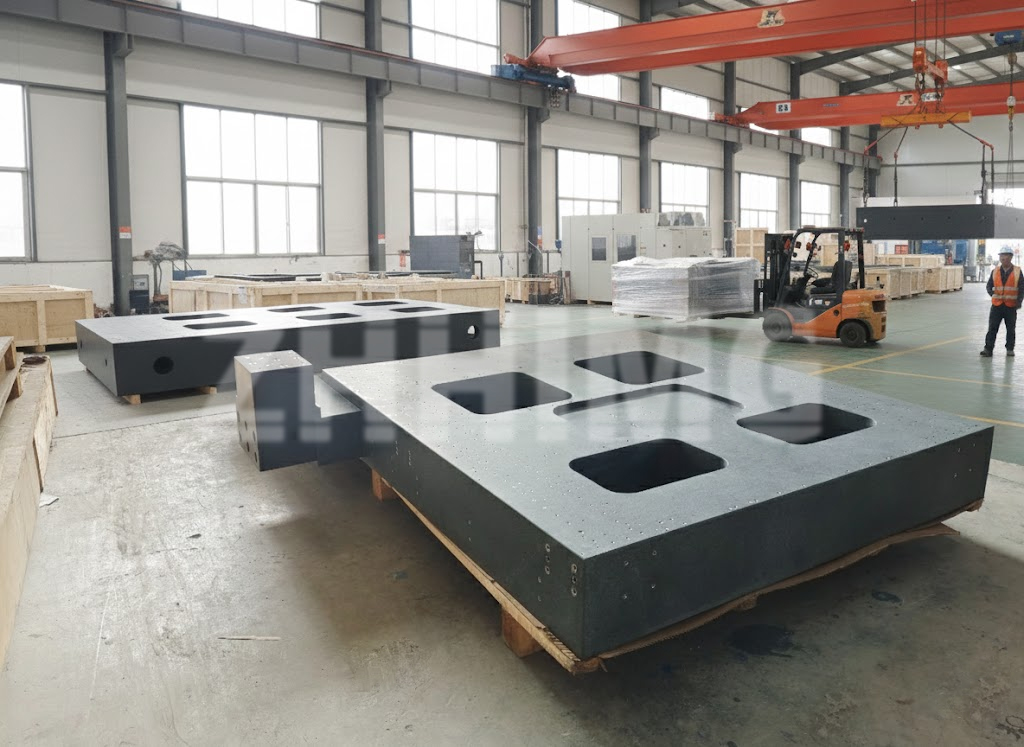
- Granite: Precision granite components can be designed with thicker cross-sections to achieve high stiffness. Because granite is heavier (higher density), it offers excellent static rigidity for its volume.
- Steel: Offers high strength-to-weight ratios, which is beneficial for moving parts, but for a static base, the weight of granite adds to its stability.
6. Magnetic and Electrical Properties
In specific high-tech sectors, magnetism is a dealbreaker.
- Granite: Is completely non-magnetic and electrically insulating. This makes it the only choice for electron microscopes, semiconductor lithography, and magnetic resonance imaging (MRI) component manufacturing.
- Steel: Is ferromagnetic and conductive. In sensitive electronic applications, steel bases can introduce interference or attract metallic dust particles.
7. Integration and Manufacturing Flexibility
Modern manufacturing requires bases that can be customized.
- Granite: Can be precision ground to extreme tolerances (flatness within microns). It allows for the integration of threaded inserts, T-slots, and air bearing surfaces directly into the stone.
- Steel: Welding and machining steel to the same level of flatness often requires stress-relieving cycles and extensive scraping, increasing lead times.
Comparison Summary
| Feature | Granite Base | Steel/Cast Iron Base |
|---|---|---|
| Thermal Expansion | Low (High Stability) | High (Prone to drift) |
| Vibration Damping | Excellent | Moderate |
| Corrosion | Resistant | Prone to Rust |
| Magnetism | Non-magnetic | Magnetic |
| Lead Time | Moderate (Machining) | Variable (Casting/Welding) |
| Cost | Competitive for high precision | Lower for rough duty |
Why ZHHIMG?
Choosing the right foundation is the first step toward precision excellence. At ZHHIMG, we specialize in manufacturing high-performance precision granite components tailored to the rigorous demands of the aerospace, semiconductor, and metrology industries.
From raw material selection to final precision grinding, our process ensures that every granite machine base we deliver offers superior flatness, stability, and longevity.
Ready to upgrade your equipment’s foundation?
Post time: Apr-07-2026