
In the highly competitive sectors of the automobile and aerospace industries, the margin for error has vanished. Whether fabricating lightweight composite panels, machining complex engine parts, or performing critical quality control metrology, accuracy is paramount. The shift toward electrification, advanced material science, and larger component sizes in both industries places immense, non-negotiable demands on manufacturing equipment. Beneath the sophisticated spindles, lasers, and robotic arms, a silent foundation—the machine base—determines the ultimate limit of achievable precision. This is where precision granite for automobile and aerospace industries has become the essential structural element.
The deployment of advanced automation technology machine bed solutions is a defining characteristic of modern aerospace and automotive production lines. These automated systems—including high-speed CNC machines, coordinate measuring machines (CMMs), and specialized additive manufacturing platforms—require a base material that can withstand high dynamic forces, absorb vibrations, and maintain dimensional integrity over vast operational envelopes. This challenging convergence of factors explains the reliance on the specialized granite machine base for automobile and aerospace industries.
Why Granite is Non-Negotiable in High-Accuracy Manufacturing
The fundamental challenge in machining large, expensive, and complex parts for the automobile and aerospace industries is the management of environmental and operational instability. Traditional metallic machine beds often fall short because they are susceptible to thermal drift and dynamic resonance. Granite addresses these issues with its innate material superiority:
1. Managing Thermal Environments: Aerospace components, such as turbine blades, and automotive parts, like transmission casings, are often machined in environments where ambient temperature fluctuations or machine heat generation are unavoidable. Steel and cast iron expand significantly, leading to thermal errors that compound across large work envelopes. The extremely low coefficient of thermal expansion (CTE) of precision granite for automobile and aerospace industries ensures the automation technology machine bed remains dimensionally stable. This thermal consistency is crucial for maintaining the required micron tolerances across parts that can measure several meters in length.
2. Active Vibration Control for Dynamic Stability: High-speed cutting, grinding, or rapid movement in automated metrology generates vibrations that can degrade surface finish and introduce measurement errors. The high internal damping of natural granite efficiently absorbs this mechanical energy. By rapidly dissipating these vibrations, the granite foundation ensures that the cutting tool’s edge or the CMM’s probe remains stable and precisely positioned. This active dampening capability is essential for achieving the mirror finishes and tight geometric tolerances demanded by the automobile and aerospace industries.
3. Ultimate Stiffness for Heavy Loads and Large Spans: Components in these sectors, particularly molds and structural airframe parts, can be massive. The granite machine base for automobile and aerospace industries must provide immense static stiffness to support the heavy payloads without any measurable deflection. Granite’s high Young’s modulus provides the necessary rigidity, ensuring that the critical alignments of the machine’s linear ways and motion axes are maintained across the entire work envelope, preventing sag and ensuring consistent machining depth.
Engineering Integration for Performance
The modern application of granite is a highly engineered process. It involves selecting the optimal grade of black granite, stress-relieving it, and then performing precision machining to integrate the structural component seamlessly into the automated system. The automation technology machine bed is no longer a passive support; it is an active, precision-engineered subsystem:
-
High-Precision Machining: Granite structures are fabricated with meticulously finished surfaces, typically achieving flatness tolerances measured in microns or less, which is vital for mounting linear guide rails and air bearing systems used in high-end automation.
-
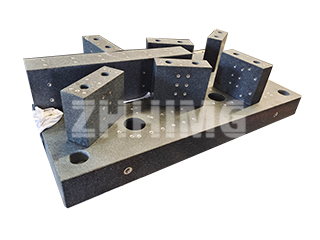
Complex Feature Integration: Features critical to the machine’s operation—including tapped holes for mounting hardware, cored channels for cooling liquids and cables, and metallic inserts—are expertly integrated. This bespoke engineering ensures the granite foundation is tailored exactly to the kinematics and utility requirements of the specific piece of automation technology.
-
Metrology and Quality Control: Given the high value and safety-critical nature of components in the automobile and aerospace industries, the granite structures themselves undergo rigorous quality assurance. Laser interferometer measurements confirm the straightness, flatness, and perpendicularity, certifying that the base provides the necessary foundation for the machine’s stated accuracy.
In summary, as both the automotive and aerospace sectors push the boundaries of design and material application, they require manufacturing equipment that is intrinsically more stable and precise. The strategic choice of a granite machine base for automobile and aerospace industries is a commitment to foundational excellence—a choice that allows sophisticated automation to operate at its peak performance, translating into higher quality, reduced waste, and the production of safer, more advanced vehicles and aircraft.
Post time: Dec-01-2025