
Precision motion components serve as the core units enabling micron and even nanometer-level motion control in high-end equipment. When linear motor slides, motion gantries, optical scanning modules and other parts perform high-speed reciprocating movement, start-stop acceleration, continuous dynamic loads and alternating forces will be generated. To keep motion tracks undeviated and positioning accuracy stable, the base plate supporting these motion components must deliver sufficient rigidity. High-rigidity precision granite mounting plates are load-bearing bases engineered for such dynamic precision working conditions.
Rigidity refers to the material’s ability to resist elastic deformation under force. Many people confuse hardness with rigidity. Hardness describes scratch resistance of the surface, while rigidity determines whether the base plate will experience tiny deflection under thrust and clamping force from motion components. Insufficient rigidity leads to invisible elastic bending every time the motion platform starts or stops. This causes motion errors, fluctuating repeat positioning accuracy and degraded equipment stability.
To boost rigidity, metal base plates have to increase plate thickness or add stiffeners. However, thickened metal parts bring a sharp rise in weight. Metal also suffers from internal stress that causes slow deformation over time and shifts the rigidity benchmark. Stiffener structures carry resonance risks; high-speed operation of motion components may excite base plate resonance and amplify vibration interference. Granite features excellent elastic modulus and inherent high rigidity. No extra welded reinforcement is required. A one-piece formed granite mounting plate can steadily support complete precision motion units. The continuous monolithic structure has no weak rigidity points from welded seams, resulting in minimal deformation under load.
In dynamic load scenarios, rigidity needs to work alongside damping properties. Impact vibration generated during start and stop of precision motion components transfers directly to the base plate. High-rigidity granite base plates resist deflection through high modulus. Meanwhile, their crystalline structure offers superior damping to rapidly absorb vibration energy from motion and suppress sustained oscillation. Compared with metal bases, granite dissipates vibration faster. Vibrations do not linger on the plate, so motion components can quickly stabilize after each positioning action and guarantee consistent scanning, inspection and machining performance.
Uniform rigidity across the base plate is equally important. Motion components often travel across a wide area. If rigidity varies at different positions of the base plate, the motion platform will produce different minor deformations at different locations, causing inconsistent accuracy over the full travel range. The monolithic granite mounting plate has homogeneous material and continuously stable rigidity distribution. No matter which area the motion component moves to, bearing deformation remains within a controllable range. This advantage of uniform rigidity becomes more prominent for large-span equipment such as multi-axis gantries and long-stroke linear motor platforms. 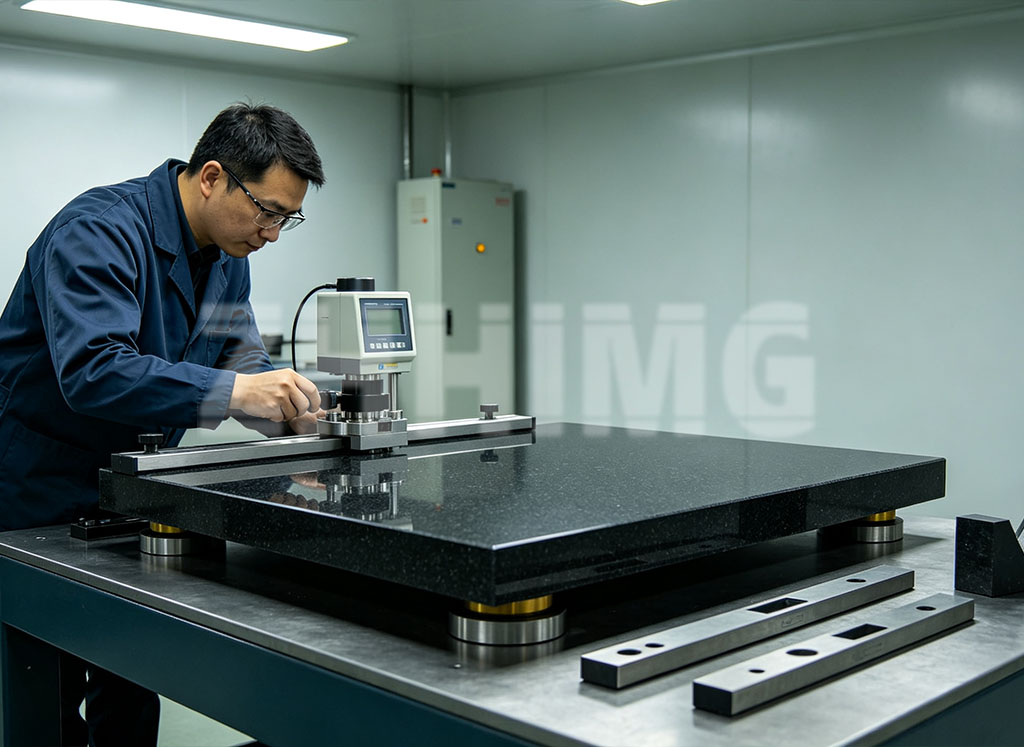
The rigidity design of the base plate requires comprehensive evaluation in advance based on the weight, maximum thrust and travel range of motion components. Granite mounting plates with customized thickness and profile are made according to the dynamic load of equipment. Mounting points are arranged reasonably to avoid local stress concentration. With precisely machined mounting holes, motion modules can be firmly fastened to the plate surface. Clamping force spreads evenly across the whole stone without local compression deformation, maintaining consistent load-bearing performance during long continuous operation.
In conclusion, high-rigidity precision granite mounting plates are not merely static holders for components. They form the mechanical foundation of precision motion systems. With outstanding elastic modulus, uniform overall rigidity and good vibration damping capacity, they firmly support precision motion components, resist deflection caused by dynamic loads and suppress vibration interference. They ensure stable equipment positioning during long-cycle high-speed movement and deliver reliable load-bearing support for motion systems in semiconductor, laser processing and precision inspection equipment.
Post time: Sep-30-2026