
In high-precision photonics research, mechanical stability is no longer a secondary consideration—it is a defining performance factor. As laboratories across North America and Europe push toward sub-micron alignment tolerances and nanometer-scale measurement repeatability, the demand for custom granite for photonics R&D lab applications has grown rapidly.
At ZHHIMG, part of the UNPARALLELED Group, we are observing a clear shift: research institutions and OEM innovators are moving away from conventional welded steel frames and aluminum structures, turning instead to engineered granite base with kinematic mounting points to ensure long-term dimensional stability and thermal equilibrium. This evolution reflects not only tighter technical requirements but also a deeper understanding of how structural materials influence optical and metrology system performance.
The Structural Challenge in Modern Photonics Laboratories
Photonics R&D environments—particularly those focused on laser systems, interferometry, semiconductor inspection, and optical metrology—require platforms that maintain geometric integrity under dynamic and thermal loads. Even minor material deformation can introduce alignment drift, measurement error, and long-term calibration instability.
Traditional metal frames offer machinability and modularity, but they present three inherent limitations:
• Higher thermal expansion coefficients
• Residual stress from welding or machining
• Susceptibility to vibration transmission
In contrast, precision granite bases provide a naturally aged, stress-relieved structure with superior vibration damping characteristics. For laboratories performing high-resolution beam alignment or optical path stabilization, this translates directly into improved repeatability and reduced recalibration frequency.
The growing search volume in the U.S., Germany, and the U.K. for terms such as “custom granite optical base,” “granite base with kinematic mounting points,” and “granite platform for laser system” confirms this industry trend.
Why Granite Is Replacing Metal in Optical and Laser Platforms
Granite has long been used in metrology equipment due to its stability and wear resistance. However, its role in photonics R&D is now expanding beyond surface plates and straight edges.
The advantages are structural and measurable:
Low coefficient of thermal expansion
High compressive strength
Excellent vibration damping
Non-magnetic and corrosion resistant
Long-term dimensional stability
For photonics laboratories operating temperature-controlled cleanrooms, granite provides a thermally inert foundation that minimizes distortion caused by localized heat from laser modules or electronic assemblies.
Furthermore, custom granite for photonics R&D lab environments can be manufactured with embedded threaded inserts, precision-ground reference surfaces, air-bearing interfaces, and complex 3D geometries—making granite no longer just a passive base, but an integrated structural platform.
The Engineering Logic Behind Kinematic Mounting Points
The integration of kinematic mounting points into granite bases represents a significant design advancement.
Kinematic mounts are based on deterministic constraint principles. Instead of over-constraining a system—which can induce internal stress and distortion—kinematic interfaces restrict exactly six degrees of freedom using defined contact geometries such as sphere-cone, sphere-groove, and sphere-flat configurations.
When incorporated into a granite base with kinematic mounting points, this approach provides:
Precise and repeatable positioning
Rapid module interchangeability
Elimination of mounting-induced stress
Controlled mechanical referencing
For photonics R&D laboratories that frequently reconfigure optical assemblies, kinematic integration allows researchers to remove and reinstall modules without losing alignment baselines.
This methodology is increasingly specified in advanced laser research centers and semiconductor equipment development facilities across Europe and the United States.
Customization for High-Precision Research Environments
No two photonics labs share identical structural requirements. Research objectives, environmental controls, payload distributions, and integration interfaces vary significantly.
ZHHIMG engineers work closely with optical system designers to define:
Load distribution modeling
Granite thickness optimization
Mounting interface tolerances
Insert material compatibility
Flatness and parallelism grades
Cleanroom surface finishing
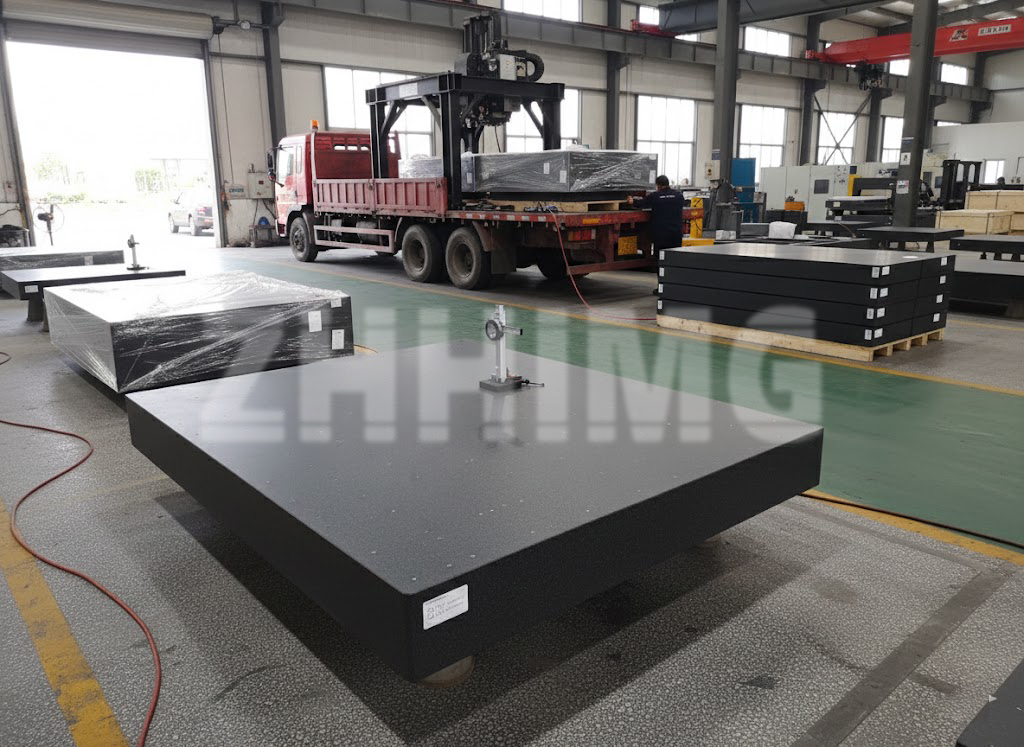
Our high-density black granite, manufactured in Jinan under controlled environmental conditions, delivers enhanced physical properties compared to marble or lower-grade stone materials. Through precision grinding and lapping processes, flatness accuracy can reach Grade 0 or higher according to international metrology standards.
For projects requiring dynamic isolation, granite bases can also be integrated with air bearing systems or vibration isolation modules, forming a complete structural solution.
Application Case Insight: Laser Alignment Platform Upgrade
A European laser equipment developer recently transitioned from a fabricated steel base to a custom granite base with kinematic mounting points for their next-generation beam shaping system.
The results were measurable:
Reduced alignment drift during thermal cycling
Improved repeatability after module replacement
Lower vibration transmission from surrounding equipment
Extended recalibration intervals
The project demonstrated how structural material selection directly impacts optical system reliability. By implementing deterministic kinematic interfaces embedded into the granite structure, the client achieved modular flexibility without sacrificing geometric precision.
This case reflects a broader pattern across aerospace photonics, semiconductor inspection platforms, and ultra-precision measurement systems.
Manufacturing Capabilities Supporting Advanced R&D
Producing a granite base for photonics R&D lab applications requires more than raw material selection. It demands process control.
At ZHHIMG’s advanced manufacturing facility, we implement:
Environmental temperature control during grinding
Multi-axis CNC machining for insert cavities
Precision lapping for reference surfaces
Strict ISO-based inspection protocols
Laser interferometer flatness verification
Our organization holds ISO9001, ISO14001, and ISO45001 certifications, ensuring consistent quality management and environmental compliance. These standards are particularly relevant for clients operating in regulated industries such as semiconductor fabrication and aerospace research.
The integration of mineral casting, ceramic components, and precision metal machining further enables us to deliver hybrid structures when required.
Industry Outlook: Stability as a Competitive Advantage
As photonics technologies expand into quantum research, advanced semiconductor lithography, and autonomous sensing systems, mechanical precision becomes increasingly foundational.
Laboratories can no longer afford micro-level drift in platforms supporting nanometer-level optical measurements. Structural stability is evolving from a background consideration into a strategic investment.
Search trends across the U.S. and European markets indicate growing awareness of terms like “precision granite base for optical systems” and “custom granite platform for metrology lab.” This suggests that procurement teams and research engineers are actively seeking more stable alternatives to conventional metal frames.
Granite, particularly when combined with kinematic mounting strategies, addresses this demand directly.
Building the Foundation for Next-Generation Photonics
The transition toward custom granite for photonics R&D lab infrastructure reflects a broader engineering philosophy: eliminate structural uncertainty to unlock measurement certainty.
By combining natural material stability with deterministic mechanical design, granite base with kinematic mounting points systems provide:
Long-term geometric integrity
Thermal neutrality
Repeatable module integration
Reduced vibration sensitivity
Improved system lifecycle performance
For research institutions, equipment manufacturers, and advanced laboratories, the structural base is no longer just a support element—it is a precision component in its own right.
As photonics systems continue to shrink tolerances and expand capabilities, the question facing modern laboratories is no longer whether granite platforms are beneficial, but how quickly they should be integrated into next-generation designs.
For organizations committed to ultra-precision engineering, the answer increasingly begins with the right foundation.
Post time: Mar-04-2026