
In modern photonics and astronomical instrumentation, structural stability is more than just a supporting requirement—it is a critical determinant of system performance. Femtosecond lasers, with their ultrashort pulse durations and high peak powers, and large telescope mirrors, requiring sub-micron optical alignment, demand platforms that minimize vibration, thermal drift, and long-term deformation. Increasingly, engineers and research institutions in North America and Europe are turning to vibration-isolated granite for femtosecond laser systems and granite foundations for telescope mirror support.
This trend reflects the convergence of material science, ultra-precision manufacturing, and metrology-grade engineering, highlighting the role of granite not just as a base, but as a performance-critical structural component.
The Precision Challenge in Femtosecond Laser Applications
Femtosecond lasers are widely used in microfabrication, precision spectroscopy, biomedical imaging, and nonlinear optics. These applications are sensitive to even nanometer-level positional deviations. A micro-vibration or thermal expansion in the laser platform can cause beam misalignment, pulse timing errors, and reduced process repeatability.
Traditional metal optical tables, though flexible and machinable, introduce three main limitations:
• High thermal expansion coefficients
• Vibration transmission from environmental sources
• Internal stresses from welding or assembly
Granite, in contrast, provides natural damping, high compressive strength, and long-term dimensional stability. By incorporating vibration isolation systems with granite bases, laboratories can achieve both static precision and dynamic damping, reducing laser beam drift during operation.
Search trends in the U.S., Germany, and the U.K. indicate increasing online queries for “vibration-isolated granite laser base” and “precision granite optical platform,” demonstrating heightened awareness of these requirements among photonics engineers and procurement teams.
Granite Foundations in Telescope Mirror Support
Large-aperture telescope mirrors, whether in astronomical observatories or research labs, require rigid and vibration-free mounting to maintain optical alignment and image fidelity. Even slight structural deformation can induce aberrations that limit resolution, especially in adaptive optics systems.
Granite foundations provide:
Low thermal expansion for consistent optical alignment
High rigidity to support mirror weight without sagging
Excellent vibration damping to isolate environmental disturbances
Non-magnetic properties to prevent interference with sensitive instruments
ZHHIMG has successfully supplied granite foundations for telescope mirror supports, incorporating precision leveling surfaces, kinematic mounting points, and optional integration with active vibration isolation systems. These solutions allow astronomers and engineers to maintain mirror position with sub-micron repeatability over long operational cycles.
Integration of Vibration Isolation Systems
The combination of granite structural stability and engineered vibration isolation offers measurable performance benefits. In laser laboratories, vibration-isolated granite tables often incorporate:
Air-bearing mounts or pneumatic isolation legs
Low-frequency dampers for seismic or floor-borne vibrations
Kinematic mounting points for modular optical components
Optimized mass distribution for resonance suppression
This integration ensures that femtosecond laser systems maintain pulse-to-pulse consistency and alignment stability during extended experimental runs. For telescopes, similar principles reduce image blur caused by micro-vibrations, supporting higher-resolution imaging and spectroscopy.
Customization for Advanced Applications
Each femtosecond laser or telescope system has unique structural and environmental requirements. Factors such as payload weight, thermal load, room layout, and motion stage integration influence granite base design.
ZHHIMG engineers collaborate closely with clients to deliver:
Granite thickness and density optimized for load and vibration control
Precision-ground reference surfaces for kinematic or optical mounts
Integration channels for air bearings or active isolation devices
Surface flatness and parallelism to international metrology standards
Environmental compatibility for cleanrooms or observatories
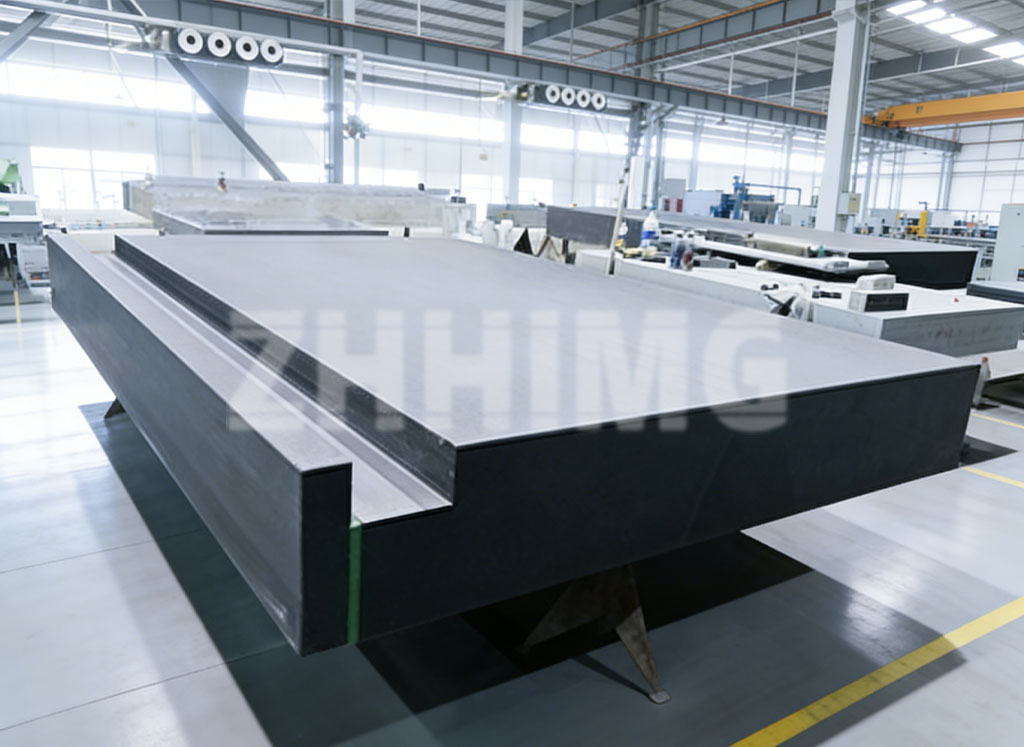
Our high-density black granite, produced in controlled Jinan facilities, offers superior hardness, low porosity, and long-term dimensional stability. Combined with precision lapping and CNC machining, flatness and surface finish can meet the strictest tolerances required in optical and photonics research.
Case Insight: Enhancing Femtosecond Laser Performance
A European research laboratory recently upgraded its femtosecond laser system from a conventional steel optical table to a vibration-isolated granite platform.
The measurable outcomes included:
Significantly reduced beam drift under thermal cycling
Lower noise levels from floor-borne vibrations
Improved repeatability in automated alignment routines
Extended operational stability over multi-hour experiments
These improvements directly translated to higher throughput, better experimental reproducibility, and longer intervals between recalibrations. The adoption of granite with integrated isolation demonstrates the critical role of structural material selection in high-performance laser systems.
Case Insight: Supporting Telescope Mirror Stability
In an astronomical observatory, a large primary mirror required replacement of its existing support frame due to micro-sag and alignment drift. ZHHIMG provided a granite foundation precisely milled to sub-micron flatness, with integrated kinematic mounts and optional active damping channels.
Post-installation, the telescope exhibited:
Improved image clarity at long exposure times
Reduced vibration transmission from building HVAC and foot traffic
Stable mirror positioning through diurnal temperature cycles
Enhanced adaptability for modular instrumentation
This case underscores the strategic value of granite as both a load-bearing and vibration-mitigating material in sensitive optical systems.
Manufacturing and Quality Assurance
Creating vibration-isolated granite platforms for femtosecond lasers or telescope mirrors requires meticulous process control:
Environmental temperature and humidity regulation during grinding and lapping
Multi-axis CNC machining for inserts and mounting cavities
Laser interferometry for flatness verification
Surface roughness and micro-topography inspection
ISO9001, ISO14001, and ISO45001 certified quality management systems
ZHHIMG’s integrated capabilities in mineral casting, ceramic components, and high-precision metal machining allow hybrid solutions when necessary, further enhancing platform performance for specialized applications.
Industry Outlook: Granite as a Strategic Component
The increasing demand for femtosecond laser systems and high-resolution telescope mirrors underscores the importance of structural platform optimization. As precision requirements tighten, the mechanical base becomes a strategic factor, not merely a support element.
Granite’s inherent stability, combined with engineered vibration isolation and precision surface finishing, positions it as the preferred foundation for cutting-edge optical research. Online search trends confirm growing interest in “vibration-isolated granite for femtosecond laser” and “granite foundation for telescope mirror support,” signaling a market shift toward high-performance structural materials.
Conclusion: Building Precision from the Ground Up
In high-stakes optical applications, performance is cumulative. From femtosecond laser pulse fidelity to telescope image resolution, every nanometer of structural stability matters.
By integrating vibration-isolated granite for femtosecond laser systems and granite foundations for telescope mirrors, research institutions and OEMs gain:
Reduced vibration and thermal drift
Long-term dimensional stability
Modular, kinematic mounting for flexible system upgrades
Improved repeatability and operational reliability
The future of precision photonics and astronomical research begins with a stable foundation. Granite, carefully engineered and vibration-isolated, ensures that every optical system reaches its full potential.
Post time: Mar-04-2026