
Purchasing a precision granite surface plate is not simply a matter of selecting a size and tolerance grade. For many engineers, quality managers, and procurement professionals, the real challenge lies in verifying whether the claimed accuracy of a granite platform genuinely meets technical requirements. In high-precision manufacturing, metrology, and semiconductor-related industries, the granite surface plate often serves as the fundamental reference. If its accuracy is uncertain, every subsequent measurement or assembly process becomes questionable.
Accuracy in a precision granite surface plate is not an abstract concept. It is defined, measured, and verified through recognized standards and traceable inspection methods. When evaluating a supplier’s claims, buyers should focus less on marketing language and more on objective evidence that demonstrates how the platform was measured, under what conditions, and with which instruments.
The most important indicator of whether a granite precision platform meets accuracy requirements is its flatness inspection report. This document should clearly state the measured flatness value, the measurement method used, the reference standard applied, and the environmental conditions during inspection. Flatness values without context offer little technical meaning. A credible report specifies whether the platform complies with internationally recognized standards such as DIN, ASME, JIS, or equivalent national specifications. These standards define not only acceptable flatness limits but also how measurements must be performed to ensure consistency and comparability.
Equally critical is traceability. A reliable inspection report should confirm that the measuring instruments used are calibrated and traceable to a national or internationally recognized metrology institute. This traceability ensures that the reported accuracy is not subjective or internally defined by the manufacturer. Without traceable calibration, even advanced measuring equipment cannot guarantee reliable results. For buyers, this distinction separates true precision from unverified claims.
Environmental conditions documented in the inspection report are another essential factor often overlooked during procurement. Precision granite measurements are highly sensitive to temperature gradients, humidity, and vibration. A valid report typically records ambient temperature, thermal stability during measurement, and support conditions of the surface plate. If these parameters are missing, the reported flatness may not reflect real-world performance once the platform is installed in an industrial or laboratory environment.
Beyond flatness, buyers should pay attention to geometry-related inspection results. Parallelism, squareness, and straightness are particularly relevant for granite platforms used in equipment assembly, coordinate measuring machines, or linear motion systems. These characteristics influence how well the granite surface plate integrates with guideways, air bearings, or precision stages. Inspection reports that include only flatness but omit other geometric parameters may be insufficient for advanced applications.
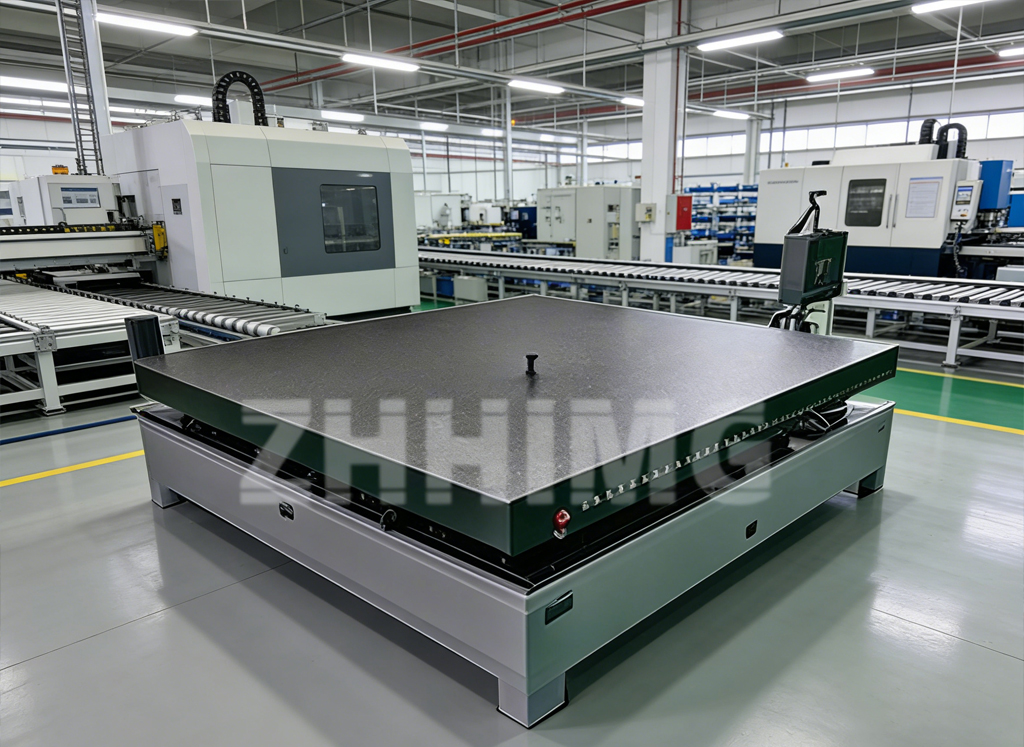
Material certification also plays an important role in assessing accuracy reliability. A proper material report confirms the type of granite used, its density, and its physical properties. High-density black granite with a fine-grain structure demonstrates better long-term dimensional stability and vibration damping. Without material documentation, buyers cannot be certain whether the platform is made from genuine precision-grade granite or a lower-grade stone that may initially pass inspection but degrade faster over time.
Another aspect worth considering is the inspection methodology itself. Advanced measurement techniques, such as laser interferometry or electronic level mapping, provide higher confidence than basic mechanical methods alone. Inspection reports that describe the measurement grid, sampling density, and data processing approach offer greater transparency. This level of detail indicates that the manufacturer understands precision measurement as a system, not a one-time check.
For buyers sourcing granite precision platforms for demanding environments, third-party inspection reports can further strengthen confidence. Independent verification by accredited metrology institutions or certified laboratories provides an additional layer of assurance, especially for critical applications. While not always mandatory, third-party validation reduces procurement risk and supports long-term quality control strategies.
It is also important to recognize that accuracy compliance is not limited to delivery inspection. A trustworthy supplier provides guidance on recalibration intervals and long-term verification practices. Precision granite surface plates are reference tools, and their accuracy should be periodically confirmed throughout their service life. Documentation that supports future calibration helps buyers maintain consistent measurement standards rather than treating accuracy as a one-time requirement.
Ultimately, judging whether a granite precision platform meets accuracy requirements requires a comprehensive view of inspection data, traceability, measurement conditions, and material quality. Procurement decisions based solely on nominal tolerance grades or price comparisons often overlook these critical details. By carefully reviewing inspection reports and understanding what they truly represent, buyers can ensure that the granite platform they select will serve as a reliable and stable reference in precision applications.
In industries where microns matter and long-term consistency defines quality, verification is not an administrative step. It is the foundation of trust between design intent, manufacturing reality, and measurement integrity.
Post time: Dec-15-2025