
In the manufacturing world, success is increasingly defined by the ability to achieve and maintain extreme precision. This foundational requirement transcends industry lines, linking the high-stakes sectors of the automobile and aerospace industries with the nanoscale demands of the semiconductor and solar industries. While their end products vary wildly—from massive aircraft components to microscopic silicon wafers—they share a critical reliance on machine stability. The common denominator enabling this shared pursuit of ultra-accuracy is the specialized use of precision granite, specifically in the form of granite mechanical components for automobile and aerospace industries and monolithic machine structures.
This specialized material is not merely a support; it is an engineered solution that actively mitigates the physical limitations of temperature fluctuation, vibration, and material instability that plague high-speed and high-precision manufacturing.
The Foundation of Accuracy: Granite Across Diverse Industries
The need for a structurally superior machine base is universal in advanced manufacturing. The properties that make granite ideal for one precision task often translate directly to another, demonstrating its versatile utility across diverse technical landscapes.
1. Driving Precision in Automobile and Aerospace
In the automobile and aerospace industries, components are characterized by their size, complexity, and the stringent safety standards they must meet. Machining large engine blocks, fabricating composite wing structures, or performing quality inspection on large metal castings requires a base that cannot deflect or distort.
-
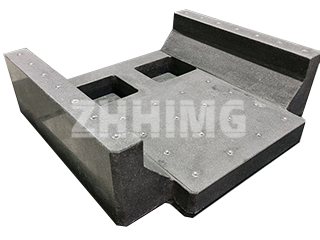
Granite Machine Bed for automobile and aerospace industries: The sheer size of many components in these sectors demands an equally large and stiff machine base. A granite machine bed for automobile and aerospace industries provides the necessary static stiffness to support multi-ton gantries and high-torque spindles without deformation. This rigidity ensures the geometric accuracy of the final part, critical for safety-related components.
-
Granite Mechanical Components for automobile and aerospace industries: Beyond the primary bed, granite is used to create specific granite machine parts for automobile and aerospace industries, such as large metrology tables, straight edges, and air-bearing guide rails. These components exploit granite’s thermal stability and flatness to guarantee that complex multi-axis measurements and machining operations are performed from an unmoving, thermally consistent reference plane.
2. The Nanoscale Backbone for Semiconductor and Solar
The semiconductor and solar industries face an even more extreme challenge: achieving precision at the nanometer scale. Wafer processing, thin-film deposition, and panel inspection are profoundly sensitive to the smallest external disturbances.
-
Vibration Control: In semiconductor lithography and metrology, external vibrations can cause placement errors measured in a fraction of a wavelength of light. Granite’s high internal damping capability is indispensable here. The material quickly absorbs the mechanical energy from internal motors and external building noise, ensuring the machine’s critical optics and stages are motionless during crucial operations.
-
Thermal Consistency: For both wafer and solar panel manufacturing, maintaining consistent thermal conditions across large substrates is critical for process uniformity. Granite’s low coefficient of thermal expansion (CTE) ensures that the machine bases holding these large, sensitive stages do not change dimensionally as the process temperature fluctuates, minimizing thermal-induced defects.
Engineering Beyond the Block: The Manufacturing Advantage
The successful application of granite relies heavily on advanced engineering and manufacturing techniques. It is the combination of the natural material’s properties with human precision that unlocks its true potential.
-
Custom Machining and Integration: Granite machine parts for automobile and aerospace industries are not simply cut; they are meticulously lapped and polished to achieve surface flatness tolerances that are far superior to those possible with metals. Furthermore, features such as threaded inserts, internal plumbing channels, and bonding points for linear motors are engineered directly into the granite, creating a seamless, high-performance mechanical component.
-
Material Selection and Certification: Not all granite is created equal. High-precision applications demand fine-grained black granite (such as diabase) for its superior density, damping, and low porosity. Suppliers must certify the material’s physical properties to guarantee consistency and reliability across complex projects in the semiconductor and solar industries.
In conclusion, the shared quest for micron and nanometer precision across the automobile and aerospace industries and the semiconductor and solar industries is fundamentally enabled by a single material: high-quality engineered granite. Whether it is a massive granite machine bed for automobile and aerospace industries supporting a five-axis mill, or finely crafted granite mechanical components for automobile and aerospace industries stabilizing a wafer stepper, this natural material provides the unwavering, thermally stable, and vibration-free foundation that allows modern AUTOMATION TECHNOLOGY to perform at its theoretical peak.
Post time: Dec-01-2025