
The quest for absolute precision in modern manufacturing has reached a point where even the most advanced electronic sensors are only as reliable as the ground they stand on. As global industries move toward sub-micron tolerances, the conversation among engineers in Europe and North America has shifted from the software of measurement to the fundamental hardware of stability. At the center of this shift is a material that has existed for millennia but is now being re-engineered for the future: natural granite.
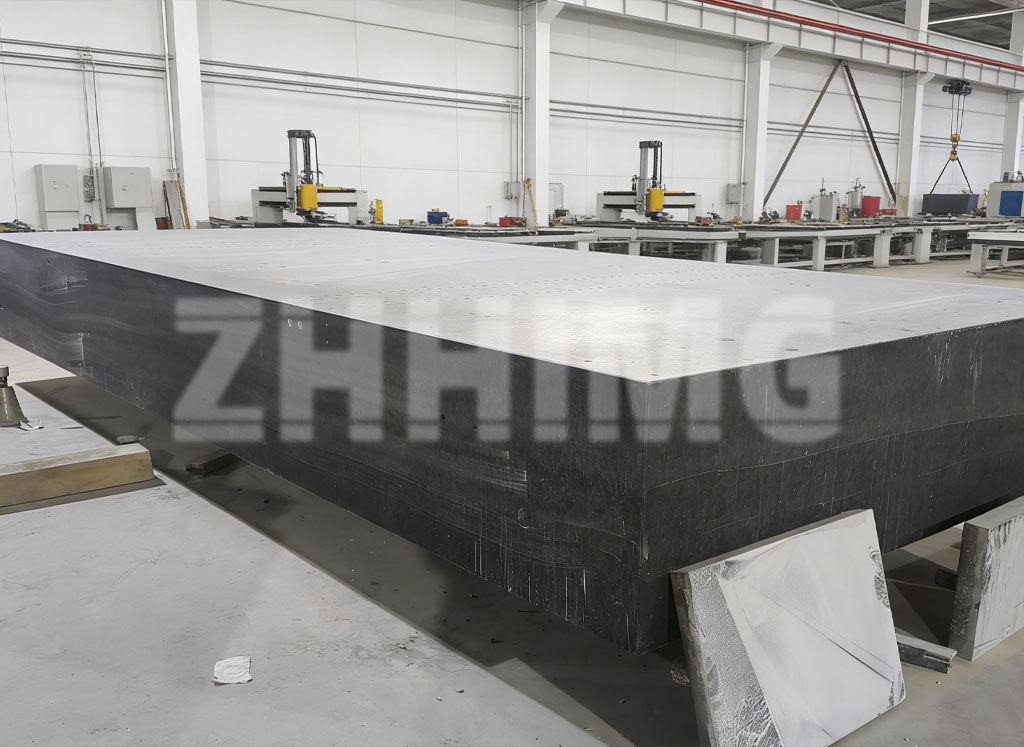
For decades, the standard for heavy machine bases was cast iron or steel. However, as the semiconductor, aerospace, and medical device sectors demand higher throughput and finer accuracy, the limitations of metal—specifically its thermal expansion and lack of damping—have become bottlenecks. This is why a Machine Base in Natural Granite is no longer seen as a traditional choice, but as a high-performance necessity for vibration-resistant environments.
The Inherent Physics of Vibration Resistance
One of the most significant challenges in high-speed metrology is the management of resonance. In a high-precision lab, vibrations are the enemy of accuracy. These can originate from internal motor movements, the cooling systems of the machines, or even external factors like heavy traffic outside the facility. A machine base in natural granite provides a level of vibration resistance that synthetic or metallic materials struggle to match.
Granite’s dense, heterogeneous crystalline structure naturally dissipates kinetic energy. When a measurement probe moves rapidly across a surface, the resulting micro-vibrations are absorbed by the granite mass, ensuring that the sensor’s readings remain clean and noise-free. This damping effect is critical for industries utilizing high-resolution optical systems or laser interferometers, where even a nanometer of oscillation can lead to a failed quality check.
The Critical Importance of NIST Traceable Flatness
For ZHHIMG’s partners in the United States and across the European Union, precision is not just a claim—it must be a certified fact. When discussing Metrology Granite Platforms, the term “flatness” is often used loosely, but in a professional laboratory context, it requires a rigorous adherence to global standards. This is where NIST traceable flatness becomes the dividing line between a generic stone slab and a professional-grade engineering component.
Achieving a surface that remains flat within a few millionths of an inch requires a combination of high-grade raw materials and masterful craftsmanship. ZHHIMG utilizes advanced hand-lapping techniques, a process that cannot be fully replicated by machines alone. By verifying every platform with laser interferometry and ensuring that the calibration is NIST traceable, we provide our clients with the documented proof required for their ISO certifications and government-level contracts. This traceability ensures that a measurement taken in a lab in California or Germany will be consistent with the data generated at our production facility.
Why Natural Granite Outperforms Synthetic Alternatives
In recent years, “mineral casting” or “epoxy granite” has gained popularity as a cost-effective alternative. While these materials have their place in general machining, they often fall short in the most demanding metrology applications. Natural granite, particularly the Jinan Black Granite used by ZHHIMG, offers a level of dimensional stability that synthetic composites cannot guarantee over long periods.
Synthetic bases are subject to chemical aging and potential degassing, which can lead to microscopic structural changes over several years. Natural granite, having been formed over millions of years under intense pressure, is geographically “at rest.” It does not internalize stresses that could lead to warping or twisting. Furthermore, granite is naturally resistant to corrosion and does not require the expensive rust-prevention coatings that cast iron necessitates. This makes it the ideal material for cleanroom environments where chemical outgassing or oil contamination could ruin a production run of silicon wafers or optical lenses.
Customization and Engineering for the Future
The modern inspection lab is a space of integration. A Machine Base in Natural Granite is rarely just a flat table today; it is a complex assembly featuring integrated air bearings, vacuum channels, and precision-threaded inserts. ZHHIMG has recognized that to support the Western market effectively, we must act as more than just a supplier. We are an engineering partner capable of translating complex CAD designs into functional granite structures.
Our ability to produce custom-sized metrology platforms allows engineers to design their systems from the ground up without being constrained by standard catalog sizes. Whether it is a base for a large-format CMM or a specialized platform for satellite component testing, the focus remains on the marriage of geological stability and mechanical precision.
Setting the Global Standard in Metrology
As we look toward the next decade of manufacturing, the role of material science will only grow. The stability of a vibration-resistant granite base is the silent partner in every breakthrough in nanotechnology and micro-electronics. By maintaining a focus on high-density natural stone and adhering to the strictest calibration standards, ZHHIMG continues to provide the foundation upon which the world’s most accurate measurements are made.
The transition to granite is not merely a change in material; it is an investment in the longevity and reliability of a brand’s quality control process. In a world where “near enough” is no longer good enough, the natural choice remains the most precise one.
Post time: Feb-28-2026