
Modern precision machinery is shifting toward modular reconstruction: equipment developers split bulky monolithic cast‑iron frames into interchangeable sub‑modules to shorten assembly cycles, simplify on‑site integration and support future function iteration. Yet most modular refacing projects face a tough trade‑off: lightweight reform often sacrifices structural rigidity and dynamic stability, while heavy‑weight modules raise transportation, installation and foundation‑loading costs. ZHHIMG explores how engineered granite structural modules resolve this contradiction, enabling real lightweight upgrading without compromising the core performance of re‑modularized precision machines.
Traditional modular transformation mostly sticks to metal‑based schemes. Steel or cast‑iron sub‑units reduce weight by wall‑thinning, which easily brings resonance risk and thermal sensitivity. When equipment is split into multiple assembled modules, tiny thermal expansion gaps or micro‑vibration transmission between joints will accumulate and turn into positioning errors. This creates a bottleneck for semiconductor platforms, ultrafast laser devices and high‑speed inspection machinery. Granite‑based modular components provide a different technical path for such renovation and new‑build projects.
Material‑level advantage: high specific stiffness reshapes modular weight‑stiffness balance
Unlike cast iron with high absolute density, ZHHIMG‑selected black granite delivers superior specific stiffness. Even with optimized hollow‑out and rib‑structured modular geometry, it maintains anti‑deformation capacity, cutting overall module mass compared with conventional metal frames of equal rigidity. Such material properties lay the physical foundation for lightweight modular upgrading.
Many manufacturers confuse lightweight with low rigidity and adopt inferior marble for cost‑saving modular blocks. Those substitutes suffer from poor internal compactness; under cyclic dynamic load from linear‑motor motion, local creep and gradual geometry shift will occur. ZHHIMG sticks to high‑density black granite at 3100 kg/m³, strictly filtering raw stone and eliminating low‑grade alternatives. Each modular granite block goes through long‑term natural aging to remove residual stress, preventing slow deformation after multi‑module assembly.
Modular interface pre‑machining: reduce on‑site workload while retaining assembly repeatability
A core difficulty of modular transformation lies in joint interfaces. For metal modules, flatness, pin‑hole position and threaded holes are finished after frame welding, introducing processing stress. Once disassembled and reassembled, relative position accuracy drifts. ZHHIMG completes all reference surfaces, embedding thread sleeves, positioning pin holes and mounting datum directly on granite modules inside its temperature‑controlled shock‑absorbing workshop. Every sub‑module leaves the factory with finished‑state interfaces, ready for direct bolt‑on combination.
This pre‑fabricated interface strategy supports equipment disassembly‑reassembly for layout adjustment or function expansion. Machine builders can recombine base blocks, cross‑beam segments and column units to reconfigure travel range, without re‑grinding key reference planes on‑site. It lowers on‑site modification workload and avoids accuracy loss caused by field manual processing, which is critical for upgraded modular production lines.
Vibration‑damping modular grouping: suppress error accumulation across multi‑unit joints
When precision equipment is split into several modules, vibration will transfer through connecting joints. Even if each single module behaves well, resonance superposition between units will hurt dynamic performance. Granite’s intrinsic high damping property becomes a key advantage here. ZHHIMG‑manufactured granite sub‑modules absorb micro‑shock inside each unit, restraining vibration propagation across bolted joints.
During custom development, the engineering team carries out modal evaluation for combined‑module layouts. According to customers’ modular‑split schemes, they optimize block dimension and joint distribution, avoiding overlapping resonance frequencies after assembly. Compared with thin‑welded metal modular frames, granite‑module groups obtain better dynamic stability under lighter overall weight, which benefits high‑speed motion systems such as XY linear‑motor stages and optical inspection frames. 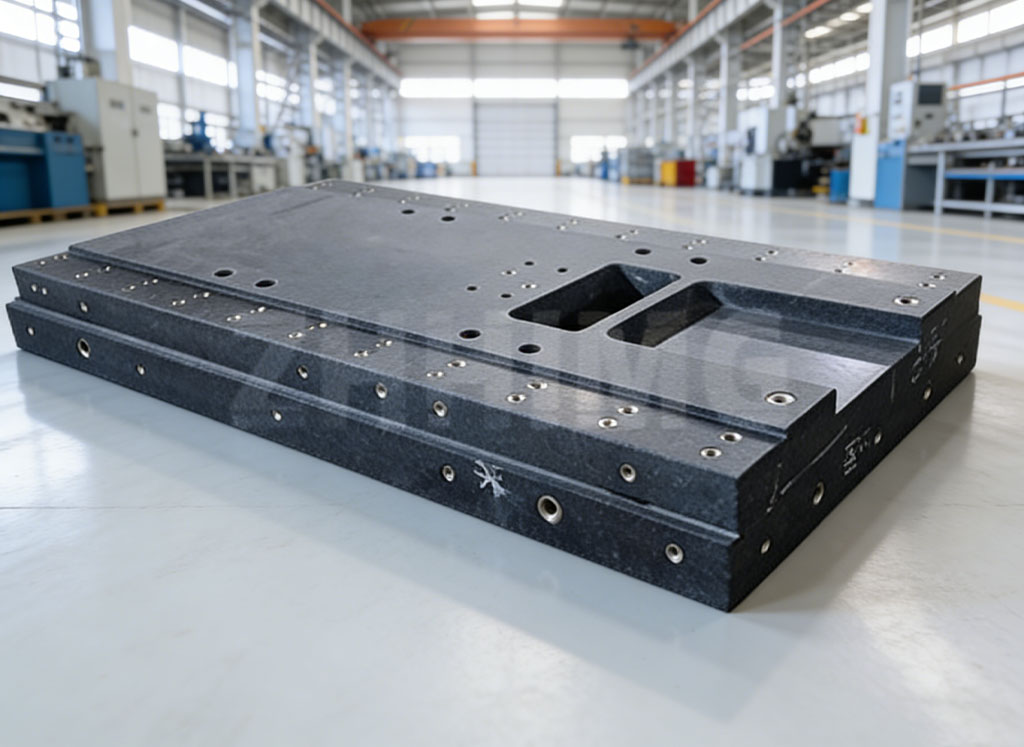
Adaptable mixed‑material modular design: hybrid assembly for complex upgrading demands
Modular transformation projects rarely adopt 100 % granite structures. More real‑world cases use hybrid‑modular solutions: granite undertakes high‑precision datum modules, while lightweight metal or carbon‑fiber beams undertake auxiliary moving‑parts. ZHHIMG supplies matching granite base‑modules, support‑columns and air‑bearing mounting substrates, cooperating with customers’ own carbon‑fiber or metal sub‑units.
The factory’s large‑scale processing capability allows single‑piece granite‑module dimensions up to 20 m length. Meanwhile, the metrology team verifies mating‑surface accuracy with Renishaw laser interferometers and WYLER electronic levels. All modules come with traceable calibration certificates. This mixed‑material modular approach helps integrators reach target weight reduction, without forcing them to switch all structural components to one single material.
Practical values for equipment lifecycle: transport, installation and iterative upgrade
Lightweight modular granite units bring tangible engineering benefits. Segmented granite modules reduce single‑unit weight, lowering requirements for factory lifting gear, container shipping and on‑site hoisting. End‑users no longer need special heavy‑duty foundation reconstruction for equipment renovation. When product lines update later, partial‑module replacement becomes feasible, instead of scrapping the whole machine frame. It extends equipment service life and cuts overall upgrade investment.
This solution gains recognition in semiconductor assembly equipment, perovskite coating platforms, industrial CT frames and precision laser processing machinery. Many global partners leverage granite‑modular schemes to realize equipment reconstruction and lightweight‑oriented iteration.
Following its quality philosophy that precision manufacturing tolerates no excessive compromise, ZHHIMG keeps optimizing granite modular‑interface technology. The company provides simulation‑aided custom modular components for system integrators, supporting the global trend toward reconfigurable, upgradable ultra‑precision equipment.
Post time: Aug-12-2026