
In modern manufacturing, dimensional accuracy is no longer a competitive advantage—it is a basic requirement. As industries such as aerospace, semiconductor equipment, precision machining, and advanced electronics continue to push tolerances to the micron and sub-micron level, the role of the CMM measurement system has become more critical than ever. From traditional inspection tasks to full-process quality control, coordinate measuring technology now sits at the heart of precision manufacturing.
At the core of this evolution is the CMM bridge structure and the integration of CNC coordinate measuring machine technology. These developments are redefining how manufacturers approach accuracy, stability, and long-term measurement reliability. Understanding where this technology is heading helps engineers, quality managers, and system integrators make more informed decisions when selecting or upgrading metrology equipment.
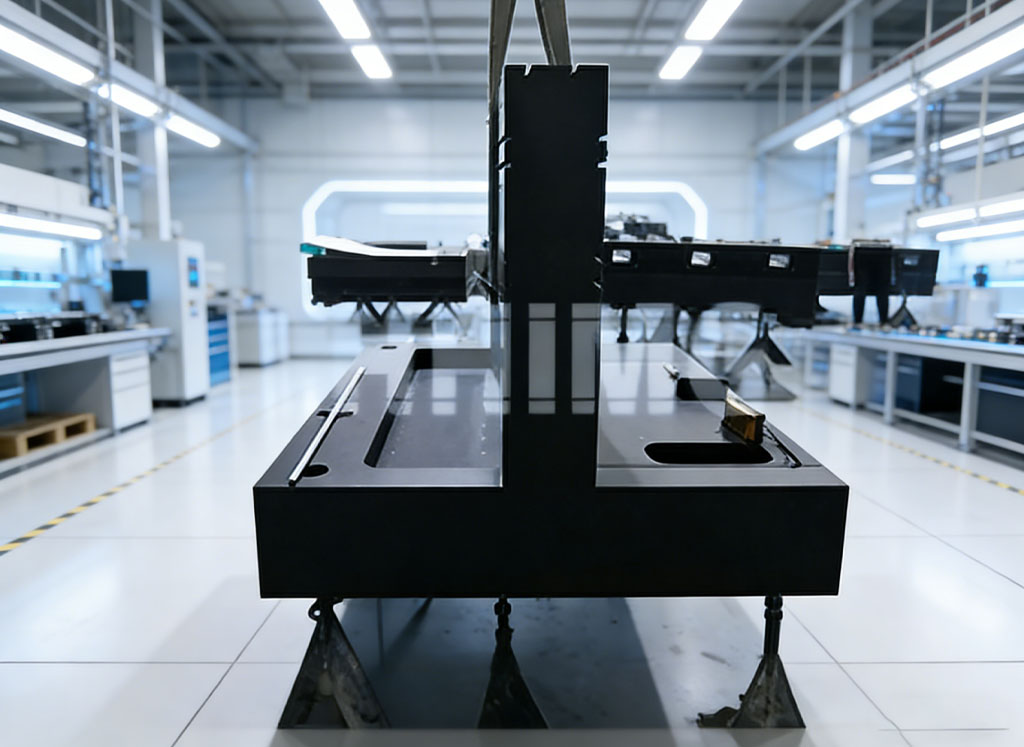
A CMM bridge is widely regarded as the most stable and versatile structural design within a coordinate measuring machine. Its symmetric layout, balanced mass distribution, and rigid geometry allow for highly repeatable motion across the X, Y, and Z axes. In high-precision applications, even minimal deformation or vibration can introduce unacceptable measurement uncertainty. This is why advanced CMM bridges increasingly rely on natural granite and precision-engineered materials with excellent thermal stability and damping characteristics.
Within a modern CMM measurement system, the bridge is not simply a mechanical frame. It acts as the foundation that determines long-term accuracy, dynamic performance, and environmental adaptability. When combined with air bearings, linear scales, and temperature compensation systems, a well-designed bridge structure enables smooth motion and consistent probing results even in demanding industrial environments.
The transition from manual inspection to CNC coordinate measuring machine operation has further transformed metrology workflows. CNC-driven CMMs allow for automated measurement routines, reduced operator dependency, and seamless integration with digital manufacturing systems. Complex geometries, freeform surfaces, and tight-tolerance components can be inspected repeatedly with high consistency, supporting both prototype validation and mass production.
In practical terms, a CNC coordinate measuring machine enhances efficiency while minimizing human-induced variability. Measurement programs can be created offline, simulated, and executed automatically, enabling continuous inspection without compromising precision. For manufacturers operating across global supply chains, this repeatability is essential for maintaining consistent quality standards.
As the application landscape expands, the demand for specialized CMM configurations has grown. Systems such as the THOME CMM have gained attention in markets that require compact footprints combined with high rigidity and measurement accuracy. These systems are often used in precision workshops, calibration laboratories, and production lines where space is limited but performance expectations remain uncompromising.
Another important development is the broader CMM spectrum now available to manufacturers. Today’s CMM spectrum ranges from entry-level inspection machines to ultra-high-precision systems designed for metrology laboratories. This diversity allows companies to select equipment tailored to their specific accuracy requirements, part sizes, and production volumes. Within this spectrum, structural materials, guideway design, and environmental control play a decisive role in determining system capability.
Granite-based structures have become a defining element across the high-end CMM spectrum. Natural granite offers low thermal expansion, excellent vibration damping, and long-term dimensional stability—qualities that are difficult to replicate with metal alternatives. For CMM bridges and machine bases, these properties directly translate into more reliable measurement results over time.
At ZHONGHUI Group (ZHHIMG), precision granite engineering has long been a core competence. With decades of experience serving the global metrology and ultra-precision manufacturing industries, ZHHIMG supports CMM manufacturers and system integrators with custom granite bridges, bases, and structural components tailored to demanding measurement environments. These components are widely used in CNC coordinate measuring machines, advanced CMM measurement systems, and research-grade inspection equipment.
The role of a precision supplier in the metrology ecosystem extends beyond manufacturing to include material selection, structural optimization, and long-term stability analysis. Granite used in CMM bridge applications must be carefully selected for density, homogeneity, and internal stress characteristics. Precision lapping, controlled aging, and rigorous inspection ensure that each component meets strict geometric and flatness requirements.
As digital manufacturing continues to advance, CMM systems are increasingly integrated with smart factories, statistical process control platforms, and real-time feedback loops. In this context, the mechanical integrity of the CMM bridge and the overall stability of the CMM measurement system become even more critical. Measurement data is only as reliable as the structure that supports it.
Looking forward, the evolution of the CMM spectrum will be shaped by higher accuracy demands, faster measurement cycles, and closer integration with automated production lines. CNC coordinate measuring machines will continue to evolve toward greater autonomy, while structural components such as granite bridges will remain fundamental to achieving consistent, traceable measurement performance.
For manufacturers and metrology professionals evaluating their next CMM investment, understanding these structural and system-level considerations is essential. Whether the application involves large-scale aerospace components, precision molds, or semiconductor equipment, the performance of the CMM measurement system ultimately depends on the quality of its foundation.
As industries pursue ever tighter tolerances and higher productivity, advanced CMM bridges, robust granite structures, and intelligent CNC coordinate measuring machine solutions will remain central to modern metrology. This ongoing evolution reflects a broader trend toward precision as a strategic asset—one that supports innovation, reliability, and long-term manufacturing excellence across the global industrial landscape.
Post time: Jan-06-2026