
In the realm of ultra-precision metrology and high-stakes manufacturing—from aerospace inspection to mold manufacturing—the Precision Granite Surface Plate serves as the bedrock of dimensional truth. While its surface flatness receives the most attention, the underlying question of thickness is equally vital, acting as the fundamental engineering variable that dictates the platform’s performance under load and its long-term geometric stability.
The thickness of a granite platform is not chosen arbitrarily; it is a meticulously calculated dimension derived from rigorous engineering principles, directly linking to the plate’s load-bearing capacity, rigidity, and its ability to function as a truly unwavering datum plane. Understanding this relationship is crucial for engineers and quality managers aiming to optimize their inspection and assembly processes.
The Physics of Stability: Why Thickness Matters
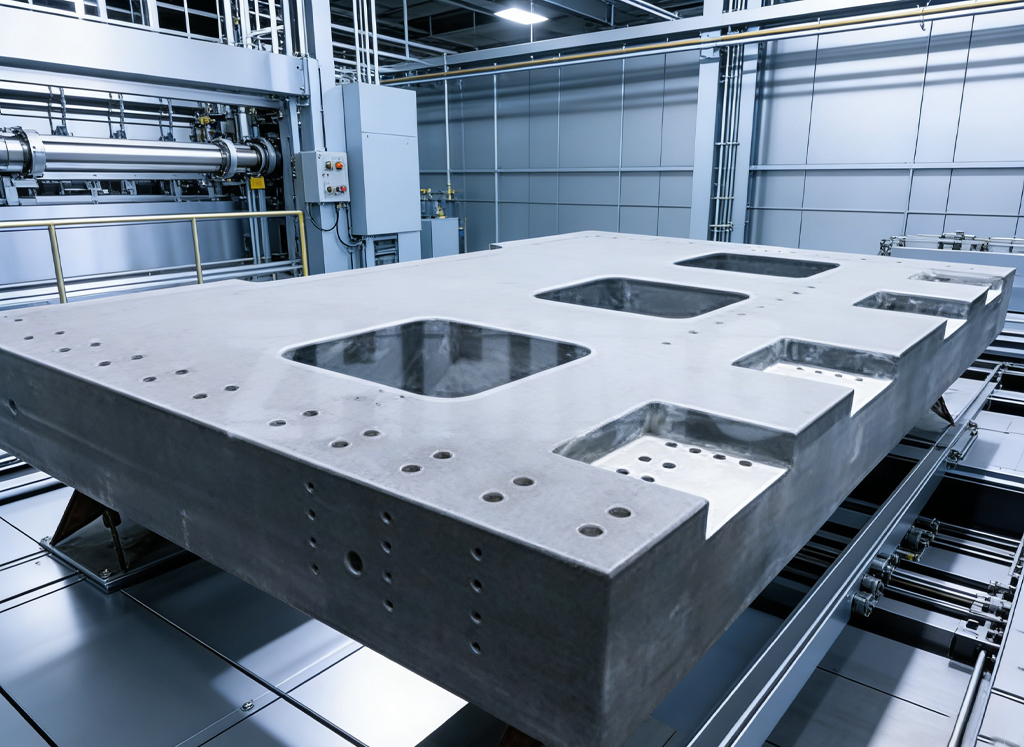
The primary purpose of a Granite Surface Plate is to resist deflection. When measuring instruments, fixtures, and heavy components are placed on the surface, gravity exerts downward force. If the plate lacks adequate thickness, it will subtly bow, introducing unacceptable geometric errors into the measurement.
This relationship is governed by the principles of material mechanics, where the rigidity of a slab is exponentially related to its thickness.
-
Resistance to Deflection (Stiffness): The rigidity of a beam or plate is related to the cube of its thickness (I ∝ h³), where $I$ is the area moment of inertia and h is the thickness. This means that doubling the thickness of the granite platform increases its stiffness by a factor of eight. For ZHHIMG®’s High-Density Black Granite (approximately 3100 kg/m³), this inherent material rigidity is amplified, resulting in superior resistance to elastic deformation under load.
-
Increased Load-Bearing Capacity: Because stiffness is exponentially linked to thickness, determining the appropriate thickness is the core engineering challenge in ensuring adequate load-bearing capacity. For large, heavy-duty plates—such as those used as a CMM Base or for inspecting massive high-precision aerospace parts—the thickness must be sufficient to ensure that the maximum expected load causes deflection far below the critical measurement tolerance (sub-micron precision).
-
Vibration Damping Mass: While granite’s internal structure provides excellent vibration damping, a thicker plate adds substantial mass. This increased mass lowers the plate’s natural resonant frequency, moving it away from the typical operational and environmental vibration frequencies (HVAC, foot traffic). This passive isolation is crucial for applications requiring stable, noise-free metrology.
The Engineering Determination: Calculating the Required Thickness
The process of determining the ideal thickness involves a detailed analysis of the application’s specific demands:
-
Application Tolerance (Accuracy Grade): The first and most critical factor is the required accuracy grade of the plate (e.g., Grade B, A, AA, or the demanding Grade 00). Tighter tolerances require higher rigidity to maintain flatness under all conditions, necessitating greater thickness.
-
Size and Span: Larger surface plates require proportionally greater thickness to compensate for the unsupported span. A large plate with inadequate thickness will sag under its own weight, even without an external load. ZHHIMG®’s ability to manufacture monolithic Granite Machine Structures up to 20 meters in length is backed by engineering expertise that precisely calculates the required thickness for such vast spans.
-
Distribution and Maximum Load: Engineers must account for the total weight of the measurement equipment, fixtures, and the part itself. The design must handle the maximum concentrated load (e.g., a localized CMM column) without exceeding the maximum allowable deflection specified by international standards (ASME B89.3.7, DIN 876).
For a standard commercial plate, thickness charts are often used. However, for custom-engineered Granite Components or Granite Machine Structures where the plate must support highly sensitive equipment like air bearings or laser interferometers, a full finite element analysis (FEA) is often employed to model stress and deflection precisely, guaranteeing the required geometric stability.
Stability Beyond Load: The Thermal Factor
The relationship between thickness and stability extends beyond mechanical deflection into the thermal domain.
-
Thermal Inertia: A thicker platform possesses greater thermal inertia. This means it takes significantly longer for ambient temperature fluctuations to penetrate the granite and affect its core temperature. Given that the granite’s low Coefficient of Thermal Expansion (CTE) is already a massive advantage over steel, the added thermal inertia from thickness ensures superior long-term dimensional stability, which is vital for operations conducted over extended periods in a lab environment. Even within a 10,000 m² Constant Temperature and Humidity Workshop, this intrinsic stability is preferred.
-
Reduced Stress Gradients: A thicker mass helps minimize internal temperature gradients, preventing different parts of the plate from expanding or contracting at different rates. This reduces the risk of subtle warpage that can compromise the Nanometer-Level Precision achieved through our rigorous lapping process.
ZHHIMG®: Engineering Thickness for Uncompromising Performance
At ZHHUI Group, the determination of thickness is a critical engineering decision driven by a commitment to the highest international standards. We leverage our knowledge of our proprietary ZHHIMG® Black Granite—chosen specifically for its high density—to engineer the thinnest possible plate that still exceeds the stability and load-bearing capacity required by the client’s specifications.
Our manufacturing ethos, “The precision business can’t be too demanding,” dictates that we do not compromise stability for cost. Whether we are fabricating a standard Granite Measuring Ruler or a complex, multi-ton Granite Gantry Base, the engineered thickness is the silent guarantee of stability, ensuring that the final certified product provides the unwavering, zero-reference plane demanded by the world’s most exacting industries.
Post time: Dec-16-2025