
Precision granite surface plates are widely regarded as the foundation of high-accuracy measurement and assembly systems. From metrology laboratories to semiconductor equipment assembly and precision CNC environments, granite platforms are trusted because of their dimensional stability, wear resistance, and thermal behavior. Yet a question frequently raised by engineers and quality managers is deceptively simple: how long does the accuracy of a granite precision platform actually last, and should long-term accuracy stability be a decisive factor when selecting one?
Unlike consumable tools or electronic components, a precision granite platform does not have a fixed “expiration date.” Its effective accuracy life depends on a combination of material quality, manufacturing process, usage conditions, and long-term environmental control. In well-managed applications, a high-quality granite surface plate can maintain its specified flatness and geometry for decades. In poorly controlled environments, however, accuracy degradation can occur much sooner, sometimes within a few years.
The material itself plays a decisive role in long-term accuracy stability. High-density black granite with a fine, uniform grain structure offers superior resistance to internal stress relaxation and micro-deformation over time. Granite with a density close to 3100 kg/m³ exhibits excellent damping characteristics and low creep behavior, which are essential for maintaining flatness under sustained loads. Lower-density stone or improperly selected materials, including marble mistakenly used as granite, may initially meet flatness specifications but tend to drift more quickly as internal stresses release during use.
Manufacturing quality is equally critical. Precision granite platforms that undergo controlled seasoning, stress relief, and extended aging before final grinding demonstrate significantly better long-term stability. Advanced grinding techniques and hand-lapping performed by experienced technicians allow surface flatness to reach micrometer or even nanometer levels. More importantly, this process ensures that the surface geometry remains stable after installation, rather than gradually changing as residual stresses dissipate. Platforms produced with insufficient aging or rushed production cycles often show measurable accuracy loss over time, even if initial inspection reports appear impressive.
Environmental conditions have a continuous and cumulative influence on the effective accuracy life of a granite surface plate. Temperature fluctuations, uneven support, vibration exposure, and humidity changes all contribute to long-term deformation risks. Granite has a low coefficient of thermal expansion, but it is not immune to thermal gradients. A platform exposed to daily temperature swings or localized heat sources may experience subtle warping that affects measurement reliability. This is why long-term accuracy stability is inseparable from proper installation, stable support points, and a controlled measurement environment.
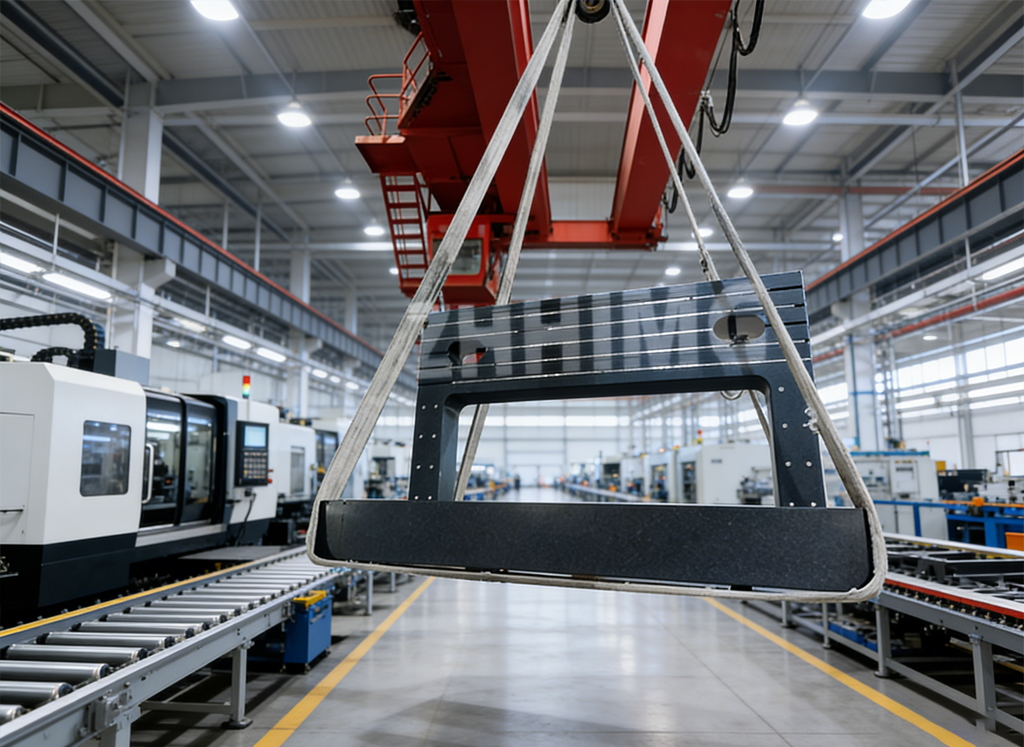
Usage patterns also determine how long accuracy remains within specification. A granite precision platform used as a reference base for light measurement tasks will age differently from one supporting heavy machine components or repeated dynamic loads. Concentrated loads, improper lifting, or frequent relocation can introduce micro-stress into the structure. Over time, these stresses may alter surface geometry, even in high-quality granite. Understanding how the platform will be used in real-world conditions is essential when evaluating long-term precision performance.
Calibration and verification practices provide the clearest indication of a platform’s effective accuracy life. Rather than assuming a fixed service period, professional users rely on periodic inspection to confirm that flatness and geometry remain within tolerance. In stable environments, recalibration intervals of one to two years are common, and many platforms show negligible deviation even after extended service. In harsher industrial settings, more frequent verification may be required, not because granite inherently degrades quickly, but because environmental influences accumulate faster.
When selecting a precision granite surface plate, long-term accuracy stability should never be treated as an afterthought. Initial flatness values alone do not reflect how the platform will perform five or ten years later. Engineers should consider the granite’s physical properties, aging process, manufacturing methods, and compatibility with the intended environment. A well-selected granite platform becomes a long-term reference asset rather than a recurring maintenance concern.
In modern ultra-precision industries, accuracy is not measured only at the moment of delivery. It is measured over time, under load, and across changing conditions. A granite precision platform that maintains its geometry year after year supports consistent measurement results, reliable equipment assembly, and reduced recalibration costs. This is especially important in applications such as semiconductor manufacturing, optical inspection, coordinate measuring machines, and high-end CNC systems, where even minor deviations can propagate into significant downstream errors.
Ultimately, the true value of a precision granite surface plate lies in its ability to remain stable long after installation. By prioritizing long-term accuracy stability during selection, users can ensure that their measurement foundation remains trustworthy throughout the full lifecycle of their equipment. In precision engineering, consistency over time is not a luxury; it is the defining standard of quality.
Post time: Dec-15-2025