
When engineers search for precision granite components, a question often appears sooner or later: how many granite materials does a manufacturer actually use? Behind this seemingly simple question lies a deeper concern about accuracy, consistency, and long-term reliability. In ultra-precision manufacturing, granite is not just a structural material. It is the physical foundation upon which measurement credibility and machine performance are built.
At ZHHIMG, the answer is not defined by quantity, but by discipline. Rather than offering a wide catalog of interchangeable stone options, ZHHIMG follows a deliberately controlled granite material strategy designed to support ultra-precision applications where stability matters more than variety.
Granite has been used in precision engineering for decades due to its natural advantages. Its internal crystal structure provides excellent vibration damping, low thermal expansion, and long-term dimensional stability. These properties make granite an ideal choice for machine bases, metrology structures, optical platforms, and high-precision measuring tools. However, not all granite performs the same, even when it appears similar on the surface.
In the global market, many manufacturers refer to “black granite” as if it were a single standardized material. In reality, granite performance depends heavily on mineral composition, grain size, density, internal stress distribution, and geological origin. Two stones with similar color can behave very differently under load, temperature variation, or long-term use. For ultra-precision equipment, these differences are not theoretical; they directly influence accuracy drift and service life.
ZHHIMG has chosen a different path from suppliers who offer multiple granite grades for different price levels. After years of material research, testing, and long-term application feedback, ZHHIMG standardized its core production on ZHHIMG® Black Granite, a high-density natural granite with a density of approximately 3100 kg/m³. This material is not selected for appearance, but for measurable physical performance.
Compared with commonly used European and American black granites, ZHHIMG® Black Granite demonstrates higher density, stronger mechanical stability, and lower susceptibility to internal stress release over time. These characteristics are especially critical in large granite machine bases, precision granite components, and granite air bearing structures, where even micro-level deformation can affect system alignment and motion accuracy.
In practical terms, this means ZHHIMG does not rely on a large number of granite materials. Instead, the company focuses on one primary granite standard, supported by strict incoming inspection and material traceability. Each granite block is evaluated for density consistency, internal structure, and suitability for precision processing before entering production. This controlled approach reduces variability and ensures that performance expectations remain consistent across different projects and production batches.
This strategy also addresses a common industry problem: material substitution. In some markets, marble or low-grade stone is occasionally used as a substitute for true precision granite to reduce cost. While such materials may look similar at first glance, their physical properties are fundamentally different. Marble has higher thermal expansion, lower wear resistance, and inferior long-term stability. In ultra-precision applications, these differences inevitably lead to accuracy degradation.
ZHHIMG firmly rejects this practice. Granite is not selected to meet a price target; it is selected to meet a precision requirement. Once a granite structure becomes part of a measurement system or machine reference, its material integrity directly affects the credibility of the entire system.
The question of how many granite materials are used is also closely linked to how granite is processed. Even the best material can fail if machining, grinding, or environmental control is insufficient. ZHHIMG operates large-scale manufacturing facilities capable of processing granite components weighing up to 100 tons, with single-piece lengths reaching 20 meters. These capabilities are essential for producing large granite machine bases and structural platforms used in semiconductor equipment, precision CNC machines, and advanced inspection systems.
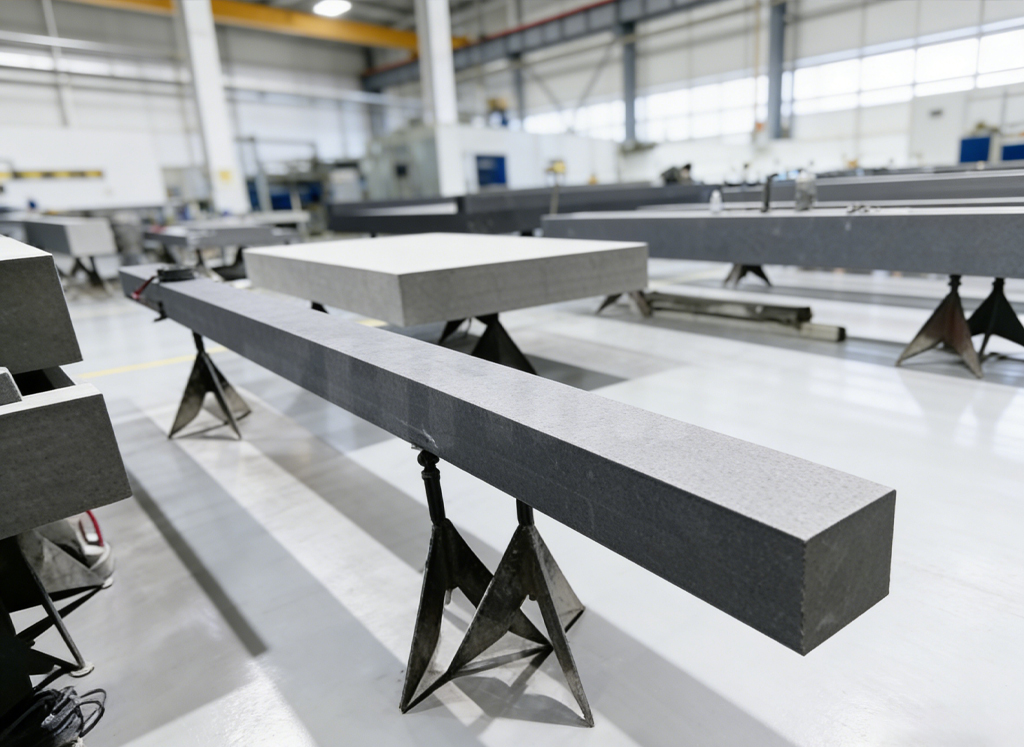
Ultra-precision grinding and finishing are performed in constant temperature and humidity environments designed to minimize thermal influence and vibration. Measurement and final verification are carried out using advanced metrology equipment, including laser interferometers, electronic levels, ultra-precision indicators, and surface roughness testers, all calibrated with traceability to national metrology standards. In this context, granite material selection is only the first step in a much larger precision system.
Human expertise plays an equally important role. Many of ZHHIMG’s master grinders have decades of experience in manual lapping, allowing them to achieve micron- and even nano-level surface accuracy through controlled hand processing. This level of craftsmanship ensures that the inherent stability of the granite material is fully realized in the finished component, rather than compromised during production.
ZHHIMG’s granite material philosophy extends beyond machine bases to granite measuring tools. Precision granite surface plates, straight edges, square rulers, V-blocks, and parallels all rely on the same stable material foundation. In metrology laboratories and inspection environments, granite surface plates serve as reference standards. Their flatness and stability directly affect measurement accuracy. By using a consistent high-density granite material, ZHHIMG ensures that its measuring tools provide reliable reference surfaces for calibration, assembly, and inspection tasks.
The application range of ZHHIMG’s granite products reflects the demands placed on the material. Precision granite components and bases are widely used in semiconductor manufacturing equipment, PCB drilling machines, coordinate measuring machines, optical inspection systems, industrial CT and X-ray inspection platforms, laser processing equipment, linear motor stages, XY tables, and advanced energy equipment. In these systems, granite is not a passive structure. It actively contributes to vibration control, thermal stability, and long-term accuracy retention.
From a broader industry perspective, the question of how many granite materials a manufacturer uses reveals much about their engineering philosophy. A wide selection of materials may appear flexible, but it often introduces variability that is difficult to control in ultra-precision applications. A focused, well-characterized material standard, supported by rigorous processing and measurement, provides a more reliable foundation for precision systems.
ZHHIMG’s approach is shaped by long-term cooperation with global universities, research institutions, and national metrology organizations. Through continuous collaboration and application feedback, material behavior is evaluated not only at delivery, but throughout the service life of the equipment. This long-term perspective reinforces the importance of material consistency over short-term customization.
Ultimately, the question is not how many granite materials ZHHIMG uses, but why it chooses discipline over variety. In ultra-precision manufacturing, stability is not achieved through options, but through control. By standardizing on a proven high-density granite material and integrating it into a complete precision manufacturing and measurement system, ZHHIMG provides structural foundations that engineers can trust.
As equipment continues to evolve toward higher accuracy, higher speed, and greater integration, the role of precision granite will remain fundamental. Understanding the material behind the structure is the first step toward understanding the performance of the entire system. For those who rely on ultra-precision mechanical components, that understanding is not optional; it is essential.
Post time: Dec-17-2025