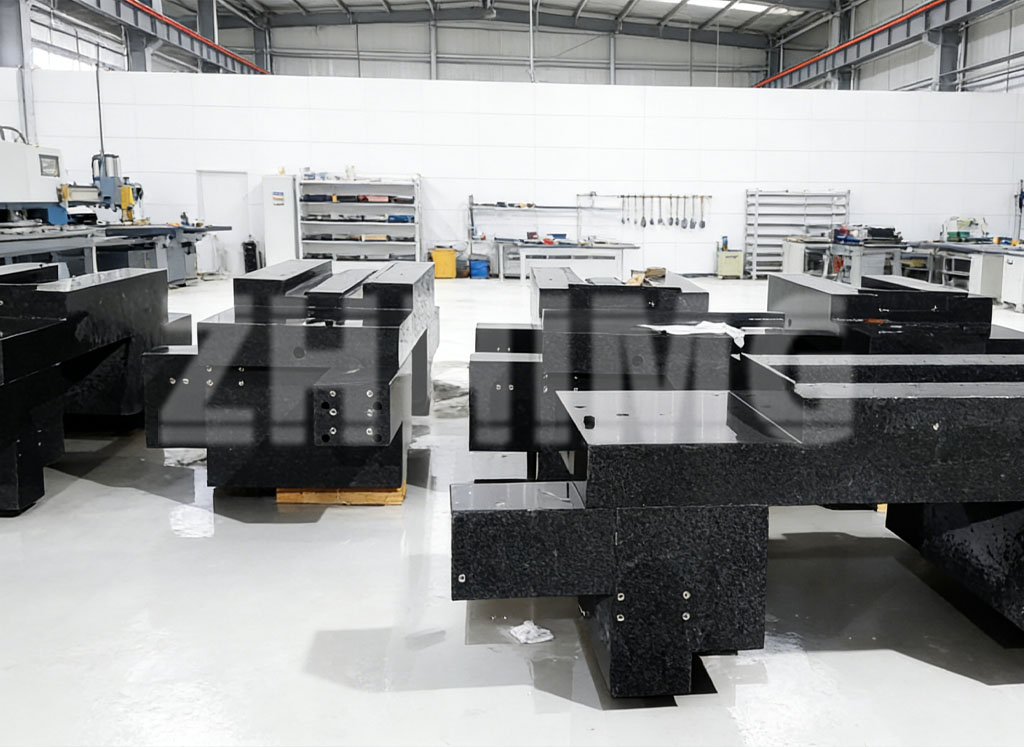
In the world of precision metrology, where tolerances are measured in microns and even nanometers, thermal expansion represents one of the most significant sources of measurement uncertainty. Every material expands and contracts with temperature changes, and when dimensional accuracy is critical, even microscopic dimensional variations can compromise measurement results. This is why precision granite components have become indispensable in modern metrology systems—they offer exceptional thermal stability that dramatically reduces thermal expansion effects compared to traditional materials like steel, cast iron, and aluminum.
Thermal expansion is the tendency of matter to change its shape, area, volume, and density in response to a change in temperature. When a material’s temperature increases, its particles move more vigorously and occupy a larger volume. Conversely, cooling causes contraction. This physical phenomenon affects all materials to varying degrees, expressed through the coefficient of thermal expansion (CTE) —a fundamental property that quantifies how much a material expands per degree of temperature increase.
The linear coefficient of thermal expansion (α) represents the fractional change in length per unit change in temperature. Mathematically, when the temperature of a material changes by ΔT, its length changes by ΔL = α × L₀ × ΔT, where L₀ is the original length. This relationship means that for a given temperature change, materials with higher CTE values experience greater dimensional changes.
In metrology applications, thermal expansion affects measurement accuracy through multiple mechanisms:
Reference Dimension Changes: Surface plates, gauge blocks, and reference standards used as measurement bases change dimensions with temperature, directly affecting all measurements taken against them. A 1000 mm surface plate expanding by 10 microns introduces a 0.001% error—unacceptable in high-precision applications.
Workpiece Dimensional Drift: Parts being measured also expand and contract with temperature changes. If measurement temperature differs from the reference temperature specified on engineering drawings, measurements will not reflect the part’s true dimensions at specification conditions.
Instrument Scale Drift: Linear encoders, scale gratings, and position sensors expand with temperature, affecting position readings and causing measurement errors across long travels.
Temperature Gradients: Non-uniform temperature distribution across measurement systems creates differential expansion, causing bending, warping, or complex distortions that are difficult to predict and compensate.
For industries like semiconductor manufacturing, aerospace, medical devices, and precision engineering, where tolerances often range from 1-10 microns, uncontrolled thermal expansion can render measurement systems unreliable. This is where granite’s exceptional thermal stability becomes a decisive advantage.
Granite exhibits one of the lowest coefficients of thermal expansion among engineering materials used in metrology. The CTE of high-quality precision granite typically ranges from 4.6 to 8.0 × 10⁻⁶/°C, approximately one-third that of cast iron and one-quarter that of aluminum.
| Material |
CTE (×10⁻⁶/°C) |
Relative to Granite |
| Granite |
4.6-8.0 |
1.0× (baseline) |
| Cast Iron |
10-12 |
2.0-2.5× |
| Steel |
11-13 |
2.0-2.5× |
| Aluminum |
22-24 |
3.0-4.0× |
This dramatic difference means that for a 1°C temperature change, a 1000 mm granite component expands only 4.6-8.0 microns, while a comparable steel component expands 11-13 microns. In practical terms, granite experiences 60-75% less thermal expansion than steel under identical temperature conditions.
Material Composition and Thermal Behavior
Granite’s low thermal expansion stems from its unique crystalline structure and mineral composition. Formed over millions of years through slow cooling and crystallization of magma, granite consists primarily of:
Quartz (20-40%): Provides hardness and contributes to low thermal expansion due to its relatively low CTE (approximately 11-12 × 10⁻⁶/°C, but bonded in a rigid crystalline matrix)
Feldspar (40-60%): The dominant mineral, particularly plagioclase feldspar, which exhibits excellent thermal stability with low expansion characteristics
Mica (5-10%): Adds flexibility without compromising structural integrity
The interlocking crystalline matrix created by these minerals, combined with granite’s geological formation history, results in a material with exceptionally low thermal expansion and minimal thermal hysteresis—dimensional changes are nearly identical for heating and cooling cycles, ensuring predictable and reversible behavior.
Natural Aging and Stress Relief
Perhaps most significantly, granite undergoes natural aging over geological time scales that completely eliminates internal stresses. Unlike manufactured materials that may retain residual stresses from production processes, granite’s slow formation under high pressure and temperature allows crystal structures to achieve equilibrium. This stress-free state means that granite does not exhibit stress relaxation or dimensional creep under thermal cycling—properties that can cause dimensional instability in some manufactured materials.
Thermal Mass and Temperature Stabilization
Beyond its low CTE, granite’s high density (typically 2,800-3,200 kg/m³) and corresponding high thermal mass provide additional thermal stability advantages. In metrology systems:
Thermal Inertia: High thermal mass means granite components respond slowly to temperature changes, providing resistance to rapid environmental fluctuations. When ambient temperature varies, granite maintains its temperature longer than lighter materials, reducing the rate and magnitude of dimensional changes.
Temperature Equalization: The high thermal conductivity relative to its thermal mass enables granite to equalize temperatures internally relatively quickly. This minimizes thermal gradients within the material—temperature differences between surface and interior—that could cause complex, difficult-to-compensate distortions.
Environmental Buffering: Large granite structures, such as
CMM bases and surface plates, act as thermal buffers, maintaining more stable temperatures for mounted instruments and workpieces. This buffering effect is particularly valuable in environments where air temperature varies but remains within an acceptable range.
Granite Components in Metrology Systems
Surface Plates and Metrology Tables
Granite surface plates represent the most fundamental application of granite’s thermal stability in metrology. These plates serve as the absolute reference plane for all dimensional measurements, and their dimensional stability directly affects every measurement taken against them.
Thermal Stability Advantages
Granite surface plates maintain flatness accuracy across temperature variations that would compromise alternatives. A Grade 0 granite surface plate measuring 1000 × 750 mm typically maintains flatness within 3-5 microns despite ambient temperature fluctuations of ±2°C. A comparable cast iron plate might experience flatness degradation of 10-15 microns under the same conditions.
The low CTE of granite means that thermal expansion occurs uniformly across the plate’s surface. This uniform expansion maintains the plate’s geometry—flatness, straightness, and squareness—rather than causing complex distortions that would affect different areas of the plate differently. This geometric preservation ensures that measurement references remain consistent across the entire working surface.
Working Temperature Ranges
Granite surface plates typically operate effectively in temperature ranges from 18°C to 24°C without requiring special thermal compensation. At these temperatures, dimensional changes remain within acceptable limits for Grade 0 and Grade 1 precision requirements. By contrast, steel or cast iron plates often require tighter temperature control—typically 20°C ±1°C—to maintain equivalent accuracy.
For ultra-high precision applications requiring Grade 00 accuracy,
granite plates still benefit from temperature control but have wider acceptable ranges than metallic alternatives. This flexibility reduces the need for expensive climate control systems while maintaining required accuracy.
CMM Bases and Structural Components
Coordinate Measuring Machines (CMMs) rely on granite bases and structural components to provide dimensional stability for their measurement systems. The thermal characteristics of these components directly affect CMM accuracy, particularly for machines with long travels and high precision requirements.
Base Plate Thermal Stability
CMM granite bases typically measure 2000 × 1500 mm or larger for gantry and bridge configurations. At these dimensions, even small thermal expansion becomes significant. A 2000 mm long granite base expands approximately 9.2-16.0 microns per °C of temperature change. While this seems substantial, it’s 60-75% less than a steel base, which would expand 22-26 microns under the same conditions.
The uniform thermal expansion of granite bases ensures that scale gratings, encoder scales, and measurement references expand predictably and consistently. This predictability enables software compensation—if thermal compensation is implemented—to be more accurate and reliable. Non-uniform or unpredictable expansion in steel bases can create complex error patterns that are difficult to compensate effectively.
Bridge and Beam Components
CMM gantry bridges and measuring beams must maintain parallelism and straightness for accurate Y-axis measurements. Granite’s thermal stability ensures that these components maintain their geometry under varying thermal loads. Temperature changes that might cause steel bridges to bow, twist, or develop complex distortions cause Y-axis measurement errors that vary depending on the bridge’s temperature distribution.
Granite’s high stiffness—Young’s modulus typically 50-80 GPa—combined with its thermal stability ensures that thermal expansion causes dimensional changes without compromising structural rigidity. The bridge expands uniformly, maintaining parallelism and straightness rather than developing bending or warping.
Encoder Scale Integration
Modern CMMs often use substrate-mastered encoder scales that expand at the same rate as the granite substrate to which they are mounted. When using granite bases with low CTE, these encoder scales exhibit minimal expansion, reducing the magnitude of thermal compensation required and improving measurement accuracy.
Floating encoder scales—scales that expand independently of their substrate—can introduce significant measurement errors when used with low-CTE granite bases. Air temperature fluctuations cause independent scale expansion that is not matched by the granite base, creating differential expansion that directly affects position readings. Substrate-mastered scales eliminate this issue by expanding at the same rate as the granite base.
Master Reference Artifacts
Granite master squares, straight edges, and other reference artifacts serve as calibration standards for metrology equipment. These artifacts must maintain their dimensional accuracy over extended periods, and thermal stability is critical to this requirement.
Long-Term Dimensional Stability
Granite master artifacts can maintain calibration accuracy for decades with minimal recalibration. The material’s resistance to thermal cycling effects—dimensional changes from repeated heating and cooling—means that these artifacts do not accumulate thermal stress or develop thermally-induced distortions over time.
A granite master square with perpendicularity accuracy of 2 arc-seconds can maintain this accuracy for 10-15 years with annual calibration verification. Similar steel master squares may require more frequent recalibration due to thermal stress accumulation and dimensional drift.
Reduced Thermal Equilibration Time
When granite master artifacts undergo calibration procedures, their high thermal mass requires appropriate stabilization time, but once stabilized, they maintain thermal equilibrium longer than lighter steel alternatives. This reduces uncertainty related to thermal drift during lengthy calibration procedures and improves calibration reliability.
Practical Applications and Case Studies
Semiconductor Manufacturing
Semiconductor lithography and wafer inspection systems demand exceptional thermal stability. Modern photolithography systems for 3nm node production require positional stability within 10-20 nanometers across 300 mm wafer travels—equivalent to maintaining dimensions within 0.03-0.07 ppm.
Granite Stage Performance
Granite air-bearing stages for wafer inspection and lithography equipment demonstrate thermal expansion of less than 0.1 μm/m across the entire working temperature range. This performance, achieved through careful material selection and precision manufacturing, enables repeatable wafer alignment without the need for active thermal compensation in many cases.
Cleanroom Compatibility
Granite’s non-porous, non-shedding surface characteristics make it ideal for cleanroom environments. Unlike coated metals that can generate particles, or polymer composites that may outgas, granite maintains dimensional stability while meeting ISO Class 1-3 cleanroom requirements for particle generation.
Aerospace Component Inspection
Aerospace components—turbine blades, wing spars, structural fittings—require dimensional accuracy in the 5-50 micron range despite large dimensions (often 500-2000 mm). The size-to-tolerance ratio makes thermal expansion particularly challenging.
Large Surface Plate Applications
For inspecting aerospace components, granite surface plates sized 2500 × 1500 mm or larger are commonly used. These plates maintain Grade 00 flatness tolerances across their entire surface despite ambient temperature variations of ±3°C. The thermal stability of these large plates enables accurate measurement of large components without requiring special environmental control beyond standard quality laboratory conditions.
Temperature Compensation Simplification
The predictable and uniform thermal expansion of granite plates simplifies thermal compensation calculations. Instead of complex, non-linear compensation routines required for some materials, granite’s well-characterized CTE enables straightforward linear compensation when needed. This simplification reduces software complexity and potential compensation errors.
Medical Device Manufacturing
Medical implants and surgical instruments require dimensional accuracy of 1-10 microns with biocompatibility requirements that limit material choices for measurement fixtures.
Non-Magnetic Advantages
Granite’s non-magnetic properties make it ideal for measuring medical devices that may be affected by magnetic fields. Unlike steel fixtures that can magnetize and interfere with measurement or affect sensitive electronic implants, granite provides a neutral measurement reference.
Biocompatibility and Cleanliness
Granite’s chemical inertness and ease of cleaning make it suitable for medical device inspection environments. The material resists absorption of cleaning agents and biological contaminants, maintaining dimensional accuracy while meeting hygiene requirements.
Temperature Management Best Practices
Environmental Control
While granite’s thermal stability reduces sensitivity to temperature variations, optimal performance still requires appropriate environmental management:
Temperature Stability: Maintain ambient temperature within ±2°C for standard metrology applications and ±0.5°C for ultra-high precision work. Even with granite’s low CTE, minimizing temperature variations reduces the magnitude of dimensional changes and improves measurement reliability.
Temperature Uniformity: Ensure uniform temperature distribution throughout the measurement environment. Avoid locating granite components near heat sources, HVAC vents, or exterior walls that might create thermal gradients. Non-uniform temperatures cause differential expansion that affects dimensional accuracy.
Thermal Equilibration: Allow granite components to thermally equilibrate after delivery or before critical measurements. As a rule of thumb, allow 24 hours for thermal equilibration for components with significant thermal mass, though many applications can accept shorter periods based on temperature differential from the storage environment.
Material Selection and Quality
Not all granite exhibits equivalent thermal stability. Material selection and quality control are essential:
Granite Type Selection: Black diabase granite from regions like Jinan, China, is widely recognized for exceptional metrological properties. High-quality black granite typically exhibits CTE values in the lower end of the 4.6-8.0 × 10⁻⁶/°C range and provides excellent dimensional stability.
Density and Homogeneity: Select granite with density exceeding 3,000 kg/m³ and uniform grain structure. Higher density and homogeneity correlate with better thermal stability and more predictable thermal behavior.
Aging and Stress Relief: Ensure that granite components have undergone appropriate natural aging processes to eliminate internal stresses. Properly aged granite exhibits minimal dimensional changes under thermal cycling compared to materials with residual stresses.
Maintenance and Calibration
Proper maintenance preserves granite’s thermal stability and dimensional accuracy:
Regular Cleaning: Clean granite surfaces regularly with appropriate cleaning solutions to maintain the smooth, pore-free surface that characterizes granite’s thermal properties. Avoid abrasive cleaners that might affect surface finish.
Periodic Calibration: Establish appropriate calibration intervals based on usage severity and accuracy requirements. While granite’s thermal stability enables extended calibration intervals compared to alternatives, regular verification ensures ongoing accuracy.
Inspection for Thermal Damage: Periodically inspect granite components for signs of thermal damage—cracks from thermal stress, surface degradation from thermal cycling, or dimensional changes detectable through comparison to calibration records.
Economic and Operational Benefits
Reduced Calibration Frequency
Granite’s thermal stability enables extended calibration intervals compared to materials with higher CTE values. Where steel surface plates might require annual recalibration to maintain Grade 0 accuracy, granite equivalents often justify 2-3 year intervals under similar usage conditions.
This extended calibration interval provides several benefits:
- Reduced direct calibration costs
- Minimized equipment downtime for calibration procedures
- Lower administrative overhead for calibration management
- Reduced risk of using equipment that has drifted out of specification
Lower Environmental Control Costs
The reduced sensitivity to temperature variations translates to lower requirements for environmental control systems. Facilities using granite components may require less sophisticated HVAC systems, reduced climate control capacity, or less stringent temperature monitoring—all contributing to lower operational costs.
For many applications, granite components operate effectively in standard laboratory conditions without requiring special temperature-controlled enclosures that would be necessary with higher-CTE materials.
Extended Service Life
Granite’s resistance to thermal cycling effects and thermal stress accumulation contributes to extended service life. Components that do not accumulate thermal damage maintain their accuracy longer, reducing replacement frequency and lifetime costs.
Quality granite surface plates can provide 20-30 years of reliable service with proper maintenance, compared to 10-15 years for steel alternatives in similar applications. This extended service life represents significant economic advantage over the component’s lifetime.
Future Trends and Innovations
Material Science Advances
Ongoing research continues to advance granite’s thermal stability characteristics:
Hybrid Granite Composites: Epoxy granite—combinations of granite aggregates with polymer resins—offer enhanced thermal stability with CTE values as low as 8.5 × 10⁻⁶/°C while providing improved manufacturability and design flexibility.
Engineered Granite Processing: Advanced natural aging treatments and stress-relief processes can further reduce residual stresses in granite, enhancing thermal stability beyond what’s achievable through natural formation alone.
Surface Treatments: Specialized surface treatments and coatings can reduce surface absorption and enhance thermal equilization rates without compromising dimensional stability.
Smart Integration
Modern granite components increasingly incorporate smart features that enhance thermal management:
Embedded Temperature Sensors: Integrated temperature sensors enable real-time thermal monitoring and active compensation based on actual component temperatures rather than ambient air temperature.
Active Thermal Control: Some high-end systems integrate heating or cooling elements within granite components to maintain constant temperature regardless of environmental variations.
Digital Twin Integration: Computer models of thermal behavior enable predictive compensation and optimization of measurement procedures based on thermal conditions.
Conclusion: The Foundation of Precision
Thermal expansion represents one of the fundamental challenges in precision metrology. Every material responds to temperature changes, and when dimensional accuracy is measured in microns or less, these responses become critically important. Precision granite components, through their exceptionally low coefficient of thermal expansion, high thermal mass, and stable material properties, provide a foundation that dramatically reduces thermal expansion effects compared to traditional alternatives.
The advantages of granite’s thermal stability extend beyond simple dimensional accuracy—they enable simplified environmental control requirements, extended calibration intervals, reduced compensation complexity, and improved long-term reliability. For industries pushing the boundaries of precision measurement, from semiconductor manufacturing to aerospace engineering and medical device production, granite components are not merely beneficial—they are essential.
As measurement requirements continue to tighten and applications become more demanding, the role of thermal stability in metrology systems will only grow in importance. Precision granite components, with their proven performance and ongoing innovations, will remain at the foundation of precision measurement—providing the stable reference upon which all accuracy depends.
At ZHHIMG, we specialize in manufacturing precision granite components that leverage these thermal stability advantages. Our granite surface plates, CMM bases, and metrology components are manufactured from carefully selected materials to deliver exceptional thermal performance and dimensional stability for the most demanding metrology applications.