
In ultra-precision machining and inspection industries, most precision drift does not stem from equipment wear, but benchmark deformation triggered by dynamic fluctuations of ambient temperature. When exposed to day-night temperature differences, heat accumulation during machine operation, air-conditioning switching and batch processing heat-up, conventional mechanical structures easily suffer dimensional shift, trajectory deviation and tilted reference surfaces. Many engineers believe high-precision production can only be achieved in strictly temperature-controlled workshops. In fact, the decisive factor lies in the thermal response characteristics of the substrate material. Compared with cast iron, aluminum and welded steel structures, ZHHIMG granite mechanical systems feature low thermal expansion, high thermal inertia and slow thermal diffusion. Under normal temperature fluctuation conditions, they deliver far superior deformation resistance, suiting non-constant-temperature, semi-constant-temperature and temperature-varying production scenarios.
1. Core hazards of temperature fluctuation: fatal weaknesses of traditional metal systems
Mechanical systems made of metal are inherently sensitive to heat. Fast thermal diffusion and high thermal expansion coefficients lead to immediate and substantial deformation when temperature changes. A small fluctuation of 1–3℃, continuous heat build-up or heat released during cutting will cause rapid expansion, contraction and local thermal distortion of metal beds. Typical symptoms include qualified static calibration but failed dynamic precision after temperature changes, positioning offset, out-of-tolerance flatness, inconsistent machining texture and drifting inspection data.
More importantly, metal structures retain residual thermal lag deformation. After temperature drops, metal beds cannot instantly return to their original shape. Tiny residual stress accumulates over time and creates permanent benchmark shift, requiring frequent shutdown for recalibration and parameter compensation. This hurts mass-production stability and productivity, which is the main reason conventional precision machines struggle with variable temperature working conditions.
2. Core physical advantages of granite: low response, slow deformation and recoverability under temperature fluctuation
ZHHIMG high-density black granite mechanical systems possess unique thermal stability unlike metal materials, eliminating precision risks caused by temperature fluctuation at the physical level. Its thermal expansion coefficient is extremely low, roughly half that of ordinary cast iron. Deformation under the same temperature difference is greatly reduced, minimizing thermal errors from the source.
The biggest differentiator is high thermal inertia and low thermal diffusion rate. Granite conducts heat slowly and retains temperature steadily. Faced with sudden temperature swings, short-time heat rise or day-night temperature changes, it does not deform rapidly like metals. During sharp heating or cooling, the stone matrix buffers thermal shocks and slows heat transfer. The overall dimension stays stable without local expansion/contraction, warping or tilted reference surfaces. Even with minor ambient temperature variation, machining and inspection benchmarks remain stable without sudden precision jumps.
Furthermore, ZHHIMG granite has no thermal lag as seen in metals. When temperature returns to the target range, dimensions recover naturally without residual deformation or accumulated stress. No precision error builds up after repeated thermal cycles, solving the common problem of degrading precision over service life in traditional machines.
3. Real-world performance: suitable for industrial dynamic temperature difference scenarios
Perfect constant-temperature environments are rare in real factories. Most workshops have recurring temperature variations. For such demanding conditions, ZHHIMG granite mechanical systems demonstrate strong environmental adaptability. Under minor temperature fluctuations, geometric accuracy, motion benchmarks, flatness and squareness barely change. Under medium-frequency thermal cycling, dimensional drift can be controlled at sub-micron level, fully meeting ultra-precision machining, metrology, optical inspection and semiconductor auxiliary manufacturing requirements.
When local heat accumulates during continuous machine operation or heat is released momentarily during cutting, ZHHIMG granite systems balance temperature differences through thermal inertia. Local micro-deformation caused by overheating is restrained, ensuring linear motors, air bearing guides and precision inspection modules follow theoretical motion paths. Scrap parts and false measurement readings induced by temperature fluctuation are avoided.
4. Process enhancement for long-term stability in variable-temperature environments
Beyond material advantages, system-level process optimization doubles the temperature resistance of ZHHIMG granite mechanical systems. All granite components undergo multi-stage natural aging and artificial stress relief to fully release native and machining-induced stress, preventing composite deformation caused by stress coupling under temperature changes.
Fine machining, lapping and assembly of components are completed inside ZHHIMG’s vibration-isolated, constant-temperature and dust-free workshops. Machining benchmarks align closely with practical operating references to avoid precision deviation introduced during production. The monolithic granite structure has no joints or dissimilar material bonding, ruling out structural deformation from mismatched thermal expansion coefficients of different materials. The whole mechanical system maintains consistent dimensional stability across the entire structure under temperature fluctuation. 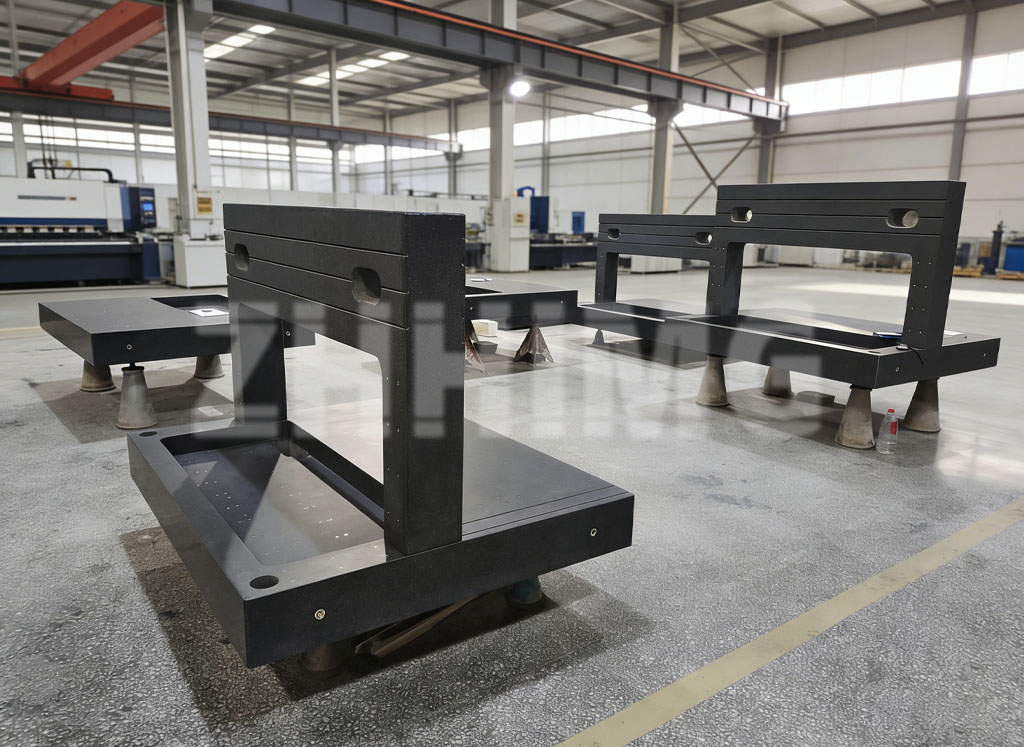
5. Practical benefits: lower demand for strict temperature control and wider working conditions
Traditional precision machines require high-standard temperature-controlled workshops with high operating costs and strict site limits. Equipped with ZHHIMG high-performance granite mechanical systems, machines can maintain sub-micron precision for a long time without rigorous temperature control.
Whether in ordinary workshops with obvious day-night temperature differences or research laboratories with intermittent operation and dynamic temperature shifts, ZHHIMG granite mechanical systems deliver stable high-precision benchmarks. Less thermal compensation adjustment and fewer calibration stops cut workshop renovation and maintenance costs, freeing ultra-precision manufacturing from ambient temperature constraints.
Conclusion
Under temperature fluctuation, ZHHIMG granite mechanical systems feature low thermal expansion, high thermal inertia, no thermal lag and no stress accumulation, offering environmental adaptability unmatched by metal structures. Absolute zero deformation cannot be achieved, yet thermal-induced precision drift can be reduced to negligible levels for precision applications. No performance degradation occurs after repeated thermal cycles, making ZHHIMG granite the optimal substrate solution for industrial temperature variation and long-term precision stability.
Post time: Sep-18-2026