
Gravitational deflection: the hidden error source over long‑span support
Unlike thermal drift which draws wide attention, self‑weight deflection occurs purely from mechanical load. Once the granite inspection ruler is laid over a gap for inspection, its own mass creates micro‑bending. For short‑span applications, this effect stays negligible. Yet as the unsupported span increases, deflection rises sharply. Even high‑grade black granite cannot escape this physical law. Many end‑users blame material quality for bad readings, while the real cause is mismatched self‑weight against actual working span.
Material density lays the foundation. ZHHIMG adopts high‑density black granite around 3100 kg/m³, delivering higher rigidity per unit volume compared with low‑density marble substitutes. Poor‑grade marble products often cut thickness and overall mass to lower costs; under moderate span, obvious bending takes place and ruins metrology performance. Following its customer‑oriented commitment, ZHHIMG strictly rejects inferior‑material substitution and evaluates every ruler’s allowable working span during custom design.
Key principles: match self‑weight to practical unsupported span
The effective span refers to the actual gap distance between two supporting points during real‑world inspection, not simply the overall physical length of the ruler. A long granite ruler may work with a short effective span, while a medium‑length unit can face a large unsupported gap. Users must clarify real‑working span before confirming thickness, cross‑section and resulting self‑weight.
For short‑span scenarios below 800 mm, moderate self‑weight meets requirements; gravitational deflection remains minimal, and priority can go to portable‑friendly configurations. When effective span extends to 800‑1600 mm, cross‑section and self‑weight must be increased correspondingly to improve bending resistance. For spans above 1600 mm, simply extending length is not enough. The structural section must be redesigned, and self‑weight raised to restrain deflection within tolerance ranges defined by DIN, ASME and GB metrology standards. In some cases, optimized support point positions are also recommended to offset gravity‑caused deformation.
Over‑specification should also be avoided. Excessive self‑weight does not improve accuracy further, but brings safety hazards during manual movement, mounting and on‑site transportation. Heavy‑oversized rulers demand extra lifting aids and raise workshop‑operation costs. Reasonable self‑weight targeting the real‑used span strikes the best balance between rigidity and operability.
Manufacturing‑side support: simulation, custom‑section and real‑world verification
ZHHIMG’s engineering team carries out deflection simulation for each custom granite inspection ruler according to clients’ announced support‑span conditions. Drawing on decades‑accumulated metrology experience and global‑standard knowledge covering DIN 875, ASME and other specifications, technicians adjust cross‑section geometry and calculate reasonable self‑weight, rather than only following fixed‑size catalog options.
After machining on large‑scale grinding equipment inside the temperature‑controlled shock‑absorbing workshop, each finished ruler undergoes complete validation. Testing instruments including Renishaw laser interferometers and WYLER electronic levels record straight‑ness data under real‑simulated support‑span setups. Calibration documents traceable to national metrology institutes record performance under target‑span conditions, not only static‑bench flatness. This practice helps customers understand under which span parameters the tool maintains its certified accuracy grade. 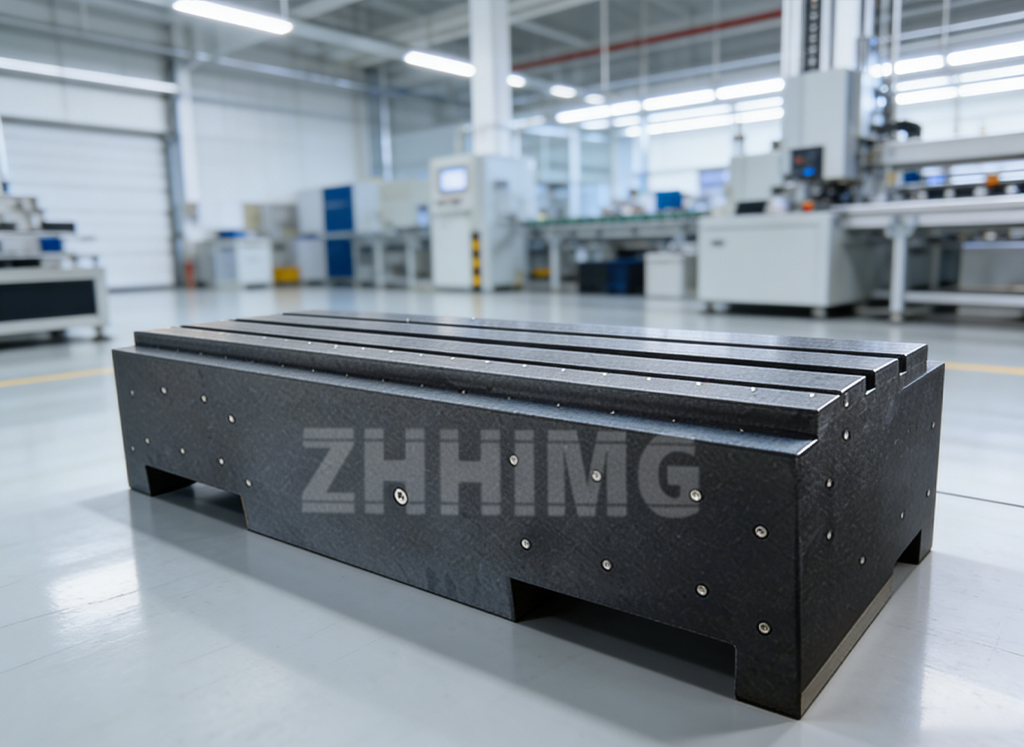
Practical tips for on‑site usage besides product selection
Even with properly‑matched self‑weight and span, field‑application details influence final results. Operators should place supports at the designated fulcrum positions suggested by the manufacturer, instead of random‑point placement. When inspecting variable‑gap work‑pieces, avoid expanding unsupported span beyond the validated limit of the granite ruler. For extra‑large gaps, adopt multi‑segment measurement workflows or select larger‑section custom‑made rulers. Storage and transportation supports should replicate working‑condition fulcrum layout to prevent permanent internal‑stress build‑up.
Wide‑range application for large‑component calibration
Reasonable span‑self‑weight matching delivers stable reference performance across many demanding fields: machine‑tool guide‑way checking, semiconductor‑equipment frame alignment, linear‑motor‑platform calibration, large‑size fixture inspection and precision‑laser‑device assembly. Many global partners from Fortune‑500 manufacturers to research institutes rely on ZHHIMG’s custom‑configured granite measuring tools for long‑gap metrology tasks.
Driven by its quality philosophy that ultra‑precision manufacturing allows zero compromise, ZHHIMG continues to promote application‑oriented custom‑design for granite metrology products. Beyond standard catalog items, the team provides span‑based structural optimization for customers confronted with special large‑gap inspection conditions, removing gravitational‑deflection risks at the product‑design phase.
Post time: Aug-12-2026