
As the semiconductor industry pushes toward 3nm processes and beyond, the margin for error has effectively vanished. For equipment manufacturers, the structural integrity of the machine base is no longer just a mechanical consideration—it is a critical determinant of yield.
At ZHHIMG Group, we recognize that in wafer inspection and lithography systems, precision granite components have become the industry standard for maintaining sub-micron stability. But how do you select the right material for your specific application?
The Material Showdown: Granite vs. Steel vs. Mineral Casting
When designing a semiconductor equipment base, engineers typically weigh three primary materials. Understanding their physical properties is key to ensuring long-term accuracy.
1. Granite: The Gold Standard for Stability
High-density black granite (such as the G684 or Jinan Black varieties often used by ZHHIMG) offers a unique combination of properties. It is naturally aged, meaning it has zero internal stress. Unlike metals, it does not rust or oxidize, and it possesses exceptional vibration damping capabilities.
2. Steel: High Stiffness, High Risk
Welded steel structures are stiff but prone to thermal distortion. Steel expands significantly with temperature changes, which can misalign sensitive optical paths. Furthermore, welded frames are susceptible to residual stress relief over time, leading to warping.
3. Mineral Casting (Polymer Concrete): The Alternative
Mineral casting offers good damping but often lacks the sheer hardness and surface durability of natural granite. While useful for certain machine tools, it may not meet the extreme flatness and wear-resistance requirements of high-end semiconductor wafer handling.
Technical Comparison: Why Granite Wins
| Feature | Precision Granite | Steel / Welded Frame | Mineral Casting |
|---|---|---|---|
| Thermal Expansion | Extremely Low | High (Requires temp control) | Low |
| Vibration Damping | Excellent (10x Steel) | Poor | Good |
| Dimensional Stability | Permanent (Natural Aging) | Drifts over time (Stress relief) | Stable |
| Corrosion Resistance | Immune | Requires coating/painting | Good |
| Magnetic Properties | Non-magnetic | Magnetic (Interferes with e-beam) | Non-magnetic |
Key Takeaway: For semiconductor equipment requiring sub-micron repeatability, granite’s low coefficient of thermal expansion and non-magnetic nature make it superior to steel and more durable than mineral casting.
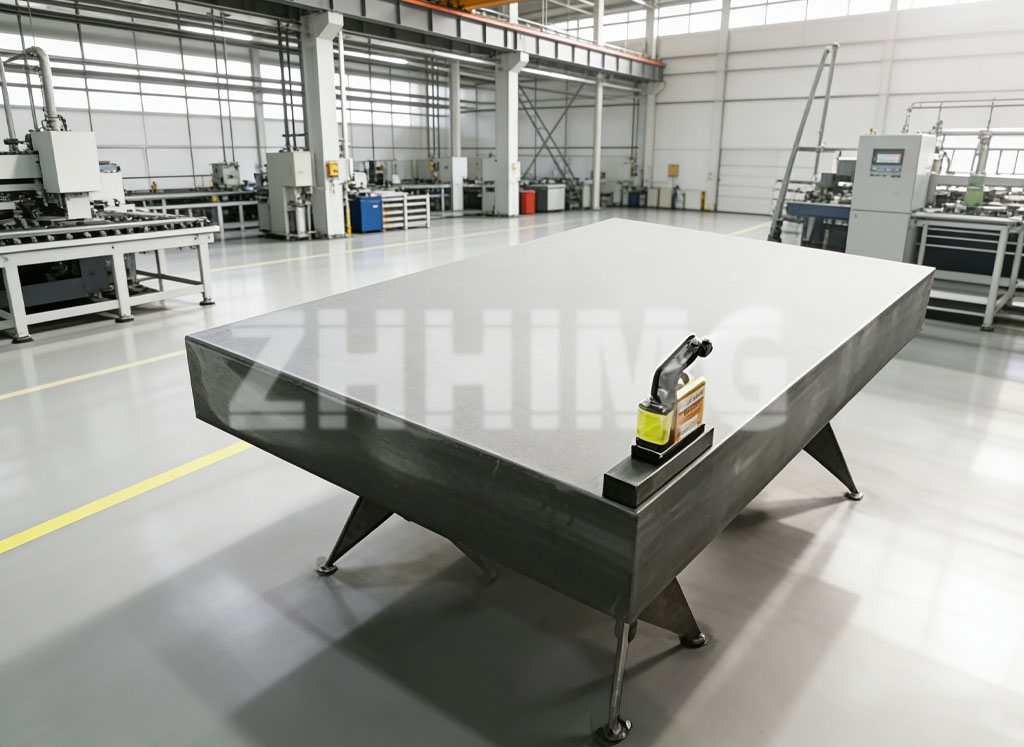
The Science of Stability: Low Expansion & High Damping
In semiconductor manufacturing, two physical properties of granite are paramount:
1. Low Coefficient of Thermal Expansion
Semiconductor fabs (factories) maintain strict temperature controls, but micro-fluctuations still occur. Granite has a very low coefficient of thermal expansion (typically around
4.5×10⁻⁶/∘C ). This means that even if the ambient temperature shifts slightly, the granite base remains dimensionally stable, ensuring that the alignment of the wafer stage remains accurate to the nanometer.
2. High Damping Capacity
Vibration is the enemy of precision. Whether it is floor vibration or vibration generated by the machine’s own motors, these oscillations blur the “image” of the process. Granite’s crystal structure absorbs vibration far more effectively than steel or iron. This high damping capacity is crucial for wafer inspection systems
Industry Case Study: Wafer Inspection Equipment
Consider a leading manufacturer of wafer inspection tools. Their challenge was thermal drift affecting the optical alignment of their sensors during long scan cycles.
The ZHHIMG Solution:
We replaced their existing metal base structure with a custom-engineered precision granite component.
We replaced their existing metal base structure with a custom-engineered precision granite component.
- Integration: We machined precise mounting interfaces and cable channels directly into the granite structure, reducing assembly complexity.
- Result: The customer reported a significant reduction in thermal distortion. The granite base provided a “neutral” temperature environment for the optics, resulting in higher throughput and fewer false defect detections.
Partnering with ZHHIMG for Precision
Choosing the right supplier is as important as choosing the right material. At ZHHIMG Group, we don’t just cut stone; we engineer precision structures.
- Advanced Manufacturing: We utilize large-scale CNC machining centers to achieve tight tolerances on complex geometries.
- Quality Control: Every component undergoes rigorous inspection using laser interferometers and electronic level gauges to ensure flatness and parallelism meet your specific semiconductor standards.
- Customization: From vacuum pre-loaded air bearing surfaces to threaded inserts, we integrate your mechanical requirements directly into the granite.
Conclusion
As we move further into 2026, the demand for sub-micron precision will only intensify. By choosing precision granite components
As we move further into 2026, the demand for sub-micron precision will only intensify. By choosing precision granite components
Post time: Apr-09-2026