
In the world of precision manufacturing, every measurement needs a “zero point”—a reliable, perfectly flat plane from which all other dimensions are derived. For over half a century, the granite surface plate has served as this fundamental reference. However, when it comes to outfitting an inspection room or a machine shop, one of the most frequent questions we encounter isn’t about the size of the plate, but rather the Grade.
Choosing the right grade is a balancing act between the precision required by your projects and the environmental realities of your workspace. Selecting a grade that is too low can compromise your quality control, while selecting one that is unnecessarily high can lead to inflated costs and maintenance challenges. To make an informed decision, it is essential to understand what these grades actually represent and how they perform in the real world.
The Anatomy of Accuracy: Understanding Flatness Tolerances
Surface plate grades are not arbitrary labels; they are strictly defined by international standards (such as ASME B89.3.7 or ISO 8512-2). These standards dictate the “Maximum Permissible Error” for flatness across the entire surface. When we talk about flatness in this context, we are referring to the distance between two parallel planes that envelope all the peaks and valleys of the stone’s surface.
The industry generally categorizes plates into three primary grades:
-
Grade AA (Laboratory Grade): The highest standard, typically reserved for temperature-controlled metrology laboratories.
-
Grade A (Inspection Grade): The workhorse of quality control departments, offering a high degree of accuracy for general inspection.
-
Grade B (Toolroom Grade): Designed for the shop floor, where initial layouts and rougher checks occur.
The difference in flatness between these grades is measured in micrometers (microns). For example, a small Laboratory Grade AA plate might have a flatness tolerance of 2.5 microns, while a Toolroom Grade B plate of the same size might allow for 10 microns. While these numbers seem infinitesimal, they become a massive factor when you are stacking gage blocks or using high-resolution electronic indicators.
Grade AA: The Laboratory Standard
If your facility is engaged in aerospace, medical device manufacturing, or semiconductor assembly, Grade AA is likely your requirement. These plates are designed for “master” calibrations. Because the tolerance is so tight, Grade AA plates are incredibly sensitive to their environment.
A Grade AA plate is only as accurate as the room it sits in. In a metrology lab, the temperature is usually held strictly at 20℃ (68℉). If you were to place a Grade AA plate on a drafty shop floor near an open bay door, the thermal gradient—the difference in temperature between the top and bottom of the stone—would cause the plate to warp enough to move it out of Grade AA specifications within minutes. Therefore, you should only select Grade AA if you have a controlled environment to protect your investment.
Grade A: The Inspection Room Workhorse
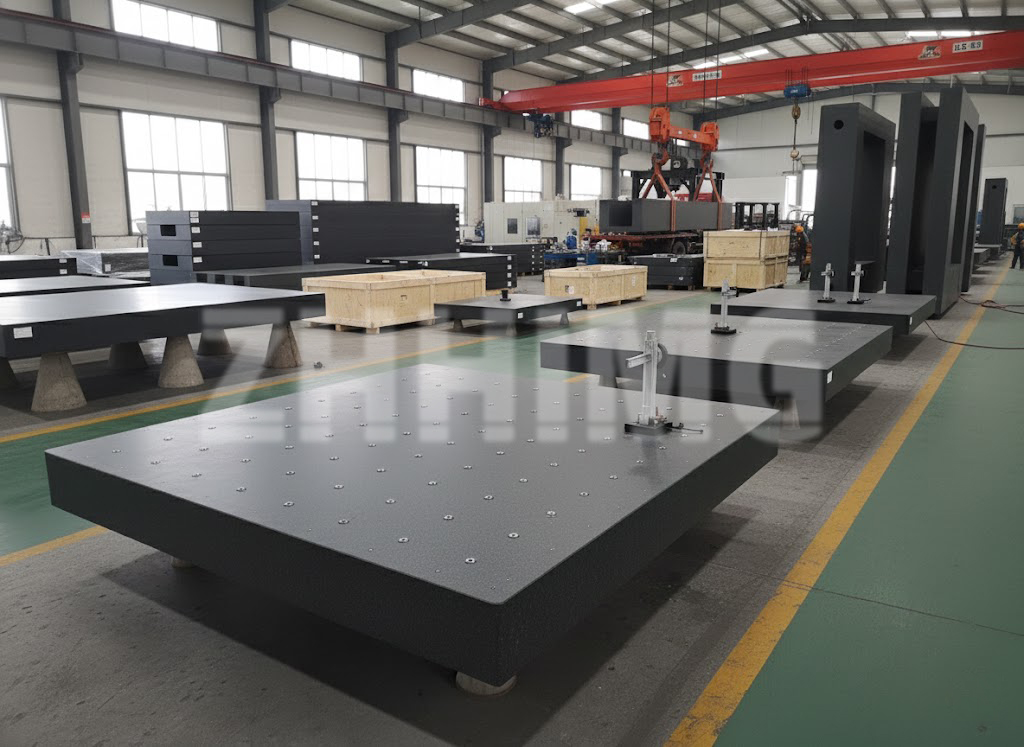
For the vast majority of precision machine shops, Grade A is the most logical choice. It provides the necessary accuracy for verifying parts produced on CNC machines without being quite as “finicky” as Laboratory Grade stone. Grade A plates are perfect for use with height gages, sine bars, and coordinate measuring machines (CMMs) in a dedicated inspection area that, while perhaps not a “cleanroom,” is kept at a relatively stable temperature.
Grade A offers a “sweet spot” in terms of ROI. It provides enough precision to satisfy most ISO 9001 requirements while remaining durable enough for daily use by multiple technicians.
Grade B: Rugged Accuracy for the Toolroom
Grade B plates are the unsung heroes of the production floor. These plates are meant to be used where the work is actually happening. They are thicker and more rugged, designed to handle the weight of raw castings or heavy fixtures.
While you wouldn’t use a Grade B plate to calibrate your master gage blocks, it is more than sufficient for checking a part’s layout or verifying a setup before a long machining run. The primary advantage of Grade B is its resilience; it provides a much more stable and accurate surface than a standard steel workbench, yet it doesn’t require the delicate “white glove” treatment of an AA-grade surface.
Key Factors to Consider When Selecting
When deciding which grade to purchase, ask yourself the following three questions:
-
What is my tightest tolerance? A common rule of thumb is the 10:1 ratio. Your measurement tool (including the surface plate) should be ten times more accurate than the part you are measuring. If your part tolerance is ± 0.01 mm, your surface plate setup should ideally be accurate to 0.001mm.
-
Where will the plate live? As mentioned, the environment is the biggest enemy of accuracy. High-grade plates require temperature stability. If your inspection room is subject to sunlight hitting the plate or air conditioning vents blowing directly on it, a Grade AA plate may never actually stay flat.
-
What is the weight of the parts? Heavier parts can cause “point loading” and deflection. While the grade refers to flatness, higher-grade plates often require more frequent calibration if they are subjected to heavy loads that can wear down specific areas of the stone over time.
Conclusion: A Foundation of Trust
A granite surface plate is more than just a piece of stone; it is the foundation of your customer’s trust. Whether you choose the extreme precision of Grade AA, the versatile reliability of Grade A, or the rugged utility of Grade B, the key is to ensure the plate is regularly calibrated and properly maintained.
By understanding the technical nuances of these grades, you can ensure that your inspection room is equipped to handle the challenges of modern manufacturing without overspending on unnecessary specifications.
Post time: Apr-13-2026