
In advanced manufacturing environments, stability is not an abstract concept—it is the foundation of precision. As robotics, semiconductor equipment, and metrology systems continue to demand tighter tolerances and greater thermal control, the materials used for structural bases are under increasing scrutiny. ZHHIMG Group has responded to this evolution by strengthening its expertise in industrial granite and high-precision base solutions engineered specifically for robotics platforms, laboratory systems, and automated production lines.
Across Europe and North America, equipment manufacturers are re-evaluating structural materials in pursuit of improved vibration damping, dimensional stability, and long-term accuracy. Industrial granite, once associated primarily with inspection tables, has become a critical structural material for modern automation. ZHHIMG’s ongoing developments reflect a broader industry shift toward engineered stone platforms optimized for dynamic and thermally sensitive environments.
Granite for Robots: Structural Stability in Dynamic Systems
Robotic systems today operate with micron-level positioning requirements. Whether used in semiconductor wafer handling, laser processing, PCB drilling, or precision assembly, robotic arms introduce dynamic loads and complex motion profiles that demand rigid and vibration-damping bases.
Granite for robots has emerged as a superior alternative to traditional welded steel frames in many precision-focused applications. Unlike steel, granite exhibits high internal damping capacity, significantly reducing vibration transmission generated by servo motors, linear guides, and high-speed spindles. This intrinsic damping characteristic enhances positioning accuracy and repeatability, particularly in high-speed pick-and-place systems or coordinate motion platforms.
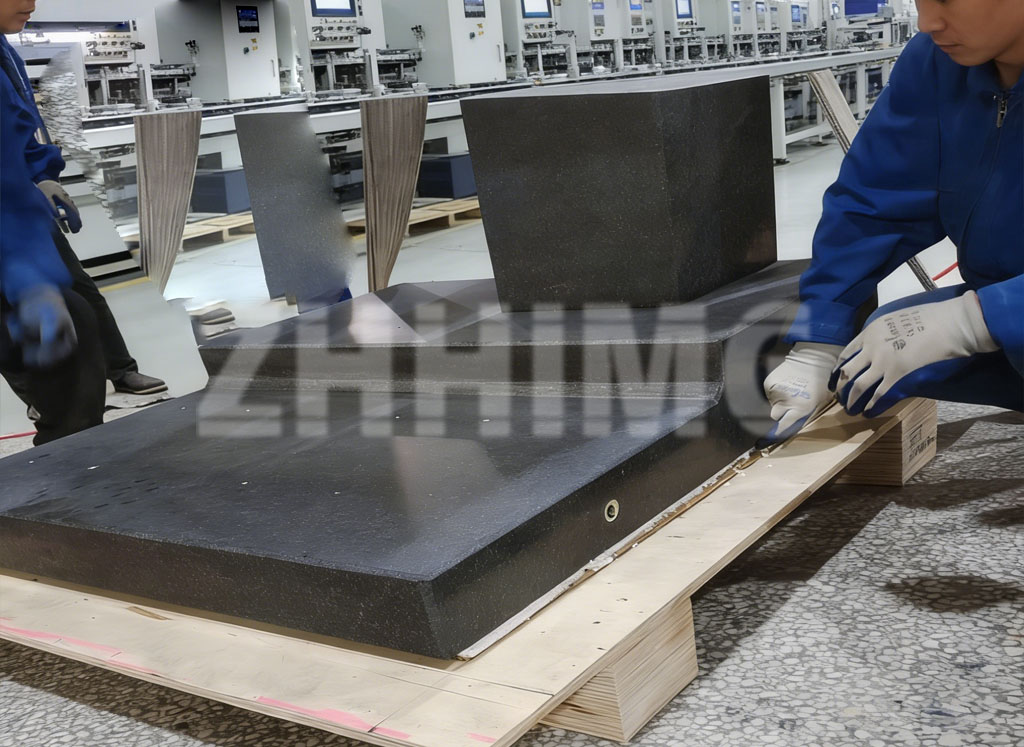
ZHHIMG’s engineered industrial granite bases are manufactured from high-density black granite selected for its uniform grain structure and mechanical integrity. After precision cutting, CNC processing, and fine grinding, each high-precision base is calibrated to meet strict flatness and perpendicularity tolerances required by European and American OEM standards.
For robotics integrators, the advantages extend beyond vibration suppression. Granite’s low coefficient of thermal expansion ensures dimensional stability across temperature fluctuations common in industrial facilities. As robotics cells increasingly integrate vision systems, laser sensors, and precision linear encoders, thermal drift becomes a limiting factor in system performance. Granite structures help mitigate that risk.
Industrial Granite in Semiconductor and Advanced Manufacturing
The semiconductor and microelectronics sectors have elevated performance requirements for structural platforms. Equipment used for lithography alignment, wafer inspection, and micro-machining requires a stable reference plane that maintains flatness and geometry over extended operational cycles.
Industrial granite offers a unique combination of compressive strength, chemical resistance, corrosion immunity, and non-magnetic properties. Unlike ferrous materials, granite does not rust or require surface coatings that degrade over time. In cleanroom environments, this stability translates into reduced maintenance and longer service intervals.
ZHHIMG’s lab granite and industrial granite platforms are increasingly integrated into:
-
Semiconductor processing equipment
-
Optical inspection systems
-
CMM and metrology platforms
-
Laser engraving and micro-machining machines
-
High-precision motion systems
By combining granite structures with embedded steel inserts, threaded bushings, and precision-ground mounting interfaces, ZHHIMG supports modular assembly designs favored by Western equipment manufacturers. The integration capability ensures granite bases function not only as passive structures but as engineered mechanical platforms ready for immediate system integration.
Lab Granite: Precision Foundations for Metrology
In laboratory environments, the term lab granite refers to more than inspection surface plates. Modern R&D laboratories require granite-based structures for vibration-sensitive measurement instruments, interferometers, coordinate measuring machines, and calibration benches.
Measurement repeatability at the micron and sub-micron level depends heavily on base stability. Air-bearing systems and optical metrology platforms often rely on granite bases due to their superior flatness retention and vibration damping.
ZHHIMG manufactures high-precision base structures for laboratory applications with certified accuracy grades compliant with international metrology standards. Each granite component undergoes rigorous flatness inspection using laser interferometry and precision electronic levels. For laboratories in Europe and North America, documentation and traceability are as important as mechanical performance; therefore, dimensional reports and quality certificates accompany each shipment.
The ability to customize lab granite platforms—whether through T-slots, threaded inserts, precision grooves, or air-bearing integration channels—allows research institutions and OEM developers to optimize their experimental configurations.
High-Precision Base Manufacturing: From Raw Stone to Engineered Platform
Producing a high-precision base from granite requires far more than cutting and polishing. ZHHIMG’s manufacturing process reflects a systematic approach that combines material science, precision machining, and environmental control.
The process begins with careful selection of raw granite blocks characterized by consistent mineral composition and structural homogeneity. After rough cutting, stress relief and stabilization procedures are applied to minimize internal tension. This step is critical in preventing long-term deformation.
CNC machining is used to define mounting features and geometric interfaces. Grinding and lapping operations then achieve the required flatness and parallelism. In climate-controlled workshops, final calibration ensures dimensional conformity to specified tolerances.
For complex robotic and automation applications, ZHHIMG integrates steel or ceramic components into granite bodies using precision bonding and mechanical fastening methods. The hybridization of materials allows customers to combine granite’s damping advantages with the structural versatility of metal components.
The result is not merely a granite slab but a fully engineered structural solution.
Why OEMs Are Transitioning from Steel to Industrial Granite
In Western markets, the trend toward industrial granite is closely tied to performance optimization and total cost of ownership considerations.
Welded steel frames are susceptible to residual stress, distortion from machining, and thermal expansion variability. Over time, these factors can degrade system alignment. Additionally, vibration amplification in steel structures can compromise sensitive processes.
Industrial granite addresses these limitations. Its natural damping reduces resonance effects, and its dimensional stability minimizes recalibration frequency. Maintenance costs decrease, while system uptime improves.
For robotics and semiconductor OEMs competing in high-precision segments, even marginal gains in stability can translate into measurable improvements in throughput and yield. As tolerances shrink and process complexity increases, structural material selection becomes a strategic engineering decision rather than a commodity choice.
ZHHIMG’s Ongoing Investment in Precision Infrastructure
To meet increasing demand from Europe and North America, ZHHIMG continues to expand its production capabilities in precision grinding, CNC machining, and quality control. Advanced inspection systems, including laser measurement and electronic leveling instruments, support the production of high-precision base platforms tailored for robotics and laboratory applications.
Collaboration with research institutions and industrial partners strengthens process innovation. By analyzing vibration response, thermal behavior, and structural load distribution, ZHHIMG refines its design methodologies to support next-generation automation systems.
The company’s engineering team works closely with clients during the early design phase, ensuring that granite base geometry, mounting interfaces, and insert placements align with system performance objectives. This consultative approach reduces integration complexity and accelerates time-to-market for OEMs.
Case Insights: Robotics Platform Stabilization
In a recent robotics integration project for a European automation manufacturer, ZHHIMG supplied a custom granite for robots solution designed to support high-speed linear motion modules. The original steel frame design exhibited unacceptable vibration levels during rapid acceleration cycles.
By transitioning to a granite-based high-precision base with optimized mass distribution and embedded steel mounting points, the customer achieved improved vibration attenuation and reduced positional deviation. Subsequent testing demonstrated enhanced repeatability under dynamic load conditions.
Such cases illustrate the material’s functional value in real-world applications, reinforcing industrial granite’s role in advanced automation.
Sustainability and Long-Term Reliability
Sustainability considerations increasingly influence procurement decisions in Western markets. Granite, as a natural material, offers durability measured in decades rather than years. Its resistance to corrosion eliminates the need for chemical coatings or frequent surface refurbishment.
Moreover, the longevity of granite structures contributes to reduced material turnover and lower lifecycle environmental impact compared to steel frames requiring periodic replacement or reconditioning.
ZHHIMG emphasizes responsible sourcing and efficient material utilization throughout its production chain, aligning operational practices with international environmental standards.
Looking Ahead: The Structural Backbone of Precision Engineering
As robotics, semiconductor equipment, photonics systems, and laboratory instruments continue to evolve, the structural backbone supporting these technologies must evolve as well. Industrial granite and lab granite solutions are no longer peripheral components; they are central to system accuracy and reliability.
ZHHIMG’s focus on high-precision base manufacturing positions the company at the intersection of material science and advanced automation. By combining engineered granite expertise with precision machining capabilities, the company supports global OEMs seeking measurable performance improvements.
In the competitive landscape of European and North American precision manufacturing, stability is a differentiator. Granite for robots and laboratory systems represents not just a material choice, but a commitment to accuracy, durability, and engineering excellence.
For organizations developing next-generation automation platforms, structural integrity begins at the base. And increasingly, that base is granite.
Post time: Feb-27-2026