
The pursuit of precision is the defining characteristic of modern high-tech industry. From the etching process in semiconductor fabrication to the multi-axis movement of ultra-high-speed CNC machines, the fundamental requirement is absolute stability and accuracy measured in nanometers. This relentless demand for finer tolerances has rendered many traditional materials inadequate, leading engineers and metrologists back to a seemingly archaic solution: granite. This durable, naturally formed rock, when selected and processed by specialized groups like ZHONGHUI (ZHHIMG®), forms the critical, silent foundation upon which the next generation of industrial equipment operates.
The metrology world, by definition, must establish a reference plane of impeccable stability. When machines need to locate a point with sub-micron accuracy, the environment and the base material are paramount. Any minute deviation caused by thermal fluctuation, internal stress, or ambient vibration can propagate errors that ruin an expensive production run. This is where the inherent material science of specialized black granite triumphs over steel or cast iron.
The Material Imperative: Why Granite Outperforms Metal
Modern machine tool bases were traditionally constructed from steel or cast iron. While these metals offer high rigidity, they suffer from two major drawbacks in ultra-precision applications: low damping capacity and high coefficients of thermal expansion (CTE). A metal base will ring like a bell when excited by external forces, maintaining oscillations that immediately compromise measurement or machining processes. Furthermore, even small temperature changes cause significant expansion or contraction, distorting the base and throwing the entire machine out of calibration.
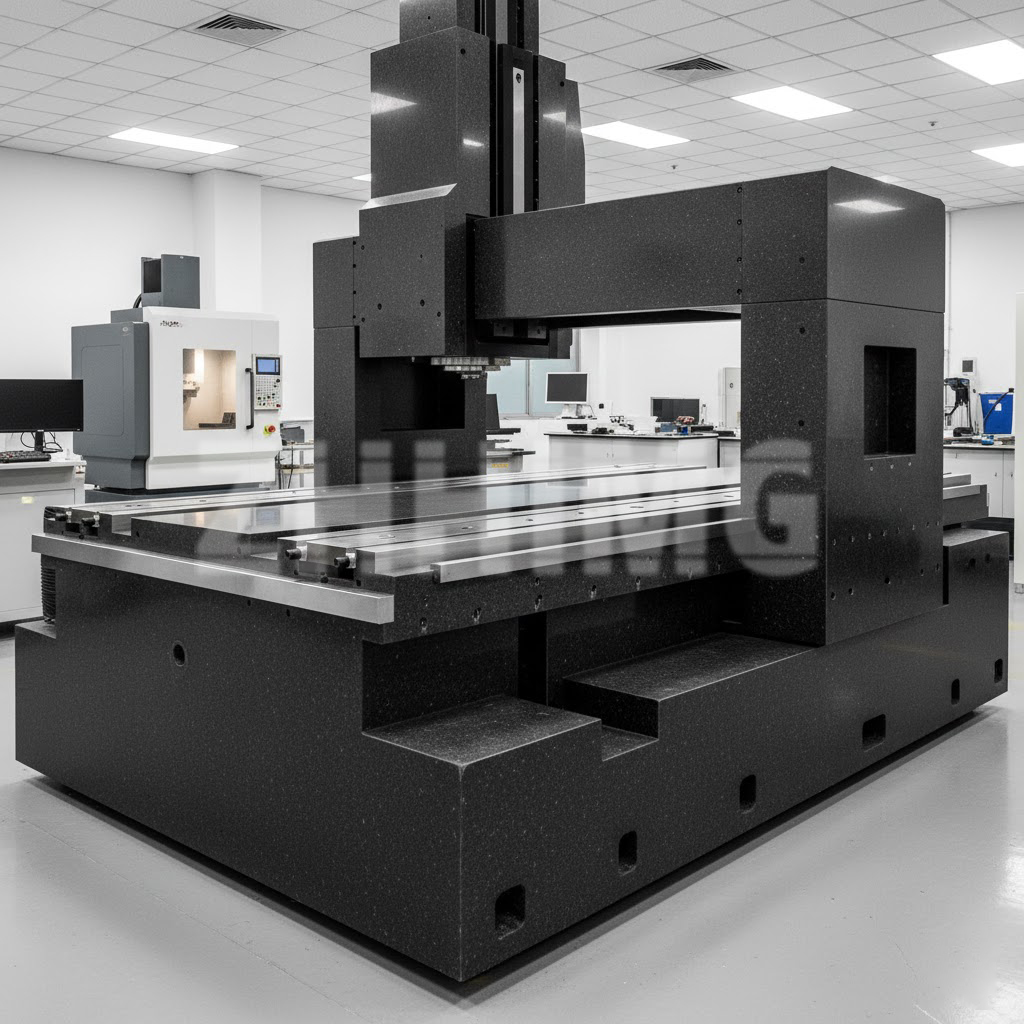
Granite, particularly the specialized, high-density variants used by industry leaders, flips this equation. Its composition is naturally isotropic, meaning its properties are uniform in all directions, and its CTE is significantly lower than that of metals. Crucially, granite possesses an exceptionally high material damping capacity—it absorbs and dissipates mechanical vibrations rapidly. This thermal and vibrational stability makes it the only truly reliable substrate for the most demanding applications, such as Coordinate Measuring Machines (CMMs) and advanced wafer inspection equipment.
For example, ZHHIMG’s proprietary black granite boasts a density approaching 3100 kg/m³. This characteristic high density is non-negotiable; it is directly correlated with reduced porosity and increased resistance to moisture absorption, further stabilizing the component against environmental changes. This superior physical performance—which many experts find surpasses even common European and American black granite equivalents—is the first layer of trust built into every component. Any deviation from this standard, such as using lower-grade materials or cheaper marble alternatives, introduces immediate physical limitations that compromise the eventual nanometer accuracy required by the client. The commitment to using only the best raw materials is an ethical and technical benchmark in this industry.
The Battle Against Environmental Noise: The granite vibration insulated platform
In a precision facility, the greatest enemy is not the machine itself, but the chaotic background noise: the footsteps of an operator, the rumble of a distant truck, or the cyclic action of nearby HVAC systems. These seemingly insignificant environmental vibrations are enough to blur an image under a high-magnification microscope or introduce chatter into a fine machining operation. This is why the granite vibration insulated platform is indispensable—it serves as the last bastion of stability between the turbulent external world and the sensitive measurement system.
These platforms are not merely granite slabs; they are meticulously engineered systems. They utilize the granite’s inherent damping properties in conjunction with advanced pneumatic or elastomeric isolation systems. The massive inertia provided by the high-density granite effectively filters out high-frequency vibrations, while the active isolation system handles the low-frequency disturbances. The sheer mass and stiffness of the granite component—manufactured by facilities capable of handling monolithic structures up to 100 tons—ensures that the natural frequency of the entire assembly is pushed far below the typical operating frequency of surrounding equipment, resulting in a ‘quiet’ zone where measurement can take place without interference.
The construction of the manufacturing environment itself is a testament to the platform’s importance. Specialized production facilities, such as those maintained by ZHHIMG, feature temperature-controlled, constant-humidity clean rooms, often spanning 10,000 m². These facilities utilize ultra-thick, anti-vibration concrete flooring, sometimes exceeding 1000 mm in depth, and are surrounded by deep anti-vibration trenches. Even the overhead cranes inside these assembly halls are selected for their ‘silent’ operation. This investment in a stable environment is crucial, particularly for components destined for sensitive applications like semiconductor assembly, where the platform’s performance directly dictates yield. The engineering philosophy is simple but uncompromising: if you cannot measure the environment accurately, you cannot produce a reliable platform.
Defining Precision: The Role of Calibrated Granite Rulers
The stability provided by the base platform must be transferred to the machine’s moving parts and, ultimately, verified by metrology instruments. This verification relies on precision reference standards that are themselves beyond reproach. This is where the ultra-precise Granite square ruler Grade AA and the specialized Granite Straight Ruler with 4 precision surfaces become fundamental tools.
The Grade AA Standard
The Granite square ruler Grade AA is the ultimate benchmark of angular and positional accuracy in CMMs and advanced machine tool assembly. The ‘Grade AA’ designation itself is a universally recognized standard (often aligning with specifications like DIN 875 or ASME B89.3.7) that denotes the highest level of geometric tolerance. Achieving this grade requires parallelism, perpendicularity, and straightness tolerances measured in fractions of a micron—levels only attainable through material stability and the most painstaking finishing processes. When a machine builder needs to ensure that the vertical axis (Z-axis) is perfectly perpendicular to the horizontal plane (X-Y plane), the Grade AA square ruler provides the immutable, calibrated reference against which the machine’s geometry is locked. Without this tool, certified geometric accuracy is impossible.
The Versatility of Multi-Surface References
The Granite Straight Ruler with 4 precision surfaces is another crucial instrument, especially for the alignment of long-travel linear motion systems, such as those found in PCB drilling machines or large-format laser cutters. Unlike simpler rulers, the four precision faces allow the ruler to be used not only to verify straightness along its length but also to ensure parallelism and squareness between machine elements simultaneously. This multi-surface capability is essential for performing comprehensive geometric alignments where the interactions between multiple axes must be verified. The precision finish on these surfaces, achieved through decades of accumulated knowledge and practice, allows these tools to serve not only as inspection equipment but also as assembly fixtures themselves.
The Unwavering Authority of Craftsmanship and Global Standards
The final, often overlooked, layer of authority and precision is the human element combined with rigid adherence to international standards. The journey from a raw quarry block to a nanometer-flat reference surface is dictated by a process that is both scientific and artisanal.
Leading manufacturers recognize that compliance with stringent global standards—including German DIN (like DIN 876, DIN 875), American GGGP-463C-78 and ASME, Japanese JIS, and British BS817—is non-negotiable. This global competency ensures that a component manufactured in Asia can be seamlessly integrated into a machine built to European specifications or measured using an American-calibrated CMM.
This process is underpinned by the mastery of the finishing technicians. It is not an exaggeration to state that the most refined granite components are still finished by hand. In the specialized workshops of groups dedicated to ultra-precision, grinding masters possess more than three decades of experience. They are, as clients often describe them, “walking electronic levels.” Their tactile sense allows them to gauge the removal of material to the single-micron or even sub-micron level with a single, practiced movement of the grinding lap—a skill that no CNC machine can replicate. This dedication ensures that even when the product’s required accuracy is 1 μm, the craftsman is working towards a tolerance often reaching the nanometer scale.
Furthermore, this manual skill is verified by the world’s most advanced metrology infrastructure, including Mahr (down to 0.5 μm), Swiss WYLER electronic levels, and British Reinshaw Laser Interferometers. Every single piece of inspection equipment must itself be traceable to national and international metrology institutes, creating an unbroken chain of calibration authority. This holistic approach—superior material, world-class facilities, adherence to diverse global standards, and verified human craftsmanship—is what ultimately distinguishes the true leaders in precision granite.
The Future is Stable
The applications for these ultra-stable foundations continue to expand rapidly, moving far beyond traditional CMMs into high-growth sectors: the bases for Femtosecond and Picosecond laser systems, the platforms for Linear Motor Stages, the foundations for new energy battery inspection equipment, and the critical alignment benches for perovskite coating machines.
The industry is governed by a simple truth, perfectly encapsulated by the philosophy of its leaders: “The precision business can’t be too demanding.” In the race for ever-finer tolerances, the trusted partnership with a supplier committed to Openness, Innovation, Integrity, and Unity—and who pledges No cheating, No concealment, No misleading—becomes just as critical as the components themselves. The longevity and authority of specialized granite components prove that sometimes, the most sophisticated solutions are derived from the most elemental materials, processed and verified to the highest ethical and technical standards the world demands. The stability of stone remains the unshakable truth in the volatile world of ultra-precision.
Post time: Dec-08-2025