
The modern manufacturing landscape is defined by dynamic complexity: high-speed automation, real-time sensor feedback, and artificial intelligence guiding robotic arms. Yet, at the heart of this technological frontier lies a singular, passive, and unchanging truth: the Granite Metrology Table. This fundamental reference surface, often a black precision granite surface plate, remains the ultimate standard against which all dimensional accuracy is judged.
The continued, critical reliance on Granite Measuring Tools in high-tech industries—from semiconductor fabrication to aerospace—is not a sign of tradition, but a profound acknowledgement of material physics. When systems require accuracy down to the nanometer, the foundation itself must be beyond reproach, possessing stability that no active electronic system can perfectly replicate.
The Immutable Physics of Granite
The primary challenge in ultra-precision metrology is isolating measurement from environmental noise. This noise manifests in two destructive forms: thermal drift and mechanical vibration.
1. Conquering Thermal Drift
The most prevalent cause of dimensional error in a manufacturing environment is temperature change. When materials heat up, they expand; when they cool down, they contract. The degree of this change is governed by the Coefficient of Thermal Expansion (CTE). Metals, such as steel and cast iron, exhibit high CTEs. Even a slight temperature fluctuation can cause a metal reference base to deform by several micrometers—an immediate failure in the sub-micron world.
Specialized black precision granite possesses a significantly lower CTE, making it highly stable. This quality ensures that a Granite Metrology Table maintains its certified flatness and dimension despite ambient temperature variations. Furthermore, the material’s high density allows it to absorb and regulate heat slowly, acting as a thermal buffer and minimizing the destabilizing effect of rapid temperature gradients across its surface.
2. Dampening Mechanical Chaos
Every factory floor is subject to vibration—from compressors, HVAC units, footsteps, and distant traffic. These vibrations, though often imperceptible to humans, can easily throw off a sensitive laser measurement or compromise the alignment of a precision component.
Granite excels here due to its superior internal damping capacity. Unlike metal, which tends to ring or resonate when struck, granite quickly dissipates mechanical energy internally. When a high-resolution instrument, such as a CMM or a laser tracking device, is placed on a black precision granite surface plate, the granite ensures that the measured data reflects the geometry of the part, not the kinetic noise of the environment. This combination of low CTE and high damping capacity makes granite the only passive material suitable for serving as the foundation for the world’s most demanding measurements.
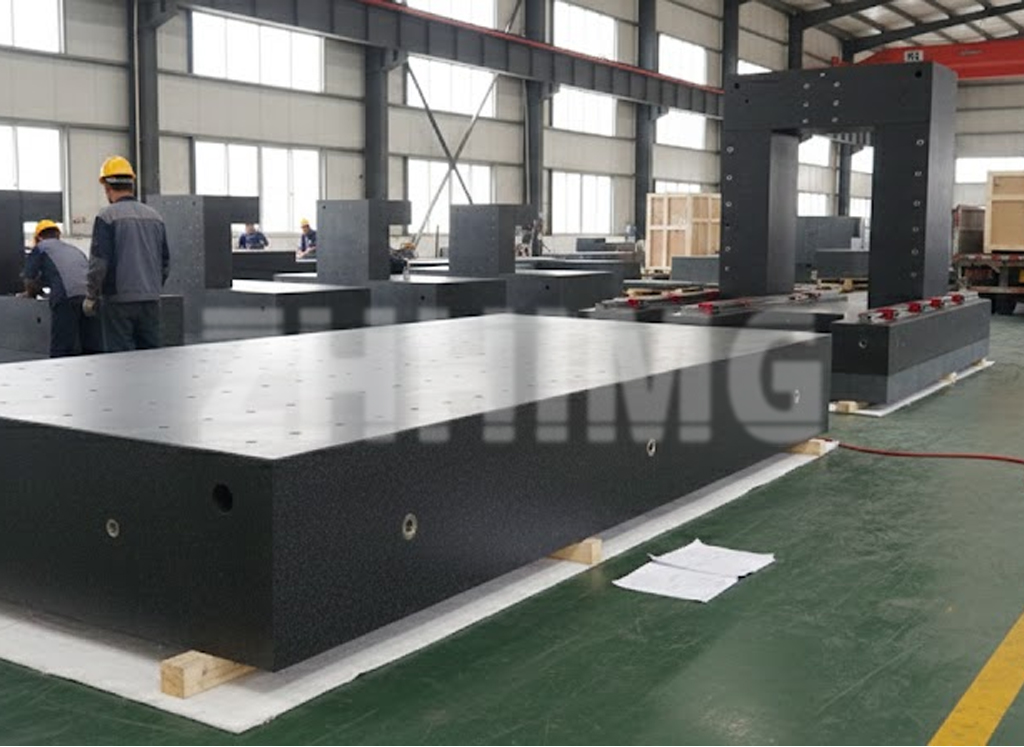
The Granite Metrology Table: Defining the Zero Plane
At the core of dimensional inspection is the Granite Metrology Table, which is typically synonymous with a high-grade black precision granite surface plate. This is not just a heavy workbench; it is the zero plane—the designated, certified reference surface from which all linear and angular measurements originate.
These tables are manufactured to incredibly demanding specifications, often adhering to international standards such as DIN 876, ASME B89, or JIS B 7510. The grade of a surface plate (e.g., Grade 00, Grade 000) dictates the permissible flatness deviation across the entire working area. The highest grades achieve flatness measured in mere nanometers, a monumental feat achieved only through meticulous final lapping processes.
The surface plate’s function extends far beyond just supporting a part:
-
Establishing Datum: It provides the ultimate datum line or plane for all geometric inspections, ensuring that parallelism, squareness, and straightness measurements are all relative to a single, verified reference point.
-
Integrating Equipment: The table serves as the stable base for auxiliary Granite Measuring Tools (like squares, parallels, and V-blocks) as well as sophisticated instruments like electronic levels and laser interferometers.
The Ecosystem of Granite Measuring Tools
The surface plate is the anchor, but its effectiveness is unlocked by the ecosystem of Granite Measuring Tools placed upon it. These supporting accessories allow for the precise transfer and verification of geometric truth.
-
Granite Parallels: Used to elevate and support workpieces while maintaining parallelism relative to the surface plate. Their stability ensures that the component’s orientation is not compromised during measurement.
-
Granite V-Blocks: Essential for mounting cylindrical objects (shafts, pins) and ensuring the axis of the cylinder is perfectly parallel to the reference plane, a critical step for eccentricity and runout measurements.
-
Granite Tri Squares and Straight Edges: As discussed in other contexts, these tools transfer the flatness of the plate into perfect squareness and straightness references, allowing technicians to verify the perpendicularity of machine movements or assembled features.
The consistent use of high-density granite for all these measuring tools minimizes material inconsistency and ensures that the entire measurement setup is thermally and kinetically uniform.
The Unwavering Authority of Craftsmanship and Traceability
The ability to consistently produce large, high-grade black precision granite surface plates requires an investment not only in advanced machinery—such as ultra-large capacity CNC processing centers and specialized 6000 mm grinders—but also in the human element. The final, crucial step of surface lapping remains an artisan skill.
Leading manufacturers maintain a staff of master technicians whose hands can literally feel and correct deviations at the sub-micron level, a skill honed over decades. This craftsmanship is then validated by an unwavering commitment to quality assurance. All Granite Measuring Tools must be certified using equipment (like laser trackers and electronic levels) whose accuracy is fully traceable to international metrology standards (e.g., NIST, NPL, PTB). This continuous chain of calibration provides the absolute confidence required by industries where precision equates to safety, efficiency, and breakthrough technology.
The philosophy guiding this industry is one of uncompromising integrity: “The precision business can’t be too demanding.” The enduring presence of the simple, static Granite Metrology Table in the highest-tech facilities proves that while machines may perform the dynamic work, the geometric truth must always be defined by the quiet, unchanging stability of stone.
Post time: Dec-08-2025