
As high-precision industries evolve, structural materials are undergoing renewed scrutiny. Equipment manufacturers, research laboratories, and system integrators are no longer selecting base materials solely on cost or availability. Instead, dimensional stability, vibration damping, chemical resistance, and lifecycle performance have become central decision factors.
In this context, the discussion surrounding epoxy granite vs natural granite has gained increasing attention in Western markets. At the same time, demand continues to grow for robust granite structural components and durable granite work surfaces for labs that can withstand both mechanical stress and environmental control requirements.
ZHHIMG Group has observed that the choice of structural material is no longer a secondary engineering detail—it is a strategic factor that directly influences system accuracy, reliability, and long-term operational efficiency.
The Expanding Role of Granite Structural Components in Precision Systems
Modern manufacturing systems depend on stable reference structures. Whether in semiconductor fabrication, battery research, optical alignment, or coordinate metrology, equipment performance begins with the base.
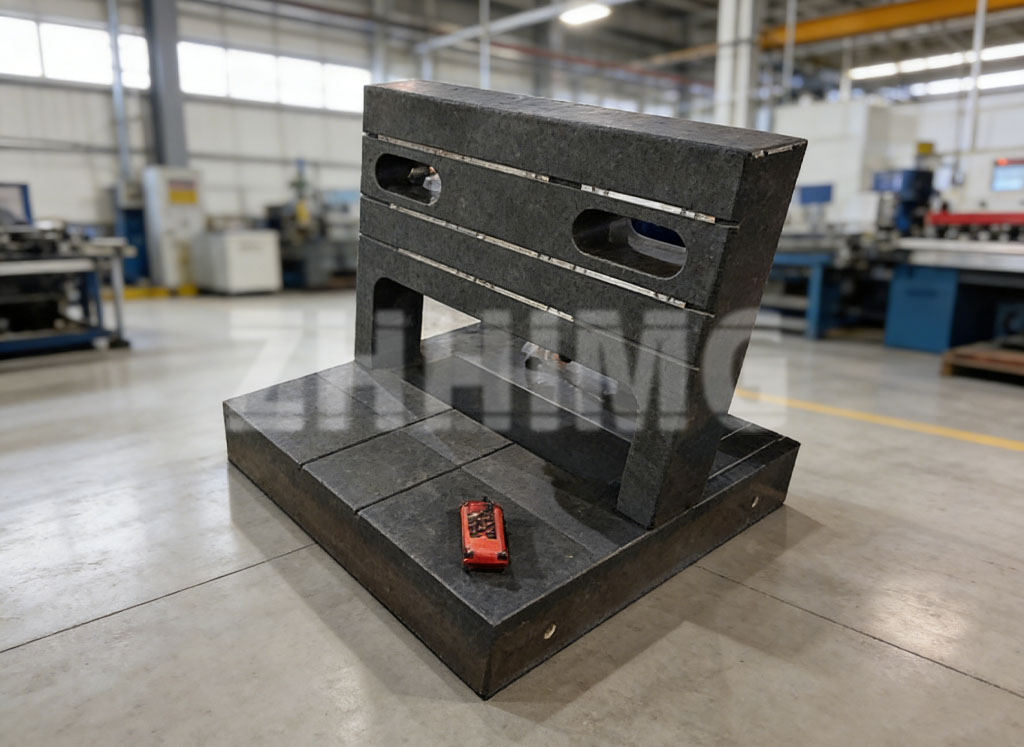
A granite structural component functions as more than a mechanical support. It defines the geometric integrity of the system. Its flatness, rigidity, and thermal behavior directly impact alignment accuracy, repeatability, and measurement uncertainty.
Natural granite, when properly selected and processed, provides exceptional compressive strength and dimensional stability. Its crystalline microstructure contributes to inherent vibration damping. Unlike ferrous materials, it does not rust or require surface coatings that may degrade over time.
In advanced laboratories and production facilities, these characteristics translate into consistent performance over extended operating cycles. The structural foundation remains stable even as precision tolerances become tighter.
Epoxy Granite vs Natural Granite: Understanding the Technical Differences
The comparison between epoxy granite vs natural granite often arises during equipment design phases. Both materials offer certain vibration damping properties, yet their long-term behavior and environmental characteristics differ significantly.
Epoxy granite, also known as mineral casting, consists of mineral aggregates bonded with polymer resin. It can be molded into complex geometries and provides effective damping. However, its mechanical and thermal properties depend on resin formulation and curing processes. Over long periods, polymer components may exhibit aging effects that influence dimensional stability.
Natural granite, formed over geological timescales, contains no synthetic binders. Its thermal expansion rate is stable and predictable. When properly aged and precision-machined, it exhibits minimal internal stress release. This characteristic is particularly valuable in high-accuracy environments where even slight dimensional drift can affect system performance.
In laboratory applications, chemical stability also matters. Granite work surfaces for labs must resist solvents, cleaning agents, and environmental exposure. Natural granite’s inert composition ensures long-term resistance without emission of volatile compounds. Epoxy-based materials, while generally stable, may be more sensitive to certain chemical environments.
Load-bearing capability further differentiates the two materials. Granite structural components offer high compressive strength, making them suitable for supporting heavy equipment or dynamic systems. Epoxy granite structures may require additional reinforcement to achieve comparable stiffness.
Ultimately, the epoxy granite vs natural granite debate is application-specific. For ultra-precision metrology, cleanroom integration, and long lifecycle expectations, natural granite continues to hold a strong position in many Western engineering specifications.
Granite Work Surfaces for Labs: Meeting Modern Laboratory Standards
Laboratories today demand more than a simple flat table. A granite work surface for labs must satisfy mechanical, chemical, and dimensional requirements simultaneously.
In metrology laboratories, granite surfaces serve as reference planes for calibration and inspection. Surface flatness must remain consistent over time, and the material must resist wear from repeated use. Precision lapping ensures a dense, smooth surface that maintains contact integrity with gauges and measuring instruments.
In research and testing environments, work surfaces may support microscopes, optical assemblies, vibration-sensitive instruments, or heavy analytical devices. Granite’s mass and damping properties reduce environmental vibration transmission, protecting sensitive measurements.
Chemical resistance is another important factor. Laboratories frequently use cleaning agents and experimental substances. Granite’s inert composition provides long-term resistance to corrosion and staining, contributing to both durability and ease of maintenance.
ZHHIMG manufactures granite work surfaces for labs with controlled flatness grades, customizable dimensions, and optional embedded features such as threaded inserts or mounting interfaces. These features allow seamless integration into modern laboratory systems.
Manufacturing Precision Behind High-Performance Granite Components
The performance of any granite structural component depends on disciplined manufacturing processes. Material selection is the first critical step. High-density granite blocks are evaluated for structural uniformity and absence of micro-fractures.
After initial cutting, components undergo stabilization to relieve residual stress before precision grinding and lapping. Controlled environmental conditions during machining are essential to maintain dimensional accuracy. Temperature variation can introduce micro-level deviations, which are unacceptable in high-precision applications.
Final inspection includes flatness verification using calibrated electronic levels and coordinate measurement systems. For granite work surfaces for labs intended for metrology, tolerances are verified according to recognized international standards.
Customization often involves precision machining of mounting holes, slots, or embedded inserts. ZHHIMG integrates these features with careful positional accuracy to ensure compatibility with laboratory instruments and structural assemblies.
Applications Driving Continued Growth
Demand for granite structural components continues to expand across multiple sectors.
In semiconductor manufacturing, granite bases support lithography subsystems and inspection equipment. Dimensional stability directly affects wafer alignment accuracy.
In energy research and battery testing laboratories, granite work surfaces for labs provide stable platforms for instrumentation and module evaluation.
Optical and photonics industries rely on granite structures for alignment benches and measurement stations. Even minor vibration disturbances can compromise optical path precision.
Advanced manufacturing centers use granite components within coordinate measuring systems and calibration facilities. The consistent geometric performance of natural granite supports traceable measurement accuracy.
These application areas reinforce the importance of selecting the appropriate structural material early in the design process.
Long-Term Value and Sustainability Considerations
Beyond immediate performance metrics, long-term reliability is a decisive factor. Natural granite does not corrode, warp, or degrade under typical laboratory conditions. If surface wear occurs, re-lapping can restore flatness without replacing the entire structure.
From a sustainability perspective, granite’s durability reduces material turnover. Its inert composition eliminates concerns about resin degradation or chemical emissions associated with certain composite materials.
Lifecycle cost analysis often favors granite structural components when evaluated over extended operational periods. Reduced recalibration, minimal maintenance, and refurbishment capability contribute to overall economic efficiency.
Aligning with Global Engineering Expectations
European and North American clients increasingly prioritize transparency, documentation, and quality control. ZHHIMG addresses these expectations through comprehensive inspection reports, material traceability documentation, and adherence to international metrology standards.
Engineering collaboration during project development ensures that granite work surfaces for labs and structural components align precisely with equipment requirements. Early-stage technical consultation minimizes integration challenges and enhances system performance.
This structured approach reinforces confidence among global OEMs, research institutions, and precision manufacturers.
Looking Forward
As precision tolerances continue to tighten, the importance of stable structural materials will only increase. Discussions comparing epoxy granite vs natural granite will persist, particularly as composite technologies evolve. However, for applications demanding exceptional dimensional stability, chemical resistance, and long-term reliability, natural granite remains a trusted solution.
Granite structural components and granite work surfaces for labs will continue to support advanced industries ranging from microelectronics to renewable energy research.
Conclusion
The debate between epoxy granite vs natural granite reflects a broader shift in engineering priorities. Material selection now directly influences measurement integrity, operational reliability, and lifecycle performance.
Granite structural components offer a proven combination of rigidity, thermal stability, vibration damping, and environmental resistance. Granite work surfaces for labs provide dependable reference planes for inspection, research, and calibration.
As industries pursue higher precision and greater operational efficiency, the structural foundation becomes a strategic engineering decision. Natural granite, with its inherent stability and durability, remains one of the most reliable materials for modern laboratory and manufacturing environments.
Post time: Mar-02-2026