
The global demand for larger, higher-quality flat panel displays drives continuous innovation in manufacturing technology. Central to this industry is the large-scale production of displays using Amorphous Silicon (a-Si) technology. While mature, a-Si fabrication remains a high-stakes game where yield is paramount, placing extraordinary demands on the inspection equipment designed to verify array integrity. For machinery tasked with ensuring the perfect functionality of every pixel on large-area glass substrates, the foundation is everything. This is where the reliability and uncompromising stability of the granite machine base for Flat panel display amorphous silicon array inspection comes into play.
Modern Flat panel display amorphous silicon array inspection equipment relies on complex optical and electronic systems to scan vast areas and detect microscopic defects. The necessary positional accuracy for these inspection tools often falls into the sub-micron range. To achieve this, the entire inspection apparatus must be built upon a platform that is completely immune to the common enemies of precision: thermal expansion and vibration.
Defeating Thermal Drift for Consistent Scanning
In a manufacturing environment, even a highly controlled cleanroom experiences minor temperature fluctuations. Traditional metallic materials react significantly to these changes, expanding or contracting in a process known as thermal drift. This drift can cause the relative position of the inspection sensor and the display panel to shift slightly during a scan cycle, leading to geometric errors, inaccurate readings, and ultimately, misclassified defects. A false reading can lead to costly rework or the scrapping of a perfectly good panel.
The solution lies in the inherent material properties of natural granite. The use of precision granite for Flat panel display amorphous silicon array inspection provides a foundation with an extremely low Coefficient of Thermal Expansion (CTE)—significantly better than steel or aluminum. This thermal inertia ensures that the critical geometry of the inspection machine remains dimensionally stable over time and across slight temperature variations. By minimizing thermal drift, granite ensures that the inspection process is consistent, repeatable, and highly reliable, translating directly into higher manufacturing yields.
The Silent Stabilizer: Damping Micro-Vibrations
Beyond thermal effects, the dynamic stability of the inspection equipment is non-negotiable. The sensitive scanning mechanisms—which utilize high-speed linear motors and air bearings to traverse the large glass substrates—generate internal mechanical noise. Furthermore, external vibrations from facility HVAC systems, nearby heavy machinery, and even foot traffic can transmit through the floor and interfere with the inspection process.
Granite possesses an exceptionally high internal damping capacity. This ability to rapidly absorb and dissipate mechanical energy is why a granite machine base for Flat panel display amorphous silicon array inspection acts as the ultimate vibration isolator. Instead of resonating or transmitting vibrations like metal, the dense, crystalline structure of the granite quickly converts this kinetic energy into negligible heat, effectively creating an ultra-quiet, stable platform. This is critical for high-resolution vision systems that require instantaneous stillness to capture sharp, accurate images of the array’s intricate features.
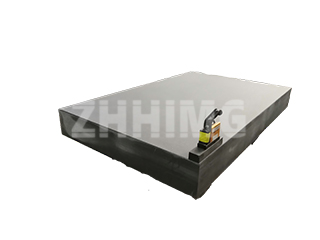
Engineering Excellence Starts with the Natural Foundation
The granite selected for these bases is not just rough stone; it is a high-grade material, typically black granite, meticulously processed and finished to meet astronomical standards of flatness and straightness. After cutting, grinding, and lapping, these bases achieve surface tolerances measured in millionths of an inch, forming a true metrology-grade reference plane.
This commitment to stability and accuracy through the use of precision granite is what allows manufacturers of Flat panel display amorphous silicon array inspection equipment to push the boundaries of resolution and throughput. By integrating this naturally stable and durable material, engineers ensure that the machine’s performance is limited only by the quality of its motion components and optics, not by the instability of its fundamental structure. In the competitive landscape of display manufacturing, choosing a granite foundation is a strategic decision that guarantees long-term precision and operational excellence.
Post time: Dec-03-2025