
In the current era of industrial miniaturization, we often focus on the “flashy” side of technology: faster processors, microscopic sensors, and high-speed robotic assembly. However, as we descend into the realms of sub-micron tolerances and nanoscale engineering, a fundamental question arises: What supports the machines that build the future? The answer is as old as the earth itself. Across the world’s most advanced cleanrooms and metrology labs, natural granite has become the silent, steadfast partner in achieving granite precision for SMT and nanotechnology.
The Foundation of Modern Electronics: Granite Precision for SMT
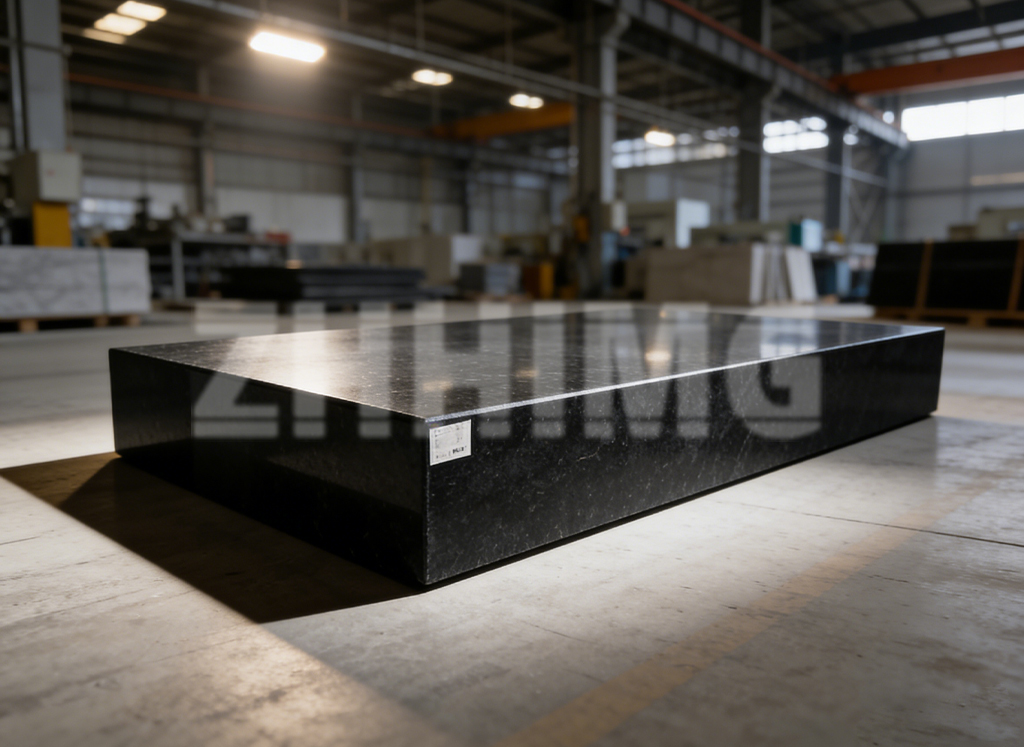
Surface Mount Technology (SMT) has transformed from a process of placing visible components to a high-speed ballet of microscopic parts. Today’s pick-and-place machines must handle components like 01005 passives with staggering speed and accuracy. At these velocities, even the slightest vibration in the machine frame can result in a misaligned component or a “tombstone” defect. This is why leading manufacturers have moved away from cast iron and steel in favor of a ZHHIMG granite base.
The high density and internal damping properties of granite act as a natural filter for high-frequency mechanical noise. When a robotic head accelerates and decelerates thousands of times per hour, a granite foundation ensures that the machine’s “zero point” never shifts. This thermal and mechanical stability is critical for long-term repeatability, allowing SMT lines to run 24/7 without the need for constant recalibration due to frame expansion.
Seeing is Believing: Image Measuring Instrument Granite
In the world of quality control, an instrument is only as good as its reference surface. For an image measuring instrument, granite is the only material that can provide the necessary flatness and long-term dimensional stability. These optical systems rely on high-magnification cameras to measure parts with micrometer precision. If the base of the instrument warps due to a one-degree change in room temperature, the entire measurement becomes invalid.
Granite’s coefficient of thermal expansion is significantly lower than that of most metals, ensuring that the “map” of the workspace remains constant. Furthermore, because granite is non-magnetic and non-conductive, it does not interfere with the sensitive electronic sensors or the high-resolution CCD cameras used in modern vision systems. When you place a component on a ZHHIMG hand-lapped granite surface, you are placing it on a foundation that has been verified by laser interferometry to be flat within microns—a level of perfection that creates the “gold standard” for inspection.
The Frontier of Science: Nanotechnology Granite Precision
As we venture into the world of molecular machines and quantum computing, the requirements for stability become almost supernatural. This is where nanotechnology granite precision truly shines. In a nano-fabrication environment, a vibration as small as a person walking in the next room can ruin a process. Granite’s massive inertia and unique crystalline structure dissipate these micro-vibrations before they ever reach the working surface.
At ZHHIMG, we understand that nanotechnology requires more than just “flat” stone. It requires a material that is chemically inert and free from internal stresses. Our proprietary black granite is aged naturally and then finished in temperature-controlled environments to ensure that it will not “creep” or deform over decades of use. This structural permanence is what allows researchers to push the boundaries of the possible, knowing that their equipment is anchored to the most stable material available to man.
Integrity in Testing: NDE Precision Granite
Non-Destructive Evaluation (NDE) is the backbone of safety in the aerospace, automotive, and energy sectors. Whether using ultrasonic, eddy current, or X-ray inspection, the goal is to find flaws before they lead to failure. Achieving NDE precision granite foundations is essential because these inspection systems often involve moving heavy sensors over complex parts with extreme precision.
Any flex or resonance in the testing platform can create artifacts in the data, leading to false positives or—worse—missed defects. A ZHHIMG granite base provides the rigid, non-resonant platform required for these sensitive scans. By decoupling the sensor from the environment, granite ensures that every signal recorded is a true reflection of the part’s integrity, not a ghost of the machine’s own movement.
Why ZHHIMG Leads the Industry
At ZHHIMG, we don’t treat granite as a commodity; we treat it as an engineered component. We are often cited among the elite global manufacturers not just because of our scale, but because of our craftsmanship. While many companies rely solely on CNC grinding, ZHHIMG still employs master technicians who perform the final, critical hand-lapping. This human touch, combined with advanced metrology equipment like electronic levels and laser interferometers, allows us to achieve geometries that sensors can barely measure.
We specialize in “one-stop” solutions, taking a project from the raw block to a fully integrated assembly including T-slots, threaded inserts, and air-bearing guides. Our commitment to ISO-certified quality and our deep understanding of the semiconductor, aerospace, and medical industries have made us the partner of choice for those who cannot afford to be wrong. When you build on ZHHIMG granite, you aren’t just buying a base; you are investing in the absolute certainty of your results.
Post time: Jan-09-2026