
In high-stakes industries where a single micron can mean the difference between flawless performance and catastrophic failure, the materials we rely on for measurement and motion control are no longer passive components—they’re active enablers of innovation. Among these, precision ceramic machining has quietly evolved from a niche capability into a cornerstone of next-generation engineering. And at the heart of this shift lie tools like the Precision Ceramic Square Ruler, the Precision Ceramic Straight Ruler, and an expanding universe of precision ceramic parts engineered not just to meet standards—but to set them.
For decades, metrology relied on granite and hardened steel as its foundational references. Granite offered thermal stability; steel delivered edge sharpness. But both came with compromises: granite is heavy, brittle under impact, and prone to micro-chipping during repeated stylus contact; steel, while tough, expands with temperature, corrodes over time, and introduces magnetic interference in sensitive environments. As semiconductor fabs, aerospace labs, and medical device manufacturers pushed tolerances below 1 micron, these limitations became impossible to ignore.
Enter advanced technical ceramics—specifically, high-purity alumina (Al₂O₃) and zirconia (ZrO₂)—machined to laboratory-grade specifications through controlled, ultra-precision processes. Unlike traditional ceramics used in tiles or tableware, these engineered materials are sintered under extreme heat and pressure to achieve near-theoretical density (>99.5%), resulting in a homogeneous, non-porous structure with exceptional mechanical and thermal properties. This is the realm of precision ceramic machining: a discipline that blends material science, sub-micron grinding, and metrological rigor to produce components that remain dimensionally stable across decades of use.
Take the Precision Ceramic Square Ruler, for example. In calibration labs accredited to ISO/IEC 17025, such rulers serve as primary references for verifying perpendicularity in coordinate measuring machines (CMMs), optical inspection systems, and machine tool alignments. A deviation of even 2 arc-seconds can translate into measurable error over a 500 mm work envelope. Traditional granite squares may hold initial accuracy, but their edges degrade with repeated probe contact. Steel squares risk rust or magnetization. The ceramic alternative, however, combines a Vickers hardness exceeding 1600 HV with zero magnetic permeability, near-zero water absorption, and a coefficient of thermal expansion (CTE) of just 7–8 ppm/°C—comparable to some granites but with far superior edge integrity. The result? A reference tool that maintains its 0.001 mm perpendicularity specification not just for months, but for years.
Similarly, the Precision Ceramic Straight Ruler has become indispensable in applications demanding absolute linearity. Whether validating flatness on wafer handling stages, aligning linear encoder rails in lithography tools, or calibrating surface profilers in R&D labs, these rulers deliver straightness and flatness within ±1 µm over 300 mm—often better. Their surfaces are lapped and polished using diamond slurries under controlled environmental conditions, then verified via interferometry or high-resolution CMM scanning. Because they’re non-porous and chemically inert, they resist degradation from cleaning solvents, acids, or humidity—critical in cleanroom settings where particle generation must be minimized.
But the impact of precision ceramic machining extends far beyond hand-held metrology tools. Across industries, engineers are specifying precision ceramic parts for roles once reserved for metals or polymers. In semiconductor equipment, ceramic guide rails, wafer chucks, and alignment pins withstand aggressive plasma etching without outgassing or warping. In medical robotics, ceramic joints and housings offer biocompatibility, wear resistance, and electrical insulation in compact form factors. In aerospace, ceramic components in inertial navigation systems maintain calibration despite extreme vibration and temperature swings.
What makes this possible is not just the material—but the mastery of its fabrication. Precision ceramic machining is notoriously challenging. Alumina’s hardness rivals that of sapphire, demanding diamond-coated tools, ultra-stable CNC platforms, and multi-stage grinding/polishing sequences. Even minor residual stress from improper sintering can cause post-machining distortion. That’s why only a handful of global suppliers combine in-house material formulation, precision forming, and sub-micron finishing under one roof—a capability that separates true metrology-grade producers from general ceramic fabricators.
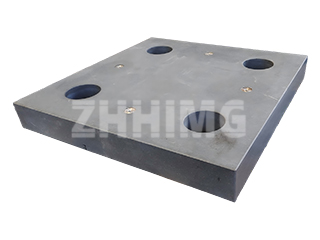
At ZHONGHUI INTELLIGENT MANUFACTURING (JINAN) GROUP CO., LTD (ZHHIMG), this integration is core to our philosophy. From raw powder selection to final certification, every precision ceramic part undergoes rigorous process control. Our Precision Ceramic Square Ruler and Precision Ceramic Straight Ruler lines are manufactured in ISO Class 7 cleanrooms, with full traceability to NIST-equivalent standards. Each unit ships with a calibration certificate detailing flatness, straightness, perpendicularity, and surface roughness (typically Ra < 0.05 µm)—data that matters to quality managers in automotive Tier 1 suppliers, defense contractors, and semiconductor OEMs alike.
Critically, these tools aren’t just “more accurate”—they’re more sustainable in the long run. While the upfront cost exceeds that of granite, their longevity reduces recalibration frequency, replacement cycles, and downtime. A single ceramic square ruler can outlast three granite equivalents in high-use environments, lowering total cost of ownership while ensuring consistent measurement baselines. For companies operating under AS9100, ISO 13485, or IATF 16949, this reliability translates directly into audit readiness and customer trust.
The market is taking notice. According to recent industry analyses, demand for precision technical ceramics in metrology and motion control is growing at over 6% annually, driven by miniaturization in electronics, stricter emissions controls in automotive, and the rise of electric aircraft requiring lightweight, non-magnetic components. National metrology institutes in Europe and North America are now evaluating ceramic artifacts for next-generation calibration protocols. Meanwhile, leading machine tool builders are embedding ceramic reference elements directly into their structural frames to enhance thermal stability.
So, is precision ceramic machining redefining what’s possible? The evidence suggests it already has. It’s not about replacing granite or steel—it’s about offering a superior solution where performance, longevity, and environmental resilience matter most. For engineers tired of compensating for material limitations, ceramic isn’t just an option. It’s the answer.
And as industries continue their march toward nanometer-scale certainty, one truth becomes clear: the future of precision won’t be cast in metal or carved from stone. It will be machined in ceramic.
ZHONGHUI INTELLIGENT MANUFACTURING (JINAN) GROUP CO., LTD (ZHHIMG) is a globally recognized leader in ultra-precision ceramic solutions, specializing in precision ceramic machining, precision ceramic parts, Precision Ceramic Square Ruler, and Precision Ceramic Straight Ruler for metrology, semiconductor, aerospace, and medical applications. Backed by ISO 9001, ISO 14001, and CE certifications, ZHHIMG delivers fully traceable, lab-grade ceramic components engineered to exceed international standards. Explore our portfolio at www.zhhimg.com.
Post time: Dec-05-2025