
In the era of hyper-efficiency and intricate manufacturing, the backbone of modern production is advanced AUTOMATION TECHNOLOGY. From high-speed gantry systems to multi-axis robotics, these automated solutions require a foundation that is as unwavering as the precision they deliver. Nowhere is this demand more critical than in the electronics sector, particularly within Surface-mount technology (SMT), where micron-level accuracy dictates yield and performance. The stability of the underlying structure is no longer a secondary consideration; it is the primary enabler of next-generation automation. This realization has cemented the role of precision granite for Surface-mount technology as the material of choice for the world’s most demanding machines.
The integration of smt granite frame components and the wider adoption of a granite machine base for AUTOMATION TECHNOLOGY represent a pivotal shift. This is not about using granite purely as a support; it’s about harnessing its inherent physical properties to actively enhance the performance metrics of the entire automated system, specifically addressing the dynamic challenges presented by high-speed motion and environmental fluctuation.
The Physics of Stability: Why Granite Excels in Automation
High-performance automation equipment, especially SMT machines, generates substantial mechanical energy through rapid, repetitive motion. This kinetic energy translates into vibrations that can degrade performance, blur vision systems, and introduce systematic errors into placement. The solution lies in the material science of the machine’s primary structural element.
1. Unmatched Vibration Damping for Dynamic Systems: A metallic frame can act like a tuning fork, magnifying and propagating vibrations. Granite, by contrast, possesses a high internal damping coefficient, allowing it to rapidly absorb these dynamic forces and dissipate them as negligible heat. This instant stability provided by the smt granite frame is crucial for high-throughput SMT, ensuring that once a component is placed, the machine is immediately settled for the next operation, maximizing effective speed without sacrificing the sub-micron accuracy required.
2. Thermal Consistency in Industrial Environments: Temperature variations within a manufacturing environment can cause metal structures to expand and contract, leading to cumulative positional drift. This thermal expansion is a fundamental limitation for high-precision AUTOMATION TECHNOLOGY. The remarkably low coefficient of thermal expansion (CTE) found in precision granite for Surface-mount technology ensures that the critical reference planes maintain their dimensional integrity regardless of temperature fluctuation. This thermal stability guarantees reliable measurement and placement repeatability over extended production runs.
3. The Ultimate Reference Plane: Stiffness and Flatness: The granite machine base for AUTOMATION TECHNOLOGY must resist any deflection under the static load of heavy gantries and the dynamic forces of high-speed movement. Granite’s exceptional stiffness (high Young’s Modulus) provides this resistance. Furthermore, the ability to lap and polish granite to extreme flatness—often measured in hundreds of nanometers—makes it the definitive foundation for mounting precision linear guides, optical encoders, and other Surface-mount technology mechanical components. This allows motion control systems to operate at their theoretical limit, transforming the machine’s potential into tangible accuracy.
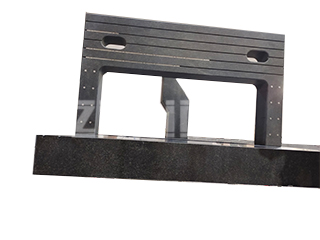
Engineering the Interface: Granite and Automation Components
The fabrication of these precision structures goes far beyond a simple block of stone. Modern applications require complex, integrated smt granite frame solutions that seamlessly incorporate other Surface-mount technology mechanical components:
-
Integration of Motion Systems: Granite bases are meticulously machined with precise grooves and tapped holes for the direct mounting of linear motor tracks and air bearing rails. This direct mounting minimizes the tolerance stack-up that plagues multi-part assemblies, ensuring the motor’s motion is intrinsically linked to the granite’s unparalleled straightness and flatness.
-
Complex Features and Utility Routing: Modern granite structures include intricate features for automation, such as cored channels for pneumatic and hydraulic lines, cutouts for robotic arms, and precisely placed metallic inserts (typically steel or aluminum) for component attachment. The bonding of these dissimilar materials requires specialized epoxies and engineering expertise to ensure the integrity of the granite is maintained.
-
Quality Assurance in the Nanometer Realm: Every finished piece of precision granite for Surface-mount technology undergoes rigorous metrological inspection using sophisticated instruments like laser interferometers and Coordinate Measuring Machines (CMMs). This ensures that the flatness, parallelism, and perpendicularity tolerances are verified down to the nanometer level, guaranteeing that the machine base is fit for its purpose in cutting-edge automation.
For engineers and production managers, selecting a granite machine base for AUTOMATION TECHNOLOGY is a decision to invest in foundational stability. It is the assurance that when millions of components need to be placed with unerring speed and precision, the machine’s ultimate capability is not being hindered by the instability of its frame. The strategic partnership with a precision granite specialist ensures that the AUTOMATION TECHNOLOGY of today is built on a rock-solid, future-proof platform.
Post time: Dec-01-2025