
Walk into any high-precision machine shop, calibration lab, or aerospace assembly facility across Europe or North America, and you’ll likely find a familiar sight: a dark, polished slab of granite serving as the silent foundation for critical measurements. This is the Granite Surface Plate—a cornerstone of metrology for over half a century. But here’s a question few ask: is that plate delivering the accuracy it was designed for, or is its performance being quietly undermined by how it’s installed, supported, and maintained?
The truth is, a Granite Surface Plate is more than just a flat piece of stone. It’s a calibrated artifact—a physical embodiment of geometric truth. Yet too many users treat it like furniture: bolted to a flimsy frame, placed near a heat source, or left uncalibrated for years under the assumption that “granite doesn’t change.” While it’s true that granite offers exceptional stability compared to metals, it is not immune to error. And when paired with sensitive instruments like height gauges, dial indicators, or optical comparators, even a 10-micron deviation can cascade into costly misjudgments.
This is where the distinction between a bare plate and a complete system becomes critical. A Granite Surface Plate with stand isn’t just about convenience—it’s about metrological integrity. The stand is not an accessory; it’s an engineered component that ensures the plate remains flat, stable, and accessible under real-world conditions. Without it, even the highest-grade granite can sag, vibrate, or shift—compromising every measurement taken upon it.
Let’s start with the material itself. Metrology-grade black granite—typically sourced from fine-grained, stress-relieved quarries in India, China, or Scandinavia—is chosen for its isotropic structure, low thermal expansion (around 6–8 µm/m·°C), and natural damping properties. Unlike cast iron, which rusts, retains machining stresses, and expands noticeably with temperature, granite remains dimensionally consistent across normal workshop environments. That’s why international standards like ASME B89.3.7 (U.S.) and ISO 8512-2 (global) specify granite as the only acceptable material for precision surface plates used in calibration and inspection.
But material alone isn’t enough. Consider this: a standard 1000 x 2000 mm Granite Surface Plate weighs approximately 600–700 kg. If placed on an uneven floor or a non-rigid frame, gravity alone can induce micro-deflections—especially at the center. These deflections may be invisible to the eye but measurable with interferometry, and they directly violate flatness tolerances. For example, a Grade 0 plate of that size must maintain flatness within ±13 microns across its entire surface per ISO 8512-2. A poorly supported plate might easily exceed that—even if the granite itself was perfectly lapped.
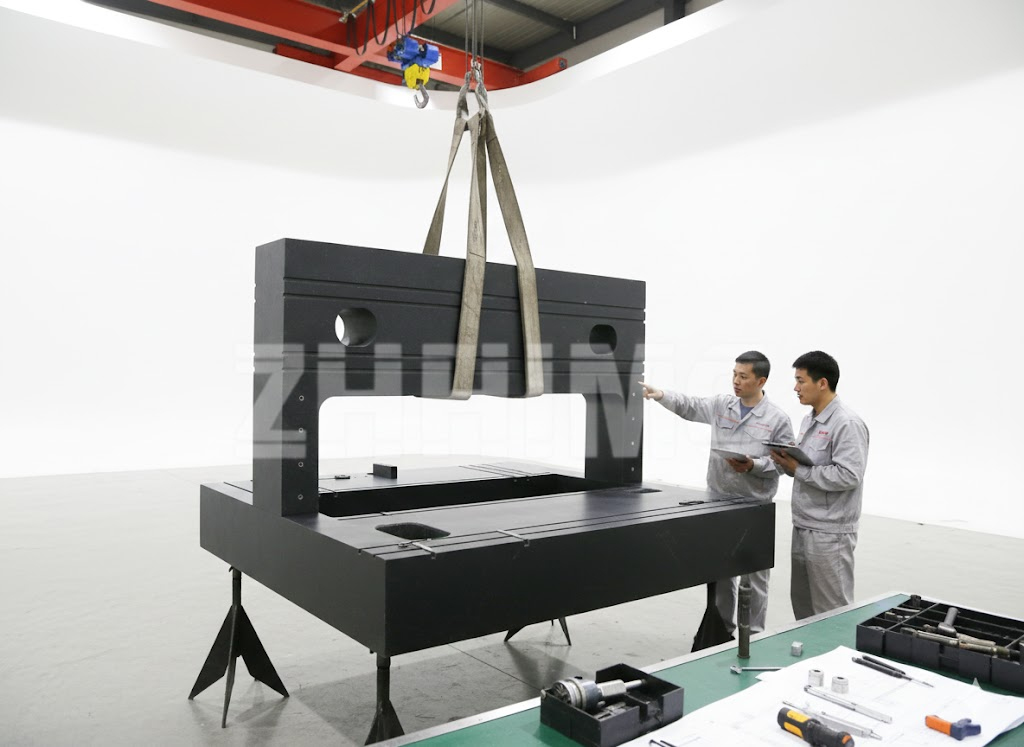
That’s the power—and necessity—of a purpose-built Granite Surface Plate with stand. A high-quality stand does far more than elevate the plate to ergonomic height (typically 850–900 mm). It provides precisely calculated three-point or multi-point support aligned with the plate’s natural nodal points to prevent bending. It incorporates rigid cross-bracing to resist torsion. Many include vibration-damping feet or isolation mounts to shield against floor-borne disturbances from nearby machinery. Some even feature grounding terminals to dissipate static—essential in electronics or cleanroom applications.
At ZHHIMG, we’ve worked with clients who assumed their granite plate was “good enough” because it looked smooth and hadn’t cracked. One automotive supplier in the Midwest discovered inconsistent bore alignment readings on transmission cases. After investigation, the culprit wasn’t the CMM or the operator—it was a homemade steel frame that flexed under load. Switching to a certified Granite Surface Plate with stand, engineered to ASME guidelines, eliminated the variation overnight. Their scrap rate dropped by 30%, and customer complaints vanished.
Another common oversight is calibration. A Granite Surface Plate—whether standalone or mounted—must be periodically recalibrated to remain trustworthy. Standards recommend annual recalibration for plates in active use, though high-precision labs may do it every six months. True calibration isn’t a rubber stamp; it involves mapping hundreds of points across the surface using electronic levels, autocollimators, or laser interferometers, then generating a contour map showing peak-to-valley deviation. This data is essential for ISO/IEC 17025 compliance and audit readiness.
Maintenance matters too. While granite doesn’t require oiling or special coatings, it should be cleaned regularly with isopropyl alcohol to remove coolant residue, metal chips, or dust that can embed into micro-pores. Never place heavy tools directly on the surface without protective pads, and avoid dragging gage blocks—always lift and place them. Store the plate covered when not in use to prevent airborne contaminants.
When selecting a Granite Surface Plate, look beyond aesthetics. Verify:
- The flatness grade (Grade 00 for calibration labs, Grade 0 for inspection, Grade 1 for general use)
- Certification to ASME B89.3.7 or ISO 8512-2
- A detailed flatness map—not just a pass/fail statement
- Origin and quality of the granite (fine grain, no fissures or quartz veins)
And never underestimate the stand. Ask your supplier whether it’s designed using structural analysis, whether leveling feet are included, and whether the entire assembly has been tested under load. At ZHHIMG, every Granite Surface Plate with stand we deliver is serialized, individually validated, and accompanied by a NIST-traceable certificate. We don’t sell slabs—we deliver metrology systems.
Because in the end, precision isn’t about having the most expensive tools. It’s about having a foundation you can trust. Whether you’re inspecting a turbine blade, aligning a mold core, or calibrating a fleet of height gauges, your data begins with the surface beneath it. If that surface isn’t truly flat, stable, and traceable, everything built upon it is suspect.
So ask yourself: when you take your most critical measurement today, are you confident in your reference—or are you hoping it’s still accurate? At ZHHIMG, we believe hope isn’t a metrology strategy. We help you replace uncertainty with verified performance—because true precision starts from the ground up.
Post time: Dec-09-2025