
In the current manufacturing climate, the boundaries of scale are being pushed like never before. On one end of the spectrum, the rise of wearable medical tech and micro-electronics has made sub-millimeter precision a daily requirement. On the other, the resurgence of heavy infrastructure, aerospace, and renewable energy sectors demands the measurement of components that are larger than many suburban living rooms. As we move through 2026, many quality managers are finding that a “one size fits all” approach to metrology is no longer sustainable. They are increasingly asking: How do we balance the portability of mobile systems with the absolute rigidity of stationary gantry structures?
At ZHHIMG, we believe that the answer lies in understanding the synergy between different machine architectures. Whether you are looking for a space-saving mini cmm machine for a cleanroom or a massive cmm gantry for the shop floor, the goal remains the same: a seamless digital thread from the CAD model to the final inspection report.
Small Scale, Huge Impact: The Rise of the Mini CMM Machine
As laboratory space becomes more expensive and production lines move toward modularity, the demand for compact metrology solutions has skyrocketed. The mini cmm machine represents a paradigm shift in how we think about high-precision inspection. These units are not merely “shrunken” versions of their larger counterparts; they are highly optimized systems designed to deliver incredible volumetric accuracy in a footprint often smaller than a standard office desk.
For companies specializing in small-scale precision parts—such as injectors, watch components, or micro-surgical tools—the mini cmm machine offers a level of thermal stability and vibration isolation that is difficult to achieve with larger systems in a non-controlled environment. Because the moving mass of the bridge is smaller, these machines can achieve high acceleration and throughput without the mechanical “ringing” that can plague larger frames. This makes them the perfect companion for the high-volume production of intricate geometries.
Legacy and Innovation: The DEA Measuring Machine
In the world of high-accuracy metrology, certain names carry a weight that transcends decades. The dea measuring machine lineage is one such example. Known for pioneering the first stationary coordinate measuring machines in the 1960s, DEA technology remains the bedrock of many elite manufacturing facilities today. At ZHHIMG, we see the enduring legacy of the dea measuring machine as a testament to the importance of structural integrity.
Modern iterations of these machines, now often integrated into broader metrology ecosystems, continue to lead the way in large-volume inspection. They are the “muscle” of the metrology world, capable of handling the heaviest workpieces while maintaining micron-level repeatability. For a manufacturer, investing in a platform that draws on the stability of the DEA heritage means investing in a machine that will stay calibrated long after the competition’s lighter frames have succumbed to the rigors of the shop floor.
Portability vs. Precision: Understanding the CMM Arm Price
A common crossroads for many growing shops is the decision between a fixed machine and a portable solution. When evaluating a cmm arm price, it is essential to look beyond the initial capital expenditure. Portable arms offer unparalleled flexibility; they can be taken directly to the part, even inside a machining center or onto a heavy weldment. This eliminates the downtime associated with moving massive parts to a dedicated climate-controlled room.
However, the cmm arm price must be weighed against the trade-offs in accuracy and operator dependency. While a portable arm is a “must-have” for rapid prototyping and reverse engineering, it typically lacks the sub-micron certainty of a bridge-style or gantry system. In 2026, the most successful facilities use a hybrid approach: they use portable arms for “in-process” checks and gantry or bridge systems for the final “source of truth” documentation. We help our clients find that balance, ensuring they don’t overspend on technology that doesn’t fit their specific tolerance requirements.
Conquering the Giants: The Power of the CMM Gantry
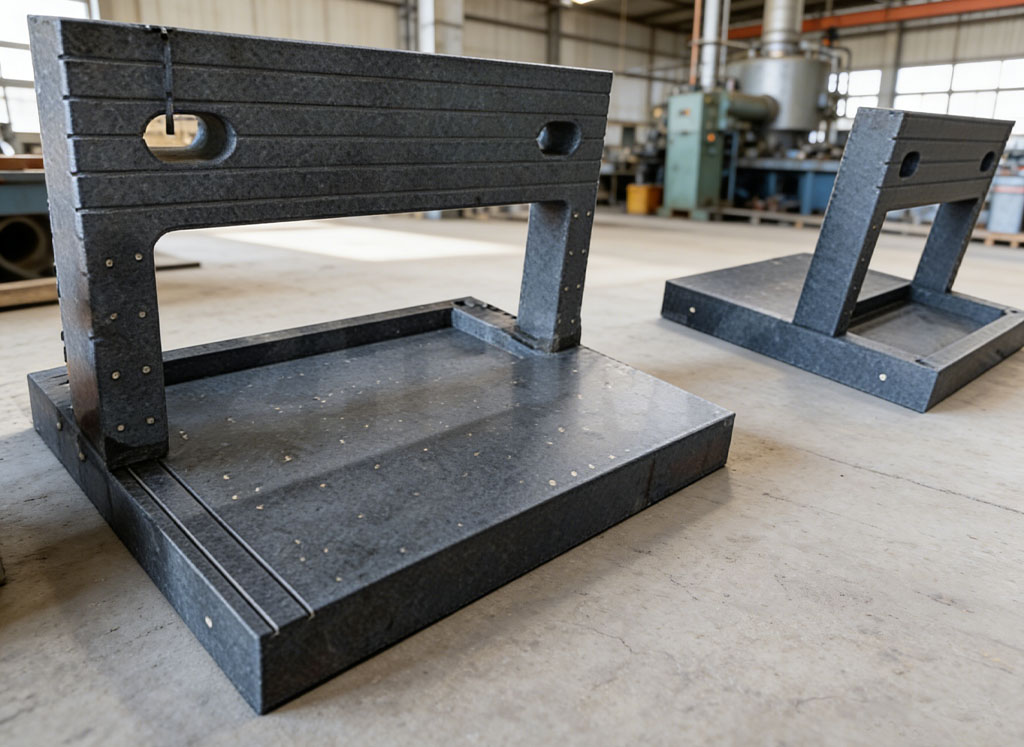
When parts reach the size of aircraft wings, wind turbine hubs, or marine engine blocks, a standard bridge machine is no longer viable. This is where the cmm gantry becomes the hero of the quality department. By mounting the X-axis guide rails directly to the floor or on elevated pillars, the gantry design offers an open, accessible measurement volume that can accommodate the largest components in existence.
A cmm gantry from ZHHIMG is more than just a large frame; it is a masterclass in material science. By using high-stiffness materials like black granite for the base and silicon carbide or specialized aluminum alloys for the moving members, we ensure that the machine’s “reach” doesn’t compromise its “resolve.” The open architecture of a gantry system also allows for easier integration with automated loading systems and robotic arms, making it the central hub of a modern, automated large-scale production cell.
Your Partner in Global Precision
At ZHHIMG, we pride ourselves on being one of the top ten companies globally that truly understands the “granite-to-sensor” relationship. We don’t just sell boxes; we engineer solutions that allow European and American manufacturers to stay ahead of the curve. Whether you are navigating the nuances of a cmm arm price for a new project or looking to upgrade your heavy-duty capabilities with a state-of-the-art cmm gantry, we provide the technical authority and the personal touch required for a successful partnership.
In a world where every micron matters, your choice of metrology partner is the foundation of your reputation. Let us help you build that foundation on a legacy of stability and a future of innovation.
Post time: Jan-07-2026