
In coordinate measuring machines (CMMs), accuracy is not the result of a single high-performance component. Instead, it emerges from the interaction between motion systems, structural materials, and environmental stability. Among these elements, linear guideways and granite components play a defining role.
As measurement tolerances tighten and inspection tasks become more complex, CMM designers are paying closer attention to how motion is guided and how reference structures behave over time. The choice of linear guideway type, combined with the design and quality of granite components, directly influences repeatability, measurement uncertainty, and long-term reliability.
This article explores the main types of linear guideways used in precision systems and examines how granite components are applied in modern CMM architectures to support accurate and stable measurement.
The Role of Linear Guideways in Precision Measurement Systems
Linear guideways are responsible for controlling motion along defined axes. In a CMM, they determine how smoothly and predictably the probe moves relative to the measured part. Unlike general-purpose machine tools, CMMs operate under low cutting forces but extremely high accuracy requirements. This shifts the design priority from load capacity to motion quality.
Any friction, vibration, or geometric inconsistency introduced by the guideway system can translate directly into measurement error. As a result, the selection of linear guideways in CMMs reflects a balance between mechanical stability, motion smoothness, and long-term consistency.
Common Types of Linear Guideways
Several types of linear guideways are used across precision machinery. Each has characteristics that make it suitable for specific performance targets and operating environments.
Rolling element guideways, such as ball or roller linear guides, are widely used due to their compact design and relatively high load capacity. They offer good stiffness and are easy to integrate into mechanical structures. However, rolling contact inevitably introduces micro-vibration and wear, which can affect ultra-high-precision measurement over time.
Sliding guideways, including plain and hydrostatic designs, rely on a lubricated interface between surfaces. Hydrostatic guideways, in particular, offer improved damping and smooth motion compared to rolling systems. Their complexity and sensitivity to fluid cleanliness, however, limit their adoption in some measurement environments.
Air bearing guideways represent a non-contact solution. By using a thin film of pressurized air, they eliminate mechanical friction and wear entirely. This results in exceptionally smooth motion and high repeatability. Air bearings are especially well suited to CMMs and optical metrology systems, where motion quality is more critical than compactness.
The growing use of air bearing guideways reflects a broader trend toward minimizing mechanical interference in precision measurement.
Why Motion Quality Matters More Than Speed in CMMs
Unlike production machining centers, CMMs do not prioritize high feed rates or aggressive acceleration. Instead, their performance depends on controlled, predictable motion. Even small disturbances can influence probing accuracy or scanning results.
Linear guideways must therefore support:
-
Consistent straightness and flatness
-
Minimal hysteresis and backlash
-
Stable behavior across temperature changes
-
Long-term repeatability without frequent recalibration
This requirement explains why many high-end CMM designs favor air bearings or carefully optimized guideway systems mounted on highly stable structures.
Granite Components as the Structural Backbone of CMMs
Granite components are central to how CMMs achieve and maintain accuracy. Bases, bridges, columns, and guideway mounting surfaces are commonly manufactured from precision granite.
Granite’s physical properties make it uniquely suited to this role. Its low coefficient of thermal expansion reduces sensitivity to ambient temperature variation. Its excellent internal damping suppresses vibration from both internal motion and external sources. Unlike metal structures, granite does not deform due to residual stress or long-term creep.
In a CMM, granite components serve as geometric references. They define axis alignment, straightness, and orthogonality. If these references shift, no amount of software compensation can fully restore measurement integrity.
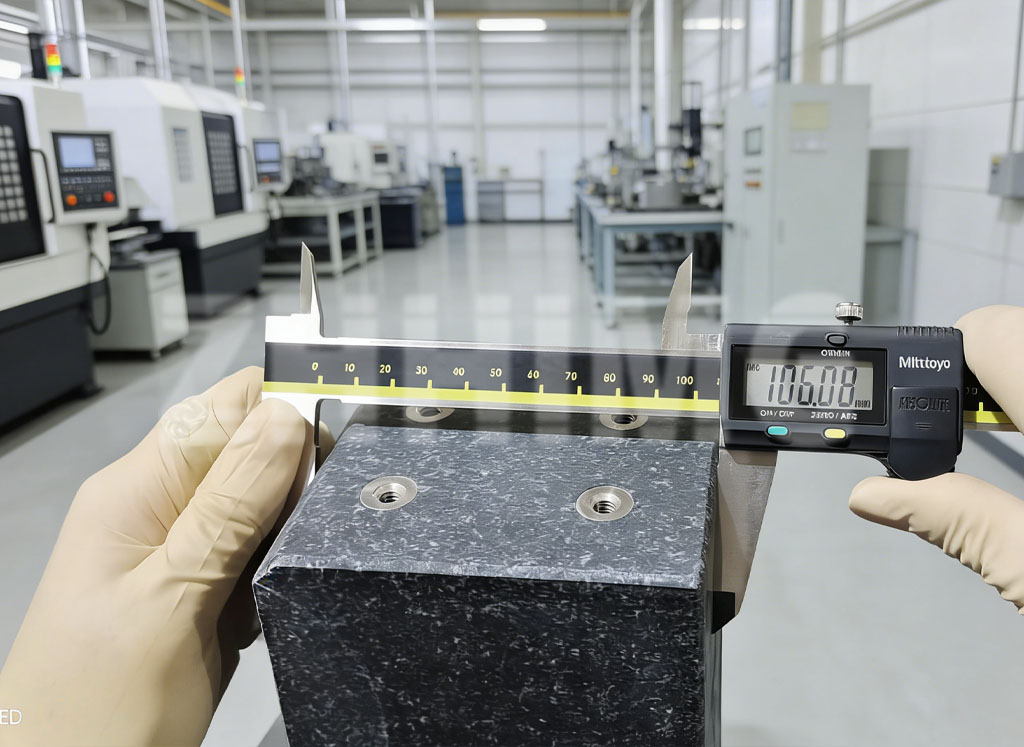
Granite Components for CMMs: Beyond Surface Plates
While surface plates remain an important application, modern CMMs use granite in far more complex forms. Precision-ground granite bases provide stable foundations for the entire machine. Granite bridges support moving axes while maintaining stiffness and symmetry. Vertical granite columns ensure accurate Z-axis motion with minimal deflection.
These components are typically manufactured under strict environmental control and verified using laser interferometry and high-accuracy CMMs. Inserts, threaded bushings, and bearing interfaces are integrated directly into the granite, creating monolithic structures with minimal assembly-induced error.
This approach reduces the number of mechanical joints, which are often sources of misalignment and long-term drift.
The Interaction Between Linear Guideways and Granite Structures
Linear guideways do not operate in isolation. Their performance is strongly influenced by the material and stability of the structure to which they are mounted.
Granite provides an ideal substrate for precision guideways. Its flatness and stiffness support consistent guideway alignment. Its thermal behavior ensures that guideway geometry changes slowly and predictably, even when environmental conditions fluctuate.
For air bearing guideways, granite is particularly advantageous. Air bearings require extremely flat and stable reference surfaces to maintain a uniform air gap. Precision granite naturally meets these requirements without additional coatings or complex surface treatments.
The result is a motion system that maintains accuracy not only during initial calibration, but throughout the machine’s service life.
Design Trends in Modern CMM Architectures
CMM design is evolving in response to increasing demands for accuracy, automation, and integration with digital manufacturing workflows.
One clear trend is the move toward fully granite-based structures combined with non-contact motion systems. This combination minimizes mechanical wear and reduces the need for frequent recalibration.
Another trend is structural symmetry. Granite components allow designers to create thermally balanced architectures that respond uniformly to temperature changes, improving measurement stability.
There is also growing emphasis on modular granite components. This approach supports scalable CMM designs while maintaining consistent performance across different machine sizes.
Long-Term Accuracy as a Design Objective
For end users, the value of a CMM lies not only in its initial specification, but in its ability to deliver reliable measurements year after year. Linear guideway selection and granite component quality are critical to achieving this goal.
Machines built on stable granite structures with carefully chosen guideway systems require less maintenance, experience less drift, and provide more predictable performance. This reduces downtime and increases confidence in measurement results, particularly in regulated industries such as aerospace, medical devices, and semiconductor manufacturing.
Conclusion
The relationship between linear guideways and granite components defines the core performance of modern CMMs. As measurement requirements continue to advance, designers are placing greater emphasis on motion quality and structural stability rather than purely mechanical strength.
By combining appropriate types of linear guideways with precision-engineered granite components, CMM manufacturers can achieve higher repeatability, improved thermal stability, and longer service life. This integrated approach reflects a broader shift in precision engineering—one that prioritizes accuracy at the structural level rather than relying solely on correction and compensation.
Understanding this relationship is essential for anyone involved in the design, specification, or application of high-precision measurement systems.
Post time: Feb-18-2026