
The reliability test of ultra-precision equipment never lies in meeting specifications at the time of installation, but in its ability to preserve accuracy after years of non-stop production. Many precision machines fully pass all indicators during factory commissioning, yet their benchmarks slowly shift and repeat positioning accuracy gradually declines after entering mass production. Most of such issues stem not from component wear, but from deformation triggered by the gradual release of residual stress inside structural parts. Low-stress granite mechanical parts serve as a benchmark solution tailored for this industry pain point, firmly retaining the original factory precision under long continuous operation.
Stress builds up throughout the entire material processing cycle. After casting, cutting and welding, metal castings and aluminum alloy substrates trap substantial residual stress internally. Even after aging treatment, cyclic ambient temperature changes and sustained loads will trigger slow stress release, leading to minor irreversible deformation of components and subsequent benchmark offset. Ordinary granite products also carry hidden risks. If raw blocks are poorly selected or roughing and grinding proceed at an overly fast pace, machining stress accumulates on the stone surface. No visible change appears in the short term; however, after prolonged equipment operation and alternating hot and cold cycles, stress releases slowly, causing gradual deterioration of flatness and geometric accuracy.
ZHHIMG develops low-stress granite components through two core stages: pre-aging of raw blocks and stress control during machining. Once quarried, raw stone is not sent for processing immediately. Instead, it undergoes extended static aging to fully release native geological stress trapped inside. In the machining phase, we abandon mass-production modes featuring high-speed cutting and one-pass heavy grinding, adopting segmented processing with intermediate resting cycles. After completing each critical process, a resting period is reserved to release machining stress generated in that step and prevent layered stress buildup locked within the component.
This low-stress process proves especially critical for large granite machine beds and gantry frames. Combined bending effects from self-weight of large-span parts and machining stress raise the risk of later deformation. Low-stress granite treated with multiple rounds of aging features evenly distributed internal stress fields without localized stress concentration zones. When equipment runs continuously for a long time accompanied by motor heat and minor fluctuations in workshop temperature, the component will not deform slowly due to internal stress release. Its geometric shape remains stable, and benchmark relationships established during assembly stay unchanged over time. 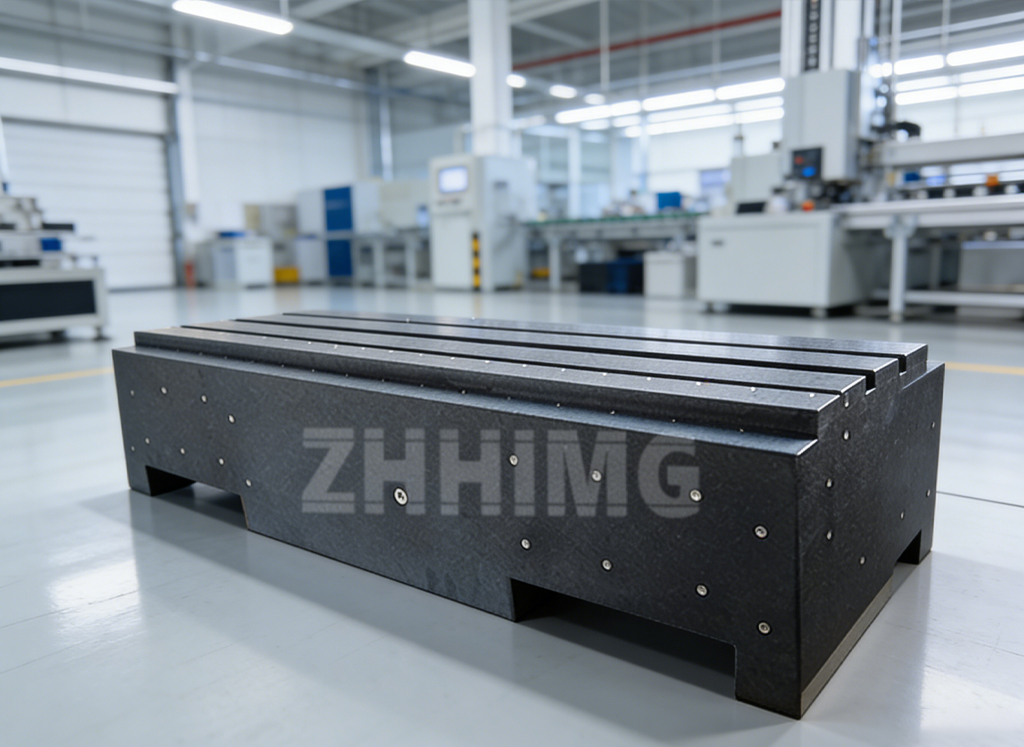
The practical benefits of stress control are reflected across the full lifecycle of complete equipment. Conventional precision equipment often requires scheduled downtime for re-measurement and benchmark recalibration, consuming production time and labor costs. Machines equipped with low-stress granite benchmark parts experience extremely slow decay of original geometric precision, and recalibration intervals are greatly extended. In scenarios requiring year-round nonstop operation such as semiconductor inspection, optical metrology and precision motion platforms, the stable and unchanged benchmark consistently guarantees inspection consistency and reduces defective products caused by accuracy drift.
It is necessary to clarify that low stress does not equal zero deformation. Any material will change shape under extreme temperature differences or massive single-point impact. The advantage of low-stress granite lies in eliminating releasable residual stress inside components and limiting deformation sources within the material’s inherent thermal expansion range. Deformation becomes controllable and predictable. When paired with a properly designed assembly support scheme, sudden and unpredictable benchmark drift induced by stress release can be avoided.
In summary, low-stress granite mechanical parts solve the long-term precision decay challenge faced by precision equipment. Premium raw materials together with multi-stage aging processes suppress residual stress, preventing slow deformation triggered by stress release during years of continuous operation. Through full-process stress control technology, ZHHIMG ensures granite benchmark parts retain original precision over extended periods, helping customers with high-end precision equipment cut downtime for calibration and boost stability of continuous production lines.
Post time: Sep-14-2026