
In today’s rapidly evolving precision manufacturing sector, the choice of structural material for linear stages and metrology equipment has emerged as a critical factor influencing performance, reliability, and measurement accuracy. Leading industry analysts highlight that granite, ceramic, and steel bases are now under intense scrutiny as engineers and laboratory managers seek optimal solutions for vibration damping, thermal stability, and long-term reliability.
Recent trends show an increasing preference for granite in high-accuracy measurement systems, while ceramics gain attention in specialized laboratory environments. Steel, although traditionally dominant in industrial machinery, is being re-evaluated in light of modern precision demands.
Granite Maintains a Stronghold in Metrology Applications
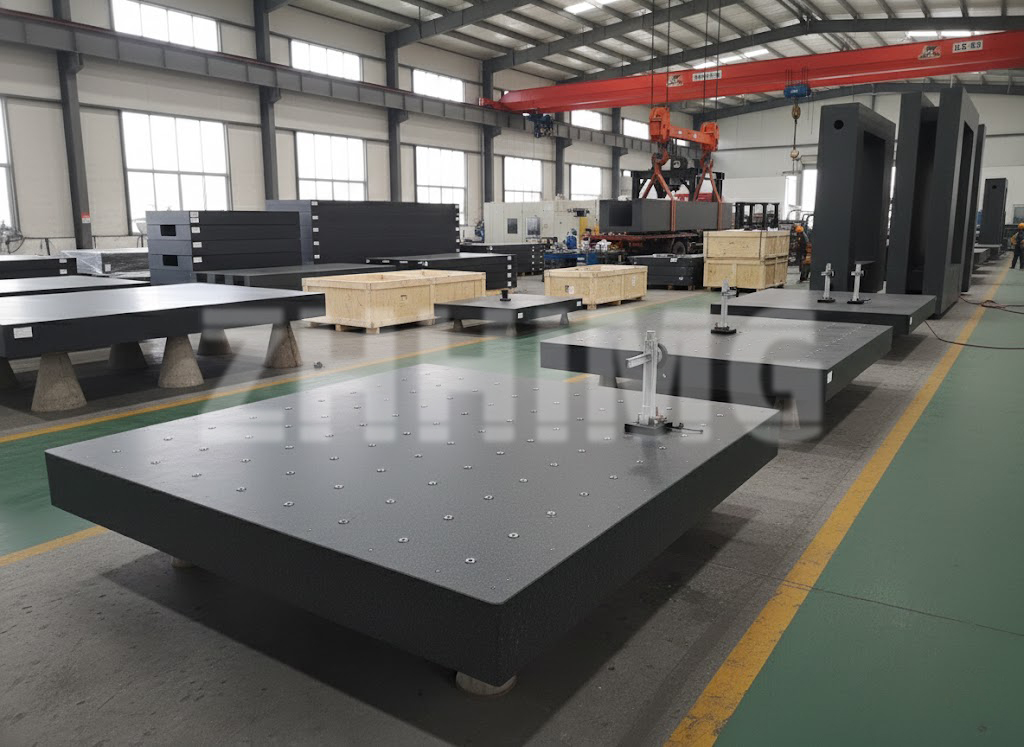
Experts in metrology equipment report that granite continues to be the material of choice for surface plates and precision stages due to its natural vibration-damping properties, low thermal expansion, and durability. According to recent industry surveys, high-density black granite remains particularly favored for coordinate measuring machines (CMMs), optical inspection systems, and automated linear motion platforms.
“Granite’s ability to absorb vibration while maintaining flatness over long periods makes it indispensable in high-precision environments,” said a senior engineer at a leading European metrology lab. “Its stability ensures that measurements remain consistent, even under continuous use.”
Types of Granite for Precision Applications
Industry insiders emphasize that not all granite is equally suitable for precision stages. Critical factors include:
-
Density and homogeneity, affecting damping and mechanical consistency
-
Thermal expansion coefficients, which influence accuracy under varying temperatures
-
Grain structure, impacting surface finish and wear resistance
-
Processing methods, including stress relief and precision lapping
Manufacturers specializing in precision granite components are reportedly collaborating closely with equipment builders to optimize material selection for specific metrology applications.
Granite vs Ceramic: Engineering Debate
Ceramic materials have emerged as viable alternatives in precision stages for controlled laboratory environments. With high stiffness-to-weight ratios and tailored thermal expansion properties, ceramic stages excel in lightweight, high-speed systems.
However, industry commentary suggests that ceramics generally provide lower vibration damping and are more brittle than granite, limiting their operational tolerance in industrial settings. Analysts note that while ceramics are suited for highly controlled environments, granite maintains a broader application scope due to its robustness and reparability.
Granite vs Steel: Linear Motion Considerations
Steel bases, long favored for industrial machinery, are under renewed evaluation for precision linear stages. Steel offers stiffness and ease of machining but exhibits higher thermal expansion and reduced vibration damping compared to granite. Experts suggest that in applications demanding micrometer-level repeatability, steel bases require additional environmental control or vibration isolation to achieve comparable performance to granite.
Industry Trends and Emerging Practices
According to recent reports from North American and European laboratories:
-
Granite bases are increasingly integrated into automated inspection systems, CMMs, and optical platforms
-
Hybrid designs combining granite foundations with steel or aluminum moving components are becoming common
-
Ceramics are gaining niche adoption in laboratories where low mass and thermal stability are critical
These trends underscore the continuing relevance of material selection in precision engineering, highlighting that base materials are no longer passive supports but active contributors to measurement accuracy.
Expert Commentary
“Selecting the right material for a precision stage is no longer a simple engineering choice—it’s a strategic decision that affects long-term calibration, system reliability, and operational efficiency,” said a senior R&D manager at a major metrology equipment manufacturer. “Granite remains dominant in most industrial and high-accuracy applications, but ceramics and hybrid systems are finding their place in specialized markets.”
Conclusion
The ongoing debate between granite, ceramic, and steel highlights a broader trend in precision engineering: materials are as critical as sensors or software in determining system performance. Granite’s long-term stability, vibration damping, and durability continue to make it a preferred choice for high-precision stages, while ceramics offer specialized solutions for controlled environments. Steel, although historically significant, now requires careful design considerations to match the performance levels of granite-based systems.
Industry analysts predict that as tolerances continue to tighten across metrology, semiconductor, and optical industries, informed material selection will remain a key determinant of measurement reliability and operational excellence.
Post time: Feb-05-2026