
The manufacturing of medical implants is a field where precision is not just a metric—it is a patient safety requirement. Titanium, the gold standard material for orthopedic implants due to its biocompatibility and strength, presents a unique set of metrological challenges. Unlike standard automotive or aerospace components, measuring titanium implants requires a specialized approach to ensure accuracy, sterility, and regulatory compliance.
At ZHHIMG, we understand that medical device metrology requires more than just standard tools. Here are three common challenges in measuring titanium implants and the technical solutions required to overcome them.
1. The Challenge of Non-Magnetic Measurement
Titanium is non-magnetic and non-ferrous. While this is beneficial for the patient (especially in MRI environments), it complicates the measurement process. Standard steel gauge blocks or magnetic chucks can introduce interference or simply fail to hold the delicate geometry of a test piece during calibration.
- The Solution: A strictly non-magnetic measurement environment. We recommend the use of ceramic gauge blocks and ceramic straight edges. Unlike steel, high-grade zirconia ceramic is completely non-magnetic, ensuring that no magnetic field interferes with the measurement of the implant’s intrinsic properties. This is critical for titanium implant measurement where even microscopic magnetic attraction can skew results.
2. Complex Geometries and Organic Surfaces
Medical implants are designed to mimic the human body. A hip stem or knee joint often features complex, organic curves and porous surfaces designed for bone ingrowth (osseointegration). Measuring these “free-form” surfaces with tight tolerances (often ±0.025mm) using traditional hand tools is nearly impossible.
- The Solution: Multi-sensor Coordinate Measuring Machines (CMM) combined with custom fixturing.
- Optical and Tactile Probing: While tactile probes measure specific points, optical sensors can map the complex surface profile without touching and potentially damaging the soft titanium surface.
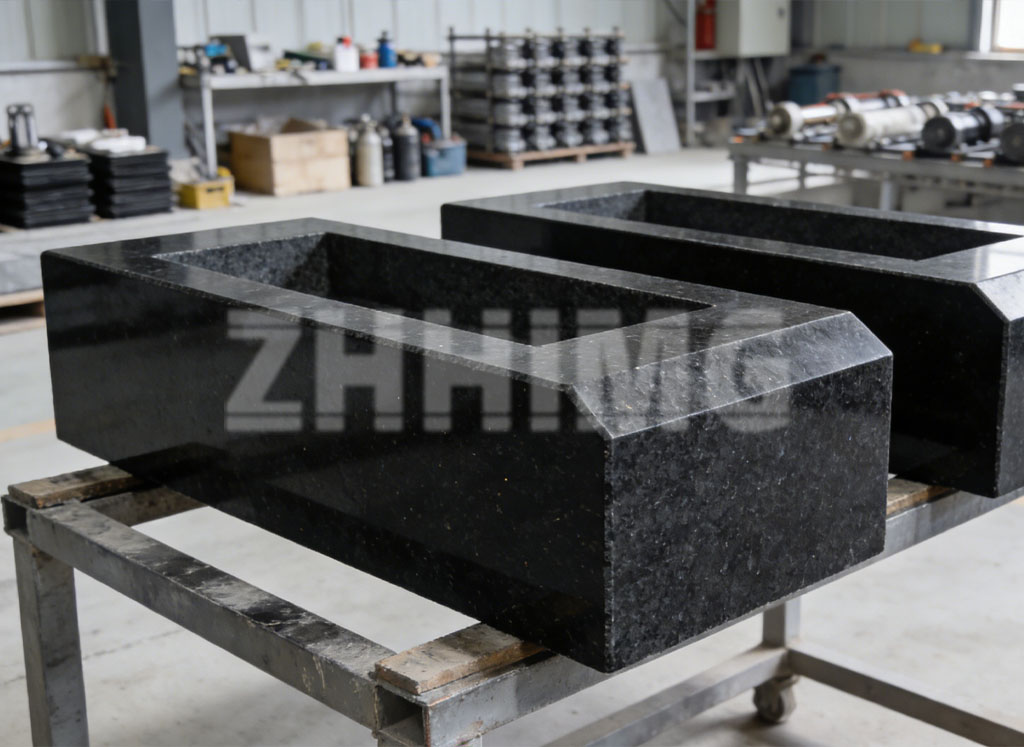
- Custom Fixtures: To ensure the part is held in a repeatable position, custom ceramic or granite fixtures are essential. They provide the stability needed for the CMM to accurately map the 5° bend angles and surface profiles.
3. Cleanliness and Contamination Control
Medical implants must be manufactured and measured in controlled environments (often ISO Class 7 or 8 cleanrooms). Standard cast iron surface plates can rust, shedding microscopic particles that contaminate the implant. Similarly, porous materials can harbor bacteria.
- The Solution: Cleanroom-compatible Granite and Ceramic.
- Granite Surface Plates: High-quality granite is naturally non-corrosive and stable. When sealed with a specialized finish, it provides an inert, easy-to-clean work surface that meets FDA hygiene standards.
- Ceramic Tools: Ceramic measuring tools are chemically inert and resistant to the alcohol and sterilization agents used in cleanrooms. They do not rust or oxidize, ensuring that the measurement process itself does not introduce contaminants to the precision medical components.
Case Study: Measuring a Titanium Hip Stem
To illustrate these principles, consider the quality control process for a titanium hip stem.
- The Part: A femoral stem with a 5° posterior bend angle and a surface profile tolerance of ±0.05mm.
- The Setup: The part is placed on a Grade 00 granite surface plate to ensure a vibration-free, flat datum.
- The Process:
- Calibration: The CMM is calibrated using ceramic gauge blocks to ensure thermal and magnetic neutrality.
- Alignment: A ceramic square ruler is used to manually verify the gross alignment of the part before the automated scan.
- Scanning: The CMM uses a laser scanner to map the organic curvature, verifying that the bend angle matches the CAD model within the ±0.05mm tolerance.
Regulatory Compliance: FDA and ISO Standards
In the medical industry, documentation is as important as the measurement itself.
- FDA 21 CFR Part 820: Requires that all inspection, measuring, and test equipment be suitable for its intended purpose and capable of producing valid results. Using stable materials like ceramic and granite helps ensure long-term calibration stability.
- ISO 13485: The quality management system for medical devices requires strict control over the work environment. Non-corrosive, cleanable ceramic and granite tools are essential for maintaining this compliance.
Recommended Equipment for Implant Metrology
| Equipment | Material | Purpose |
|---|---|---|
| Surface Plate | Black Granite | Vibration damping & flat datum |
| Gauge Blocks | Zirconia Ceramic | Non-magnetic calibration standard |
| Straight Edge | Ceramic | Checking flatness of fixturing |
| CMM Fixtures | Ceramic/Granite | Holding complex organic shapes |
Partner with ZHHIMG for Medical Precision
Navigating the complexities of medical device metrology requires a partner who understands both materials science and regulatory requirements. At ZHHIMG, we provide the high-stability granite and advanced ceramic measuring tools that form the foundation of accurate medical manufacturing.
Ensure your implants meet the highest standards.
Post time: Apr-07-2026